
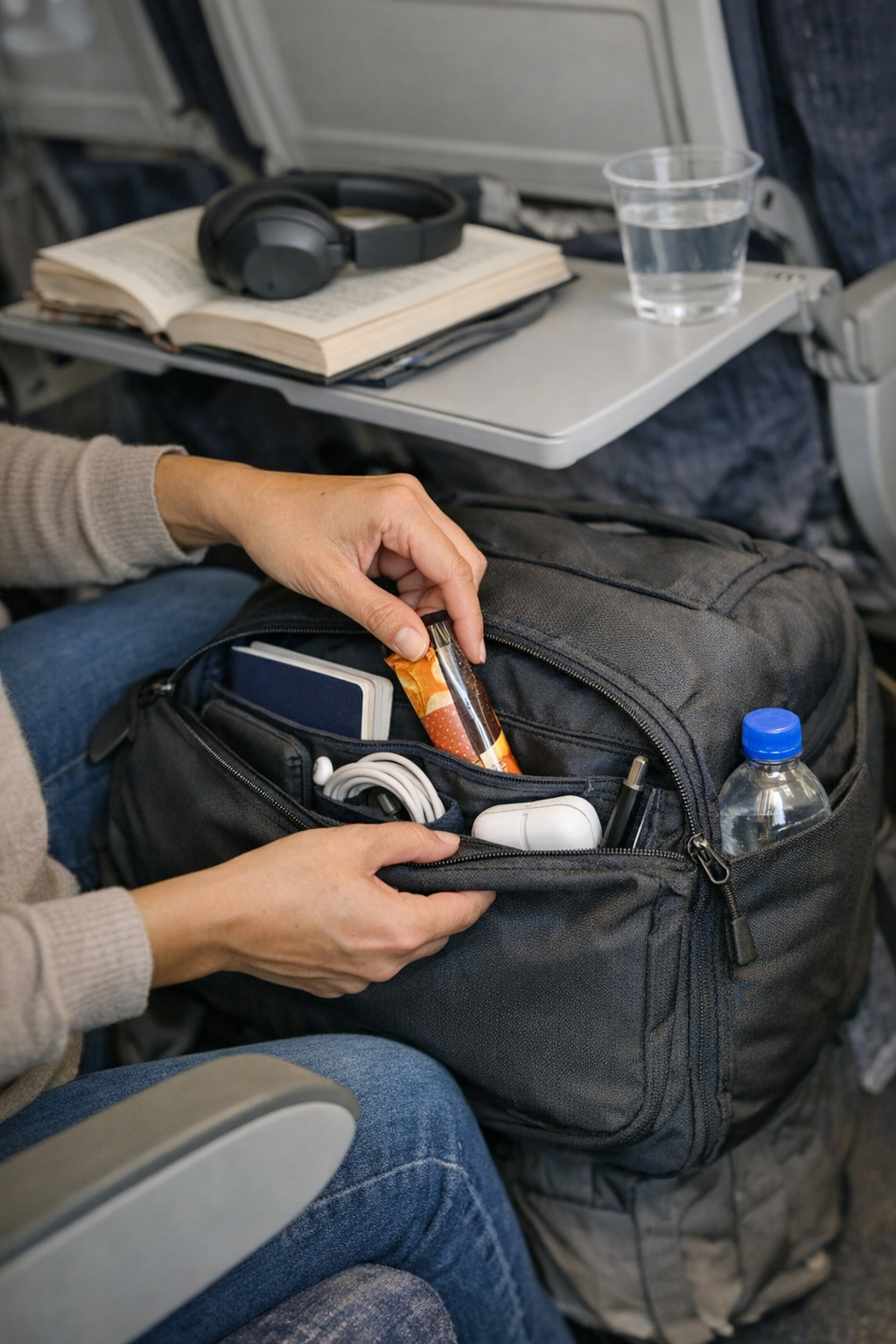
Your carry-on looks sharp when you zip it shut at home—but on the plane, that “order” faces a real test. The real trouble waits until you’re halfway through a flight: knuckles jammed under the seat hunting for your charging cable, a snack wedged in the wrong pouch, or your passport nowhere near reach when you actually need it. The bag that felt streamline in the boarding line quickly reveals its weak points—awkward reaches, layered cubes, and lost seconds every time you dig for the wrong item. A setup that was “perfectly packed” in your hallway becomes a clumsy obstacle course during routine retrievals or when you need to slide into your seat mid-boarding.
When “Organized” Still Isn’t Easy: The Cabin Reality
Surface order fools you—until you’re boxed in and pressed for space. In the security line or gate area, it all looks under control. Cubes and pouches stacked tight, zippers closed, everything in its square. But as soon as you’re crammed in the cabin, knees colliding with the next row, your setup’s real nature surfaces.
Simple requests—reaching for a pen, headphones, or snack—turn into half-unpacking jobs. You’re pulling at one cube to reach another, stacking pouches on your lap, and shuffling loose charging wires or spilled lip balm, all while trying not to elbow your neighbor. Each retrieval adds a little more disorder. Instead of quick grabs, you’re working around your own organization—forced to reverse your packing logic every single time you need one small thing.
Why Functional Access Matters More Than First Impressions
Packing discipline hides structural mistakes. Plenty of travelers obsess over how their bags look in the queue—no clutter, all sections flush. But the moment you have to reach for anything after takeoff, the flaw is obvious: visual order is meaningless if every access interrupts your row, shakes your tray, or requires a noisy full-bag unzip.
After four or five reaches, finger fatigue and cramped knees make minor inefficiencies feel major. If your charger lives beneath three “neat” layers, even the cleanest pack layout becomes a liability. The true test is rapid, silent, one-hand retrieval—without dismantling your seat ecosystem or holding up the aisle. Not just “packed well,” but functionally set up for repeated use when headspace and elbow room vanish.
Spotting the Carry-On Pain Points In Real Time
That One Item Always Buried
Every routine exposes the flaw you designed in. On every flight, one essential always ends up trapped: the ID lost beneath pouches, the snack morphed into a scavenger hunt, or a cord wedged into the tightest cube. Not a big deal once, but across a trip or two, the small irritation compounds, making your bag feel more like a blockade than a toolkit. That’s when setups with no true quick-access section start breaking down.
The Accordion Effect: Repeated Repacking in Tight Spaces
Aisle bottlenecks and limited seat width leave no space for re-sorting. Grab a book and your toiletries come along too; try replacing a pouch quietly, and you end up restacking your “order” from scratch. By the arrival gate, the carry-on that was packed to perfection now carries the subtle chaos of a rushed repack—items lurk in the wrong spot, and you’re already dreading the next retrieval.
Anatomy of an Interrupted Rest
On overnight flights, even small retrieval jobs feel disruptive. The sleep mask you packed “neatly” now means sliding a hand beneath trays or footwells, risking spills or waking your neighbor. Often, it’s not worth the hassle—so you do without, trading comfort for the false promise of initial order. The cost: missed rest and a setup that resists your real needs.
Fast-Access: The Quick Win That Changes Everything
Simple structure beats clever stacking every time: move essentials—passport, charger, snack, pen—into a top-zip or slim exterior pocket. The real shift is clear when the aisle crowds or the seat in front reclines. Suddenly you reach what you need with one discreet motion, staying settled and not unraveling your core pack job. The more you travel, the more you notice: every effective carry-on has a visible, reachable “high frequency” section that’s never blocked by cubes, pouches, or compression straps.
Compartment Choices: Stacks Aren’t Always Smarter
Everyone tries to maximize inside dimensions with vertical stacks, but deep-layered cubes mean a full mini-unpack each time you want something from the bottom. With exterior-access layouts, you cut the friction—repeat retrieval is a quick grab, not a production. That’s worth more than a few square inches saved inside. The lesson: if you need it more than once in flight, it doesn’t belong under cubes or inside your “arrival only” zones.
Lessons From Repeat Travel: What Actually Reduces In-Transit Friction?
On repeat trips, you spot patterns. Packing for looks means fatigue down the line: every extra unzip, every cube toppled, every missed zip path adds up. The real wins go to setups that let you move only once per needed item—not setups that look perfect on the baggage scanner. A single, intentionally designed quick-access pocket is more valuable than double the packing cubes for mid-trip convenience.
If you keep fishing out the same item mid-air, give it front-row access. If you avoid opening your main compartment because it feels like opening a mini suitcase each time, you’re ready for an outer-pocket reset. When one quick retrieval turns into three movements and two repacks, it’s not organization—it’s just delay in disguise.
How to Reorganize for Real Comfort: Simple Adjustments That Last
Shift your most-used items—snacks, travel docs, earbuds—into exterior pouches or flat-access pockets meant for flight, not just for packing show. Keep “in-seat” essentials spread flat, so nothing gets buried beneath a layered stack. Treat outer pockets as mission-critical space; the fewer steps between you and your everyday items, the less friction you’ll feel as time and tiredness stack up.
Your main compartment still holds its place: stash your “arrival only” gear deep and out of mind. But for everything else you need again and again, trade that perfect, dense stack for honest, instant access. You’ll feel the improvement before the flight even lands—and every time you sidestep the urge to reorder your entire bag just to find what you need in transit.
Shop CarryOnSupply for travel organizers, quick-access pouches, and other carry-on essentials