
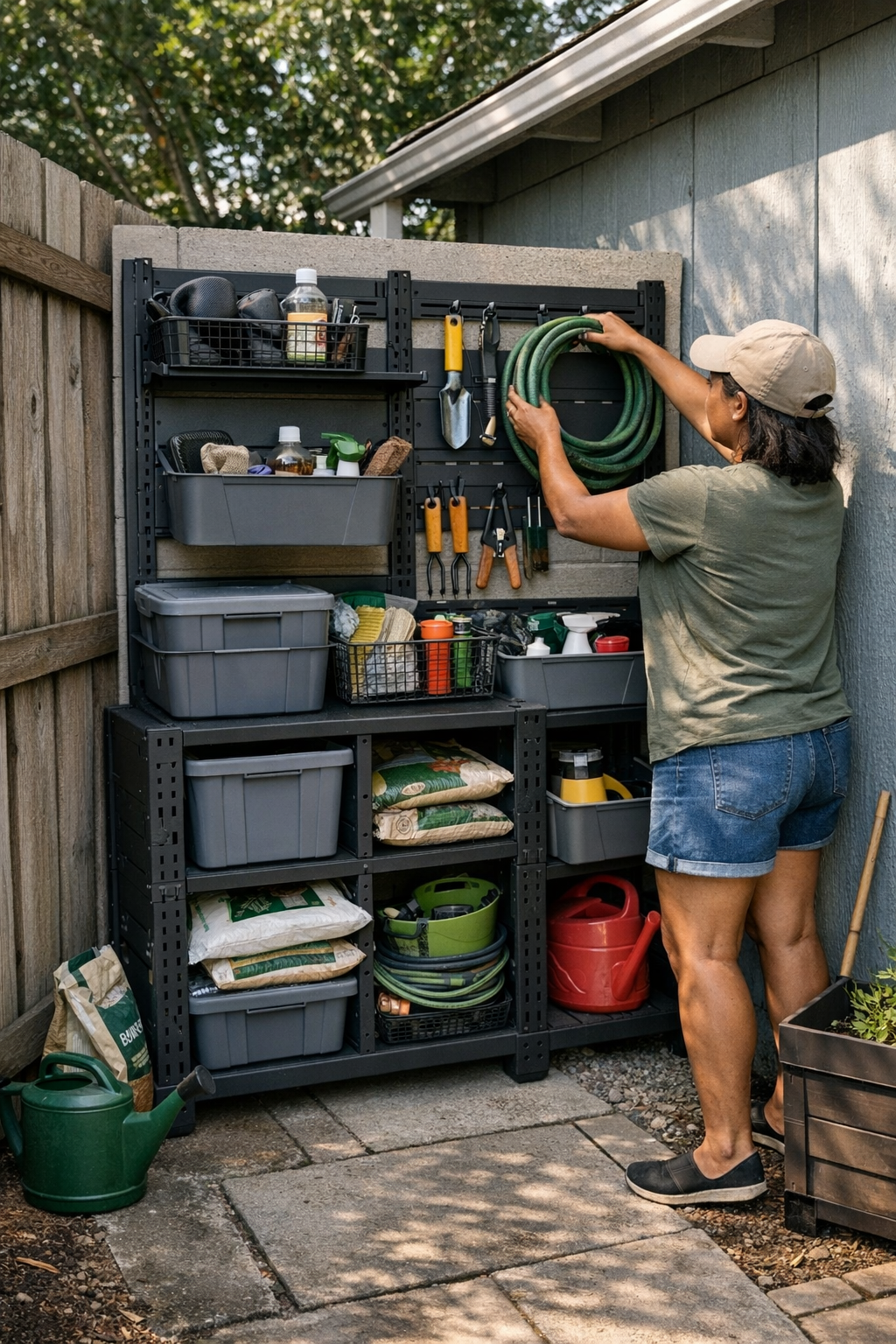
Outdoor storage in a tight space can turn a quick trip outside into a series of slow-motion sidesteps. The side path meant as a shortcut becomes a gauntlet of bins, boxes, and gear that never quite has a real home. If you’ve ever balanced grocery bags while nudging aside folding chairs just to reach the gate, you know the real cost isn’t surface clutter—it’s lost flow, daily workarounds, and a setup that never stops requiring a reset.
When “Stack and Stash” Turns Into Stuck and Shuffle
Most small yards, side strips, or patio-edge utility areas start optimistically: bins lined against a fence, a floor unit standing sentry beside the shed, stray gear corralled “for now.” But as weeks fill with lawn games, garden projects, or kids’ bikes, the scheme collapses. Anything that lands on the ground or stacks just inside the walking lane isn’t stored—it’s stranded. The narrow passage from garage to garden gets pinched by each thing left on the floor, until rerouting your day becomes automatic.
Frustration builds in tiny increments: a rake propped at the wrong angle, planters blocking the utility meter, a bag of potting soil you mean to put away but never do. One errand means dodging handles, sidestepping overflow, or awkwardly shifting bins to unlock the gate. Even returning a single item—if it means moving two—starts to feel pointless, so things pile up “until later.” Eventually, the path becomes the problem.
How Floor Storage Quietly Hijacks a Space
It’s rarely the number of bins that breaks the system—it’s the way storage creeps from the margins into your main route. The moment gear moves from the edge into your walking path, space shrinks and routines stall. Picture trying to grab a trowel for quick weeding: instead of a three-second task, it’s now a shuffle—slide the bucket, tip the chair, unstack the lid, squint for gloves. That friction breeds shortcuts and clutter: gear that never goes back, bins whose surfaces turn into new drop zones, and a constant sense you’re cleaning around the mess, not through it.
When a yard juggles mixed routines—morning bike runs, evening garden watering, weekend sports equipment—this crowding accelerates. What felt “organized” on Sunday afternoon looks like a heap by Wednesday. Floor bins become invisible obstacles. Wall space goes unused. Corners silently collect overflow until the effort to restore order demands a whole Saturday.
Wall Systems: The Difference Between Clear and Crowded
The breakthrough isn’t squeezing in more bins. It’s reclaiming the pathway—keeping movement automatic, not something you have to engineer every time you step outside. Wall-mounted racks, modular panels, or even simple hooks transform how a space feels and how much work it demands.
When tools, balls, or air pumps hang at shoulder height, there’s less dodging and less stack-and-topple. Returning a trowel doesn’t mean moving three things, and grabbing hedge shears becomes a one-step move, not a dance around clutter. Cleanup doesn’t compete with your main route; it slots right in. The more gear stays off the ground, the less likely you’ll find yourself working around your own setup.
Real Fix: Put the High-Traffic Gear Where You Walk
Let the wall carry the weight of your daily routine. Reserve the prime zone—between eye and waist—for anything you use every week. Floor bins still have a place, but move them out of the main lane and make them home base for things you store, not things you grab. Watch how much easier it is to return secateurs or stash the leash when it’s a straight reach, not a mini excavation.
What Happens When a Routine Gets Boxed In
Imagine a compact yard with stepping stones barely a foot wide. Early spring: it’s tidy, bins lined up against the fence. By July, two side chairs are wedged in after a birthday BBQ, one bag of charcoal blocks the spigot, and cones from last weekend’s soccer practice cluster by the door. You can still get through, but every return means a pause: move the lid, adjust the planter, push a bin so you can reach the hose.
Over time, intent gives way to avoidance. One person delays putting tools back. Another leaves gloves on the table. The “quick reset” never gets done, because what should take 20 seconds now gets deferred until someone feels like spending 20 minutes reshuffling everything.
What’s Different When The Wall Does the Lifting?
Even a four-foot panel of wall hooks—placed right along your path—shifts the pattern. Balls, clippers, and folding chairs hang ready. Returning them is fast because the rack is in the flow of traffic, not behind a pile. You notice how much less time is spent moving one thing to reach another, how less often gear sits temporarily on the ground “just for a day.” Resetting becomes instinctive—a motion you make as you pass through, rather than waiting for a scheduled cleanup that rarely happens.
The smallest details compound: an open basket to drop gloves at the right height, a shallow shelf for go-to cushions, a simple hook for the hose. These fixes are the difference between a compact utility lane and a yard that eats up your afternoon with chores.
The Day-One Trap: What “Organized” Misses After Real Use
It’s easy to celebrate an organized scene: new bins, tidy rows, fresh labels. But watch the space after the first real week—it tells the story. Does returning a shovel mean moving a storage box blocking the wall rack? Is a tall floor unit eating up the only open sight line or wedging blocking movement? Does the overflow corner reappear, even after you swore to tackle it last month?
- Is putting something away forcing you to move something else first?
- Does one big “storage win” actually interrupt your daily walk-through?
- Is there a spot that keeps becoming a dumping ground—no matter how you organize?
If the answer is yes, the setup is built for the photo, not the real routine. Effective organization respects daily friction: high-traffic gear gets top wall space, bins living in tucked-away spots never cross the main route, and the system flexes with your changing cycle of use—not just at the initial setup.
Adjusting on the Fly: Storage that Moves with You
Rigid systems break under real use. Modular panels, repositionable hooks, and easy-swap baskets let you shift the setup as your needs change—soccer season to garden season, winter to spring. Permanent drilling isn’t always necessary; some of the most practical setups let you swap accessories, adjust spacing, and change layouts without committing to a single pattern. Flexibility is what turns a one-time tidy-up into ongoing relief.
The Test: Can You Move, Reset, and Return—Without Thinking About Storage?
This isn’t about a showroom yard or Instagram “after.” It’s whether you can step outside, bring in groceries, or chase down a runaway ball without rerouting around your own gear. When storage absorbs clutter at the edge—not in the main circulation lane—the space finally stops fighting you. Each routine runs smoother, and the process of keeping up with it slips into daily life instead of piling up for a dreaded Saturday reset.
It doesn’t take a renovation: one hook for the only tool you actually use, a bin set aside for once-a-year gear, a shelf that changes as your needs change. The difference isn’t cosmetic—it’s whether your yard serves your day, or just looks organized until the next routine derails it. That’s what you notice, every time you step outside.
Explore more practical storage options for real outdoor spaces at TidyYard.