
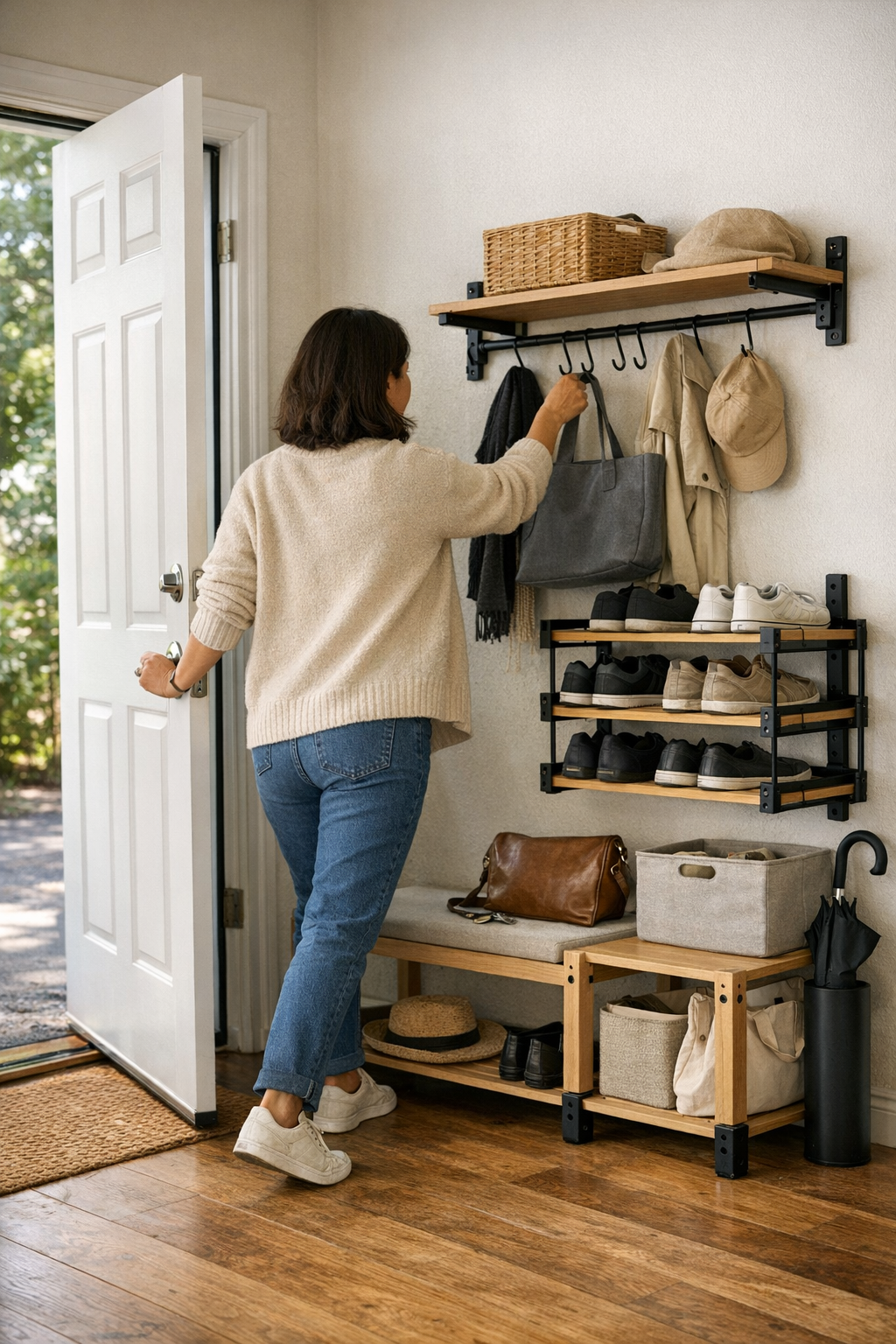
Add any storage—bench, bin, basket—near a door that swings open, and you sign up for a daily test of what fits where. An inward-swinging entry door doesn’t just limit how much you can store; it reshapes the entire path in and out, forcing split-second decisions every time you cross the threshold. The “storage solution” that looked efficient the day you brought it home can slowly become a lineup of toe-stubs, sidesteps, and small detours, especially when you have to nudge shoes out of the way or slide a basket just to get the door all the way open. Real use reveals a pattern: every inch claimed by storage is another pinch point where routines pile up, overflow drifts, and resets slow down.
The Invisible Battle Between Door Swing and Storage
Every swing door slices through your entryway on an invisible path—an arc that no basket, rack, or bench can cross without setting up a future collision. At first, the zone seems clear enough: the door opens, your bench tucks along the edge, maybe no one complains. But as days stack up and routines layer on, the mess builds without anyone deciding it: shoes decide their own new boundary, bags get dumped at the nearest edge, and an umbrella—soaking wet—wobbles where the door barely misses it. These aren’t mistakes; they’re natural results when the “don’t-block” line is a living, moving thing.
Storage units, even the most compact, tend to creep into this arc. And as each bit of storage encroaches, you give up just a little more of your only open lane. Eventually, every movement gets narrower, more awkward—and the bench you thought would solve mess starts to collect extra shoes, pushing everyday flow into a real bottleneck. Scuffed paint and banged toes are just symptoms of what’s actually happening: your entry’s working space has shrunk into an obstacle course, one that refills on its own.
How Small Setup Choices Affect Everyday Flow
A layout that looks neat at 7 a.m. rarely survives to dinner without cracks showing. It isn’t about too much stuff; it’s about the difference between storage that looks planned and storage that gives way under stacking routines. Say you plant a deep bench beside the door or a row of bins within arm’s reach—they fit on paper, but as soon as two bags and three pairs of shoes drop down by sunset, the open path you counted on disappears. You might think you just need more discipline, but every arrival tests one core thing: can you ever get the threshold actually clear, or does each reset end up temporary?
Repeated Use Reveals the Flaws
Picture the weekday reset that unravels by noon: shoes that begin in rows but balloon sideways by midweek; a work bag landing on the bench’s easy-access corner—right inside the door’s swing zone; jackets tossed to the nearest hook, which crowds the fallback zone you didn’t even plan for. Suddenly someone’s backed up in the entry, shifting bags, wedging their shoulder around the door to get in or out. The meltdown isn’t caused by too much storage—it’s the slow collision between moving bodies and the arc that storage always seems to cross. If you’re moving things aside every day just to open or shut the door, it’s the layout, not just the users.
Common Patterns: When Storage Turns Into New Friction
The “just for now” effect: The entryway bench is a magnet for anything “just dropped for a minute”—but the minute never ends. Shoes, bags, groceries, or gear accumulate in the gap between intention and real movement, crowding the only clear zone you need on repeat.
The overflow edge: Every system finds its weak spot—usually the bench’s far end or in front of a utility cabinet. These areas catch whatever lacks a set home, quickly turning the area you value most into the one you have to dodge or step around, even if you “reset” it nightly.
Daily door block: If the door bumps, pushes, or doesn’t open fully even once a week, the setup isn’t working under pressure. A shoe rack that gets nudged, a basket that takes the impact—that’s not just minor annoyance, it’s evidence your entry setup is fighting your natural routines instead of supporting them.
Practical Fixes: Reset the Zone by Respecting the Door’s Arc
The turning point comes when you move high-traffic storage—shoes, main bags, overflow bins—completely outside the door’s swing, even if it requires ditching bigger floor pieces for slimmer wall racks or upright cabinets. For example, shifting shoes from a bulky floor bench (always drifting into the danger zone) onto two narrow wall racks cleared up the mess almost overnight. The bench didn’t leave—it just moved further down, and only items that don’t migrate land there now. The result: at least 18 inches of clear path right at the entrance, even during peak chaos.
The amount of storage didn’t change—the main collision point did. For once, you could walk through with arms full, not dodge surprise bags or a wall of scattered sneakers. The urge to create a “dump zone” lessened, resets sped up, and nobody had to stop to move five things behind the door just to leave. It’s not just about owning less; it’s about clearing the zone where everything otherwise bottlenecks.
What to Watch for When Reviewing Your Layout
- Door arc buffer: Measure your door’s full sweep and add a buffer—4–6 inches beyond the arc. Any item inside is a future collision, and the closer it is, the more likely it’ll collect clutter you never intended.
- Wall-mounted options: Racks and hooks installed above the swing zone protect your path. These excel for keys, small bags, or daily-use gear, but heavier or kid-friendly items may demand alternative zones within reach but out of harm’s way.
- Benches/cabinets: Place these outside the critical swing—far enough along the wall that nothing crosses into the threshold. Accept the tradeoff of taking a few extra steps; quick resets and free movement matter more than squeezing in one more bin beneath the door handle.
Real-World Tips for Living With a Swing Door Entryway
- Test your routine: Simulate a real return—hands full, jacket half-off, bag slipping, or muddy shoes in one hand. Where do you naturally want to drop things? If your answer is “where the door must swing,” adjust that zone until easy placement doesn’t block movement.
- Don’t apologize for open floor: Emptiness right inside the threshold is leverage: it keeps routines smooth, resets fast, and movement constant. That unused patch is the difference between an entry that feels jammed and one that gives you breathing room day after day.
The Daily Impact: Why This Detail Matters
Living with a swing door isn’t about making the entry look perfect, but about catching how even the “best” organized system buckles under daily, repeated use. Most setups hold their shape for an hour after a deep clean; very few survive three days of real family life without the entry path clogging, the return flow stalling, or the same four bags and pairs of shoes drifting right back into the critical lane. The trouble isn’t visible on day one—it’s in the small scuffles at the threshold: the door that never opens all the way, the bag you keep nudging, the pile that returns even after last night’s cleanup. That’s the consequence of ignoring the door’s arc: every pass-through feels tighter, and the whole entry fills with small, avoidable friction.
The difference is immediate when you respect the space a swinging door claims. Suddenly, routines that once slowed down now glide—walking in is faster, exits are calmer, and there’s less need for constant reshuffling. The best entry isn’t packed—it lets everything return to zero with less effort, keeping the threshold ready for anything your day throws at it.
Find transition-space storage that fits your real routine at Betweenry.