
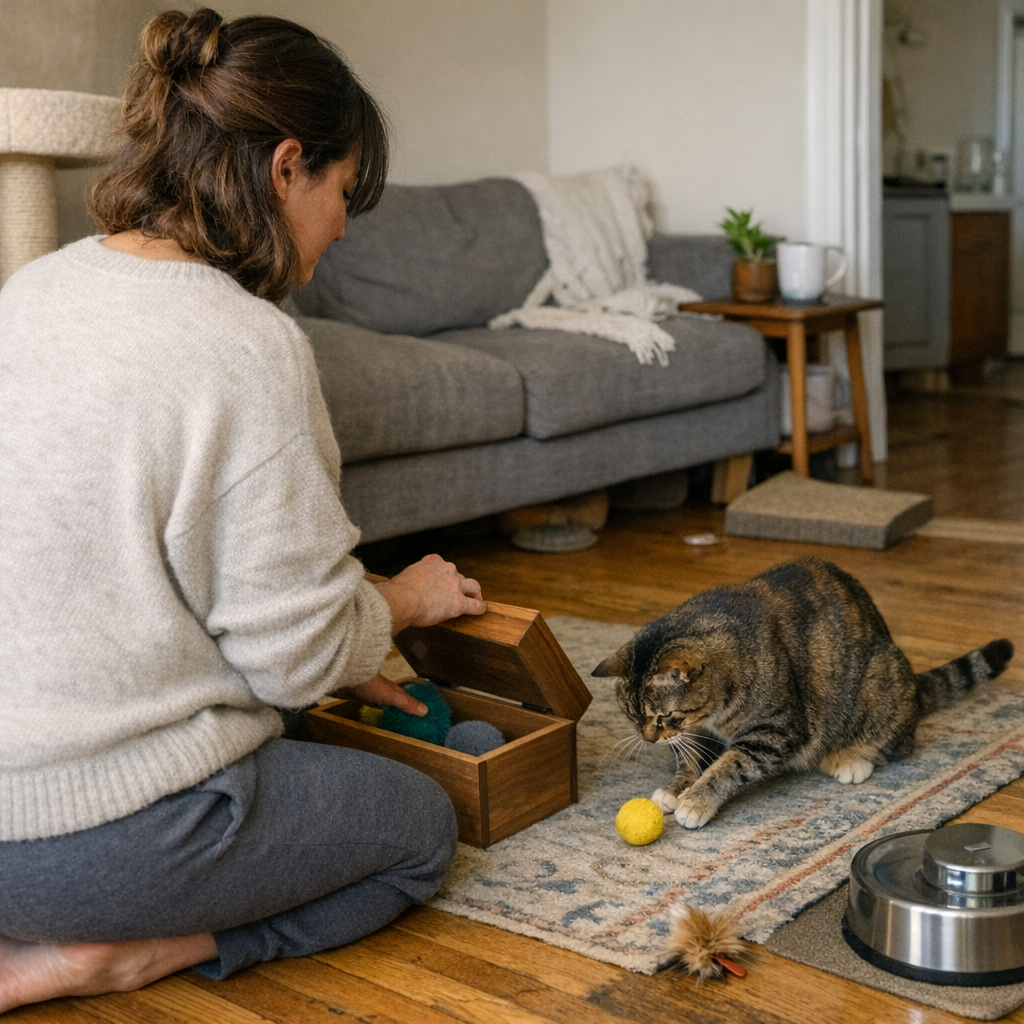
If you keep tripping over cat toys in the hallway or fishing a wand from behind the fridge just before bed, you’re not alone. Managing toys for indoor cats quietly shapes your day in ways you notice most during the worst moments: a crinkle ball wedged right in front of the food bowl when you’re just trying to refill water, or a pile of plush mice left in the walkway after a late-night cleaning sprint. These aren’t dramatic crises, but tiny friction points—a morning derailed by cleanup, a hidden toy blocking your fast sweep, a play zone that leaks into every other corner you need uncluttered. Over weeks, routine upsets like these add up, and what started as a small mess becomes a repeated hassle. Every cat owner reaches a point where keeping enough toys out for play turns into keeping themselves caught in a cycle of endless retrieval, stray clutter, and routines that never quite stay set.
The Slow Creep: How Toy Setups Turn Into Traps
Letting toys roam free feels simple—at first. One open basket, a few favorites scattered around, and for a few days, it almost works. Then the patterns settle in:
- The same stuffed fish slides behind the couch after every play session—and pulling it out means moving the sofa again.
- Plastic balls collect under the radiator, out of reach unless you’re willing to crawl or tip furniture.
- A wand toy is always just far enough under a chair leg to demand an awkward crouch—not a disaster, just a slow drain.
Individually, none of these is much. But stack them on top of 6 a.m. routines, unplanned guest visits, or a mad dash to tidy before dinner, and each misplaced toy becomes a fresh interruption. Tidy in theory is not tidy in practice—especially after a week of cat-life cycles.
Why Less Isn’t Always Less—And More Isn’t Always More
Your cat finds favorites: a certain wand, a small plush, the feather that somehow becomes territory. But the more toys stay out, the faster they migrate to exactly the wrong places. The problem isn’t just what you see; it’s what you keep having to move:
- Cat toys in feeding, water, or litter areas turn a fast reset into a multi-step process—now you move a ball before you can refill a bowl or sweep up the litter scatter.
- Toys end up crowding rest spots, transforming what should be a quiet nap space into a messy catchall—so a cat’s comfort zone becomes part play-pen, part obstacle course.
- Worst of all, you stop noticing until you step on one at night, or grab a broom only to find the floor blocked—again.
The invisible pattern: left unchecked, open-access toys quietly undermine your routine, bleeding play clutter into every shared home zone. And unlike litter tracked onto a mat or a water spill under the bowl (handled once and gone), stray toys return day after day.
Rotation vs. Open Access: Does a Predictable System Help?
All-in vs. steady rotation isn’t about preference—it’s about what eventually breaks down and what keeps you going. If every toy is out all the time, resets get slower, and cleaning sidetracks multiply. By deliberately limiting toys in circulation and swapping them on a schedule, the chaos doesn’t just look smaller—it actually feels lighter. Here’s where it shows:
- Open Access: At first, tidying up means tossing everything in the basket. But every week, strays reappear, and each cleaning takes longer than last time.
- Rotation: Two or three toys out, swapped every few days means less to trip over, less to retrieve from under furniture, and cleanup that becomes predictable rather than urgent.
Your floorplan dictates some of this. In a small apartment, the difference between a scatter zone and a set zone is immediate; even larger homes develop blind spots where toys pile up until the next full sweep. Either way, the weak point is revealed when you’re forced to clean in a hurry—or when an unexpected guest makes the disorder impossible to ignore.
Recognizing Trouble: Signals You’re Due for a Change
Repeated friction sends warnings, even if routine makes them easy to miss. These are the common signals that your toy handling isn’t working:
- You can’t swap water bowls or pick up litter without moving stray toys out of the way.
- Ball toys sneak against window ledges, interfering with the one jump path your cat uses every morning.
- Cleanup takes twice as long—not from actual dirt, but because toys have to be relocated before wiping or vacuuming can start.
- Toys migrate into storage areas meant for grooming gear, or under laundry baskets—sparking those inconvenient scavenger hunts during already busy routines.
If you keep pausing to move a toy out of reach or rearrange play items in the middle of ordinary chores, the system isn’t helping—it’s quietly sabotaging your routine.
Containment Doesn’t Mean Banishment: Resetting Without Losing Play
What’s worked for other frustrated cat owners? Move from an open basket to a closed bin or box, limiting access to two or three toys at a time and rotating the rest in every three to seven days. This structure:
- Keeps play interesting by letting toys regain novelty on reentry.
- Makes resets predictable—what’s out, what’s away, where stray toys belong at the end of the day.
- Means “lost” toys (under tables, behind chairs) crop up less and, if they do, require far less effort to keep in check.
The visible order is only half the effect. The deeper improvement is the shift in your daily minutes—retrievals drop, interruptions shrink, and you can actually finish your routine without surprise kneeling or sudden detours. Toy management isn’t about making things look perfect; it’s about not letting play create new friction in every routine reset.
A Measurable Difference: One Real-World Detail
Take the felt ball that always settles beneath the dining set. Previously, you’d be on your knees prying it out almost every day—a pause, a reach, an awkward head bump. Once you limit toys in circulation and start rotations, that same ball needs rescuing maybe every few days, sometimes only once per week. The surface looks a little better, but your day feels much lighter—because you’ve taken out a repeat burden without losing play value.
Pacing the Rotation: How Often To Swap Toys
Rotating toys every three to seven days gives most indoor cats a balance between novelty and comfort. It’s enough time for a toy to feel familiar and for your cat to miss it by the time it reemerges.
- If your cat ignores a toy, tuck it away for a week or two before bringing it back—cycling prevents toys from becoming invisible clutter.
- Skip the urge to buy new toys every time interest dips—familiar favorites resurface as novel during the next routine swap.
This cuts urgent cleanup moments and reduces the pressure to constantly expand the toy collection. Most cats build favorites through repeated exposure, not constant novelty.
Finding the Balance in Shared Spaces
In rooms that get double use—where your cat’s “zone” shares space with your eating, working, or passing through—the cost of toy overflow goes up fast. Too many toys in a small space clog paths, overlap with feeding and litter routines, and increase unexpected, recurring cleanup. The fix isn’t less play; it’s more structured containment: closed boxes, fewer toys visible, reliable rotations, and clear zone boundaries.
Watch for silent creep: a favored resting mat drifting into food prep area, a pile of toys blocking the hallway, or a cat ball always under your desk chair. Each signals cleanup pressure and demand a system fix, not just another quick tidy.
When Setups Seem Fixed But Trouble Returns
The tidy basket solution is seductive, but often short-lived. You clean, sort, and for a day or two—maybe even a week—everything appears in place. Then routines crack: old retrievals return, stray toys slip back into weak spots, and you’re kneeling on the hard floor for the third time before breakfast. This gap between “organized” and “repeat-proof” reveals why most setups falter under steady home use, even when they look fine at a glance.
Every routine exposes the real structure—especially with indoor cats who test every edge and return clutter to the same high-friction spots. The right containment can’t banish play, but it can shave hidden minutes off the places where your patience and your floor plan keep colliding.
If your routines keep circling back to the same toy traps, it’s time to upgrade your system—for less retrieval, less cleanup drag, and smoother resets. See real-world