
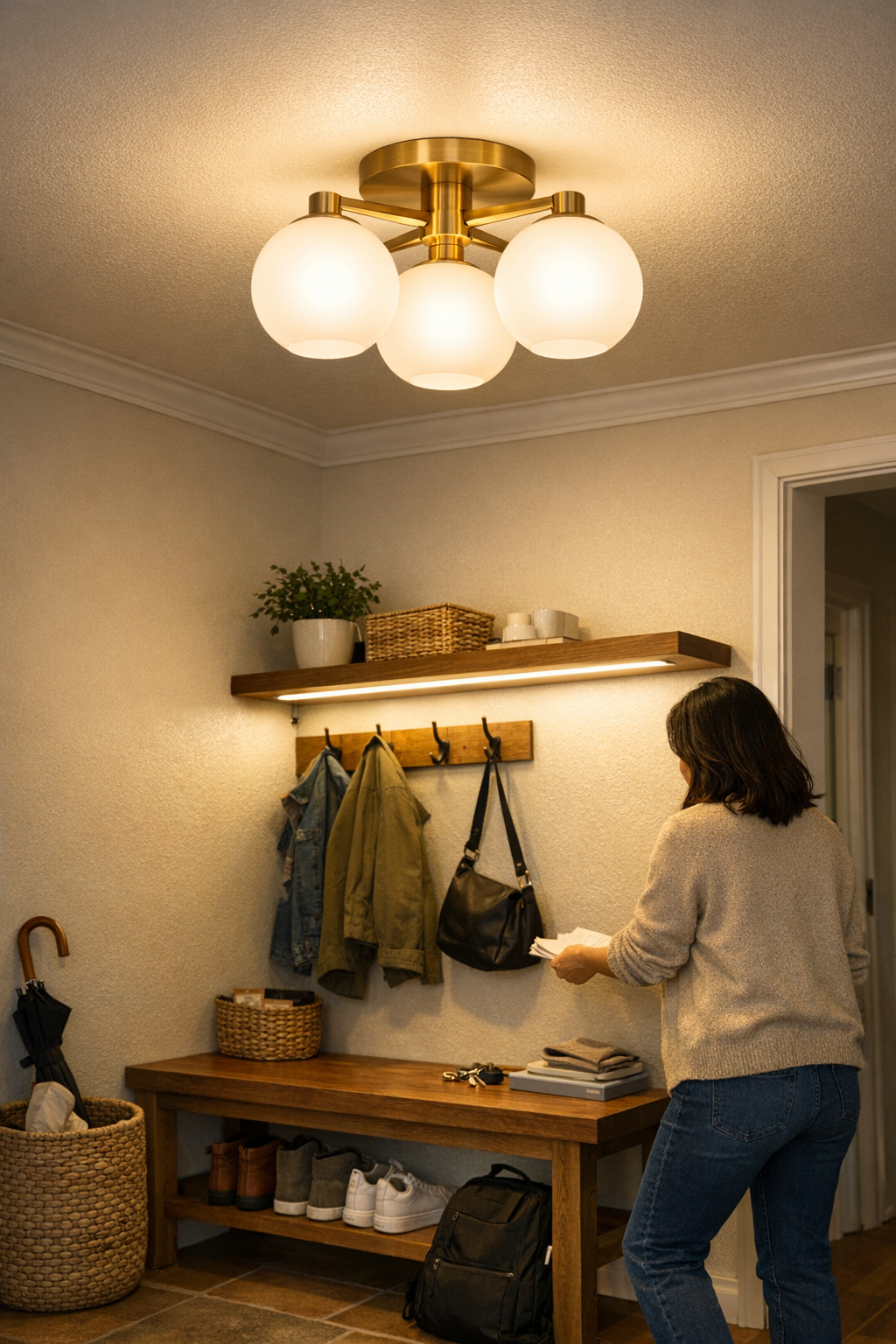
There’s a catch to a tidy entryway under a new ceiling light: the room looks finished, but every morning, shoes vanish under a shadowed shelf, keys get hunted by feel, and the one cable you tried to route cleanly is still the first thing you notice. The main fixture handles “at a glance” neatness, yet the routines—dropping bags, reaching for bins, glancing for essentials—start to grind. If the space feels ready but keeps slowing you down, you’re not missing brightness. You’re missing the kind of lighting and support that actually gets used.
When Overhead Lighting Leaves You in the Dark
Flush-mounts and pendants promise a streamlined look, but by the second week, you’re side-stepping glare, tripping over bag straps left in blind spots, and realizing the corners where you drop things feel invisible after dusk. Overhead lighting almost never lands where hands, feet, and shelves actually operate. A clean glow across the general zone does nothing for the bench’s dim edge, the shelf’s run of shadow, or the mail slot that’s bright at noon but useless at night.
Everyday friction builds in the same places: missed sneakers in a shadow pocket, keys somewhere on the shelf but out of sight, bags tangled at the bench’s dark end. In busy entryways—high traffic, quick departures—the wrong light isn’t just “less perfect.” It makes routines clumsy. The more you ask of a cramped zone, the faster a single overhead source fails.
Shadowed Surfaces: Where Friction Builds
A room can measure bright—but if drop spots are dim, the illusion is short-lived. Picture a narrow hall, shallow shelf, and hooks meant for fast exits. Central light smooths out photos, but by night two, you’re dropping mail into partial darkness, losing keys at the shelf lip, and nudging bags toward the only bright sliver. The minimalist setup stays “undisturbed” until repeated use makes the inconvenience hard to ignore.
Why Key Surfaces Stay Difficult
Benches end up striped in shadow. Wall hooks—perfect on paper—fall into the dark. Move through this space and the patterns surface fast: someone fishes for shoes under the bench with a phone flashlight, someone else pauses because the bag hook is just past the glow. The one spot near full brightness becomes the traffic jam. The rest turns from “organizing solution” to friction factory.
The Real Difference: Direct, Low-Profile Lighting
What’s usually missing isn’t total lumen count, but usable, reachable light right where it’s needed. Surface-focused lighting—slim LED bars under shelves, compact wall fixtures on support brackets, adhesive-mounted mini strips—creates a direct improvement you notice mid-motion. Instead of adding another dose of harsh ceiling glare, these setups target the edge of the shelf, under the bench, over the key tray. Suddenly, finding what you need means looking—not guessing.
Real change kicked in with one slim under-shelf bar: the key pile stayed visible, drop-offs got snappier, and nobody even noticed the cable because it was clipped snugly along the wall, out of the step path. No more groping for sunglasses, no more overlooked bins. The main shift wasn’t extra “brightness”—it was the end of minor, annoying detours in the morning rush.
Glare, Cables, and the Setup That Stays Stable
Adding surface lighting should solve, not swap, problems. Cables left exposed, sloppy support brackets, or loose routing just replace one nagging distraction with another—even launching new hazards if cords drift near feet. Lasting setups use thin brackets pinned out of sight, adhesive channels to guide cords behind shelves, and wall lines to keep wiring invisible but accessible. If any support or cable reroute makes the zone feel messier, setup stability wasn’t solved—it just moved.
Recognizing When the Setup Actually Works
A usable upgrade shows as less pausing, less fiddling, fewer “Where did I put that?” moments at the threshold. Shelves don’t blot out stretches of cable at night. Bins and hooks snap into clear view, not half-glare. The difference is the flow: people make fewer adjustments, bins get used as intended, and the sensation of the routine falling apart vanishes. Light that helps the action, not just the photo, is what settles the entryway down.
Avoiding the Ceiling Fixture Trap
It’s a common assumption: if the main space feels dull, just swap in a brighter bulb or flashier pendant. But the only thing that ramps up is glare and shadow contrast—surface and support lighting fixes half-used corners much faster. The first sign of failure is always the same: glare bomb at the ceiling, shadows under shelves, and cabinet corners left unused. Replacing one fixture after another never touches the real cause—active surfaces stay out of the beam.
This is why the next step often means shuffling furniture around the light, re-angling benches, or giving up on symmetry to make the spot actually work. The “best looking” entry rarely survives the first month of real use; the most livable one fades into the background because it keeps hands, bags, and keys moving—no readjustment needed.
Setups That Support Repeated Use
Light where people handle things, not just where a fixture lands. Entryways that work keep illumination anchored at the drop-off, bin, or hook, not floating overhead. A well-placed under-shelf bar, wall bracket light, or shelf-run strip may draw a bit more attention than a perfect ceiling-matched look, but it’s the setup that stops daily micro-irritation cold. If you find that everyone stops mentioning the lighting after a week, that’s the real win: nothing is lost, no routine is interrupted, and every morning feels slightly—quietly—easier.
LightSupport: Solutions for Everyday Entryway Friction
Effective entryway lighting isn’t about more bulb power. It’s about making every shelf, drop point, and grab zone visible, safe, and frustration-free—especially after dark. Put usable light where it’s needed, hug cords out of sight, and choose mounts and supports that don’t draw attention for the wrong reasons. A small adjustment—one surface fixture, one clean support, one invisible cable—can be the difference between missing a step and moving through the door without a second thought.
For more ideas and solutions that focus on real, repeated indoor use—without trading clarity for superficial neatness—visit LightSupport.