
The slowdown always hits mid-task—not with a bang, but with a drag: the saw that starts clean but bogs halfway through a sheet, the drill that lags on the last few lags, the sander that fades before the surface is glassy. You checked everything: battery charged, blade sharp, fresh bit. Still, the cut struggles, the drive stalls. Most days, it’s not your setup or your hands—it’s the unseen mismatch in batteries and chargers that look identical in the bin, but perform worlds apart once work gets serious.
When Similar Equipment Creates Subtle Headaches
Batteries and chargers seem interchangeable, especially when your toolbox is stacked with the same brand and voltage. Clip in, snap shut, green light—back to work. But over a week of ripping, fastening, or continuous sanding, invisible differences crawl to the surface. That’s when you spot:
- Torque dropping inconsistently—no pop left in the drill as you chase lag bolts into hard studs
- Saws that hit resistance mid-panel, leaving you with ragged edges and more splinters than progress
- Batteries giving up before the last board, forcing you to swap and restart with sore hands and tighter deadlines
These aren’t dramatic meltdowns. They’re the nagging snags and slowdowns that make everything a little bit harder. The steps get doubled: sand again, cut again, refill with fresh batteries and hope for better luck on the next pass.
Why “Fully Charged” Doesn’t Mean Ready
Go by the lights—charged, ready, matching shape—and it should all work smoothly. That illusion sticks around until you’re deep into real work: boring holes through dense joists, grinding awkward welds, cutting stubborn MDF. Suddenly, that “full” battery fades before the job’s done, or the charger proves it fills the battery, but not to full power.
What’s happening? Age and repeated cycles wear batteries down, sometimes unevenly. Some fresh-from-the-box batteries underperform right away. You won’t spot a weak cell by sight or charge indicator. Only with real pressure do the cracks show—a tool that hesitates, a cut that demands extra muscle, a finish that’s dustier and rougher than it should be.
Worksite Reality: Where the Weak Links Hide
Imagine swapping in a “good” battery mid-job. Sander hums, then sags just two boards later—the result: streaks, patches, and extra work smoothing what should’ve been done in one pass. Or powering through grinding only to find the disc bogs and vibrates more, your forearm aching after half the run. These little failures aren’t accidents. They’re signals: a cell that’s lost its edge, a charger that leaves batteries half-hearted, invisible until the work pushes them to their limit.
The Domino Effect of Weak Batteries
Picture this: halfway through routing grooves on a tight framing schedule, everything’s lined and measured. Suddenly, one pass struggles, the saw’s pitch drops, motor strains. The edge comes up splintered. Not only do you have to recut—now you’re testing batteries, swapping chargers, losing flow and patience. The cost isn’t just time, but control and precision: rushed corrections, uneven fits, and the fatigue of doing the same task, twice.
For anyone building or remodeling day after day, this scenario isn’t theory—it’s what slows down real jobs, more often than most will admit.
The Check That Changes Everything: Output Voltage
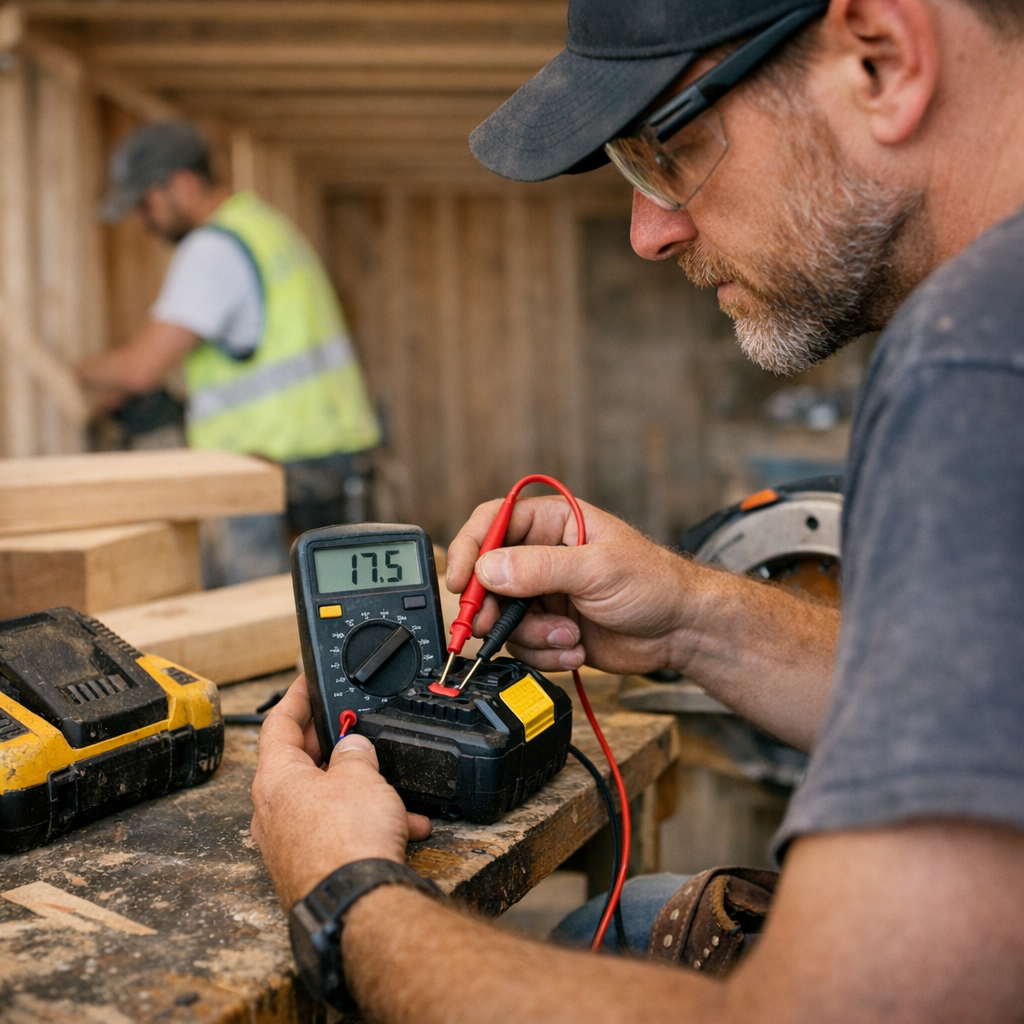
It wasn’t more charging or swapping that caught the bad batteries in our shop—it was checking output voltage after heavy use. Any pack that fell below 17.8V after a demanding run was retired, no matter how fresh it looked. Chargers that brought batteries up to “full” while delivering less voltage made the replacement list, too. The difference? Tools held steady through each cut; boards came out clean, not burned. The rhythm of the day smoothed out, with less time wasted fighting fading packs.
Sharper Habits—Catch Fails Before They Cost You
- Ignore the charge lights: Focus on how your batteries actually perform under load, not just off the charger.
- Watch for lag: If your saw drops pitch or your driver strains right after swapping, you’ve found a battery or charger holding you back.
- Check with a meter: After a full job, use a simple voltage check. Packs outside spec are draining speed, control, and your endurance.
You don’t need to geek out with diagnostics. You need to spot the habits—extra effort, slowdowns, chunkier finishes—that point to power slipping away, long before total failure.
Reliable Power Pays Off—Ignore It and You Pay Twice
Two 18V batteries, both from the same brand, can leave you worlds apart: one drives all day; the other sputters by noon, leaving rework and roughness behind. You pay for every mismatch—every time a cut goes rough, a finish needs a second pass, or a screw strips out before sinking flush.
Those end-of-day corrections aren’t just extra steps—they’re a slow grind that wears out your focus and your finish. A single voltage check added to your shutdown routine—right after you sweep up and hang your drivers—shaves off repeat work and frustration, leaving you with cleaner edges and less fatigue across the week.
Don’t let identical-looking batteries and chargers quietly chip away at your precision and momentum. The real return isn’t in a logo or a warranty—it’s in every tool, every cell, earning its place by delivering what your work demands, job after job.