
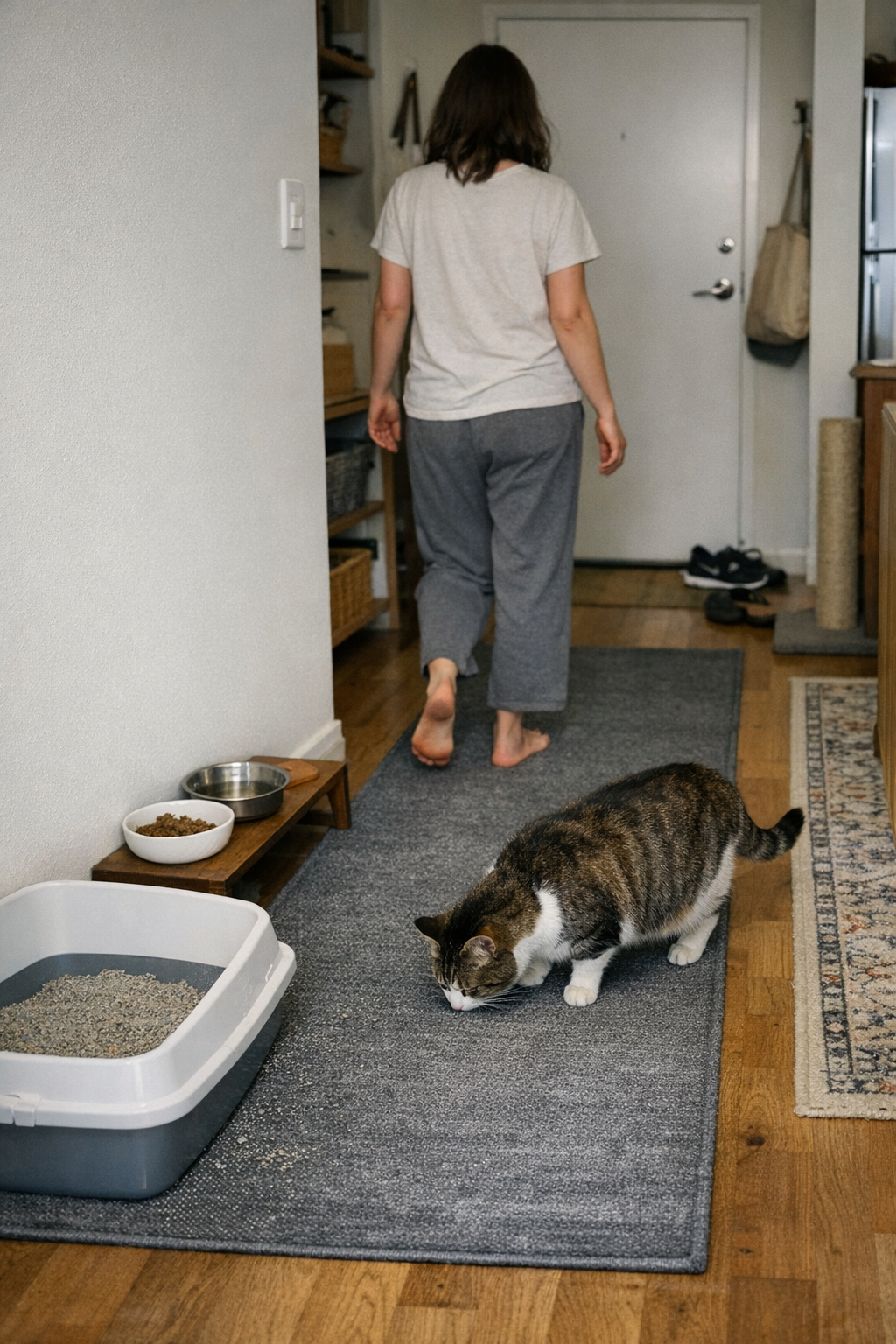
When a litter box gets parked near the entryway, the plan sounds simple: keep the mess locked in one corner. But by midweek, most setups start to fall apart—especially if you have to dodge gritty patches while grabbing your keys or make a last-second broom run after guests track debris through the main hallway. What looked “contained” on day one is now a slow-motion chase: stray litter creeping past the mat’s edge, fine grit clustering beyond the intended zone, and the welcome mat turning into a daily battlefield. If you’ve ever shuffled around a stray clump while putting on shoes or discovered crunching underfoot during a midnight water run, you’re already familiar with how fast the entry-litter problem outgrows its borders—sometimes by the end of the first real weekend.
Why Entryway Litter Zones Stop Feeling Contained
Most people start with a mat: neat, squared to the box, edges sharp, the zone “defined.” On paper, it should work—paws land on the mat, loose bits drop, cleanup contained. But watch after a few rounds of cat-to-bowl and human walkthroughs: grit picks up and rides past the mat, collecting in odd places. By day three, those invisible specks solidify into real clusters you feel before you see—a row of particles halfway to the living room or a dusting by the food dish. The friction point always emerges fastest where traffic and litter overlap.
A cat’s post-box route is anything but predictable. Sometimes it’s a zigzag exit; sometimes paws jump the mat entirely and head straight to the food area. Meanwhile, human feet cross through on autopilot, spreading the debris even farther. Add food and water setups nearby, and there’s no pause—the litter zone and feeding zone blur together. Suddenly, resets become reactive: a frantic sweep every time you realize granules have reached the hallway—or a guest arrives, and the only clean-up tool is whatever’s closest.
Cleanup That Keeps Interrupting the Day
The main frustration isn’t always the visible mess; it’s a setup that looks correct in a photo but can’t go three days without blowing its cover. Here’s where that gap between “tidy appearance” and “routine proof” becomes clear:
The Compact Mat: Looks Right, Fails on Repeat
Small mats do their job—at first. Sweep, align, wipe: the litter stops right where the mat ends. But as the days stack up and routines layer over one another, the edges fail. Gritstacks build just beyond the mat: from the spot you always cross to refill the bowl, to the path the cat takes to their next nap spot. Each trip—cat or human—nudges those micro-clusters further into the house. The mat’s boundary is only visual; the real border is where the next inconvenience appears. By then, “litter area” has shifted all the way to the rug under the dining chair or under the water bowl you thought was safe.
This is the tradeoff: a space looking managed after a reset, yet never making it through the day without another sweep. The more the day unfolds, the more the same mess returns right after you thought you’d cleared it.
Overlap Zones: Feeding, Play, Litter Collide
Where feeding, entry, and litter zones pile into one stretch of floor, the cleanup problem multiplies. Mats might overlap with water corners, toy storage, or the only route to the kitchen—meaning there’s always more than just litter: stray kibble, splashed water, toy fuzz, and litter grains mix. Mat edges collect everything, making the “boundary” a catch-all that never fully empties. Missed debris finds a way underfoot, fusing with whatever didn’t get swept last time.
This is why, when the mat reaches its limit or the wipe stack gets buried, you spend less time relaxing and more shuffling, moving mats for access, and double-sweeping. Reset moments offer relief, but it’s fleeting—the cycle restarts with every routine. Constant spot-cleans keep you from ever having the “contained” feeling last beyond a single tidy-up.
Washable Runners: Expanding the Zone (and Breathing Space)
Trading a compact mat for a washable runner isn’t about making the setup look fancier—it’s about shifting the cleanup burden from constant, scattered micro-cleans to a single, more forgiving surface. Runners stretch those few extra feet that matter: covering not just “where the paws land” but the actual traffic pattern from litter to feeding to door. Suddenly, granules don’t break past in a single leap; there’s room for the mess to settle and get stopped—before it reaches the rest of the home.
In practice, the first week reveals the shift: the pile-ups don’t reach the hallway, and the mat doesn’t need hourly attention. Most of the mess gathers along the runner, making it easier to tackle in one grab—either a shake-out before heading to take out the trash or a toss into the wash with the rest of the week’s laundry. Raised seams or textured ridges work as speed bumps, catching the finer debris that once escaped with every step. The result isn’t perfect, but you notice: cleanup becomes a regular slot in the week, not a string of unscheduled interruptions.
Washable runners transform more than just the coverage area. They break the reactive cleaning pattern—no more cycles of sweeping after every pass. Instead, you get a longer stretch of time before anything slips through, and a single wash or shake resets the whole high-traffic path. It’s less time spent chasing a mess that never quite clears and more time with a genuinely usable shared space.
Practical Placement: Why Coverage Beats Size
You don’t need a full-length hallway runner, but you do need smart placement. It’s not the amount of matting—it’s whether it actually stops the problem. Track how both cat and human move across the area. If the path hooks around a corner, an L-shaped runner or two connected mats work better than one big rectangle. If your cat launches behind the coat rack but you always step through the main center, overlap your coverage so both real routes get blocked. Runners work only when they fit the actual rhythm, not just the imagined “straight line” version of your setup.
When the Runner Alone Isn’t Enough
Some homes need layered defense. Maybe your space is tight or toy scatter is a bigger headache than the litter itself. In these cases, use the runner as your main filter, but add a small mat under the water dish or a quick-grab wipe caddy at the edge. The goal isn’t maximum flooring—it’s covering every real escape point for mess, so you aren’t forced into extra resets or re-cleaning the same spots every time the play zone erupts.
Reset Flow: Making Cleaning Easier to Stick With
The big payoff isn’t just cleaner floors—it’s that resets finally stop being a hassle. Old mats mean awkward shake-outs (and half the dust floating back). Runners let you grab and shake hard, then toss straight into the wash when it fits your laundry schedule. No pausing mid-morning for a broom run. No bending down to spot-treat a surprise pile. Most reset moves collapse into one step, making it practical to keep up with the mess without the irritation of doing all your cleaning “out of order.”
The first real sign: you catch yourself walking past the entry without needing to check for grit, knowing the runner has it covered. On rushed mornings or after an intense play burst, one sweep or shake is enough—that time saved adds up, and so does the sense that the cleanup is finally fitting the routine (not disrupting it).
Downside and Repeated-use Realities
No setup stops every particle. Washable runners aren’t magic barriers. There will still be days when a muddy paw or messy feeding session leaves you with extra work. Sometimes a stray clump escapes, or tracking happens anyway, especially during rearrangements or busy days. What changes is the scale: the “emergency” cleanups shrink, the space near the entryway stays calm longer, and each reset holds up through more regular use. Bare feet, shoes, and scattered toys don’t drag as much mess into your living room—or worse, into the bedding. The friction point—that sense of always being a step behind—eases, even if it doesn’t disappear.
This is the actual shift: surfaces look managed, but—more importantly—they hold up through real daily traffic.
The “Before and After” in Daily Home Use
Picture a narrow apartment entry: door, shoes, box, bowl, all crowded close. Day one: mat under the litter box, everything looks clean. Day three: residue dots already showing up by the food bowl, dust trailing toward the hall rug, and one toy batting debris further. Resetting means moving items out of the way—maybe twice a day—while the same spots keep refilling with grit.
Change to a runner, and the routine shifts. The walkway from box to room becomes the barrier. The grit stalls out on the textured strip, with far less making it to the bowl or crossing into the main living space. Cleanup happens as a single check-in, not a scramble after every crossing. Resetting, once a time-crunch, now fits the weekly laundry rhythm without