
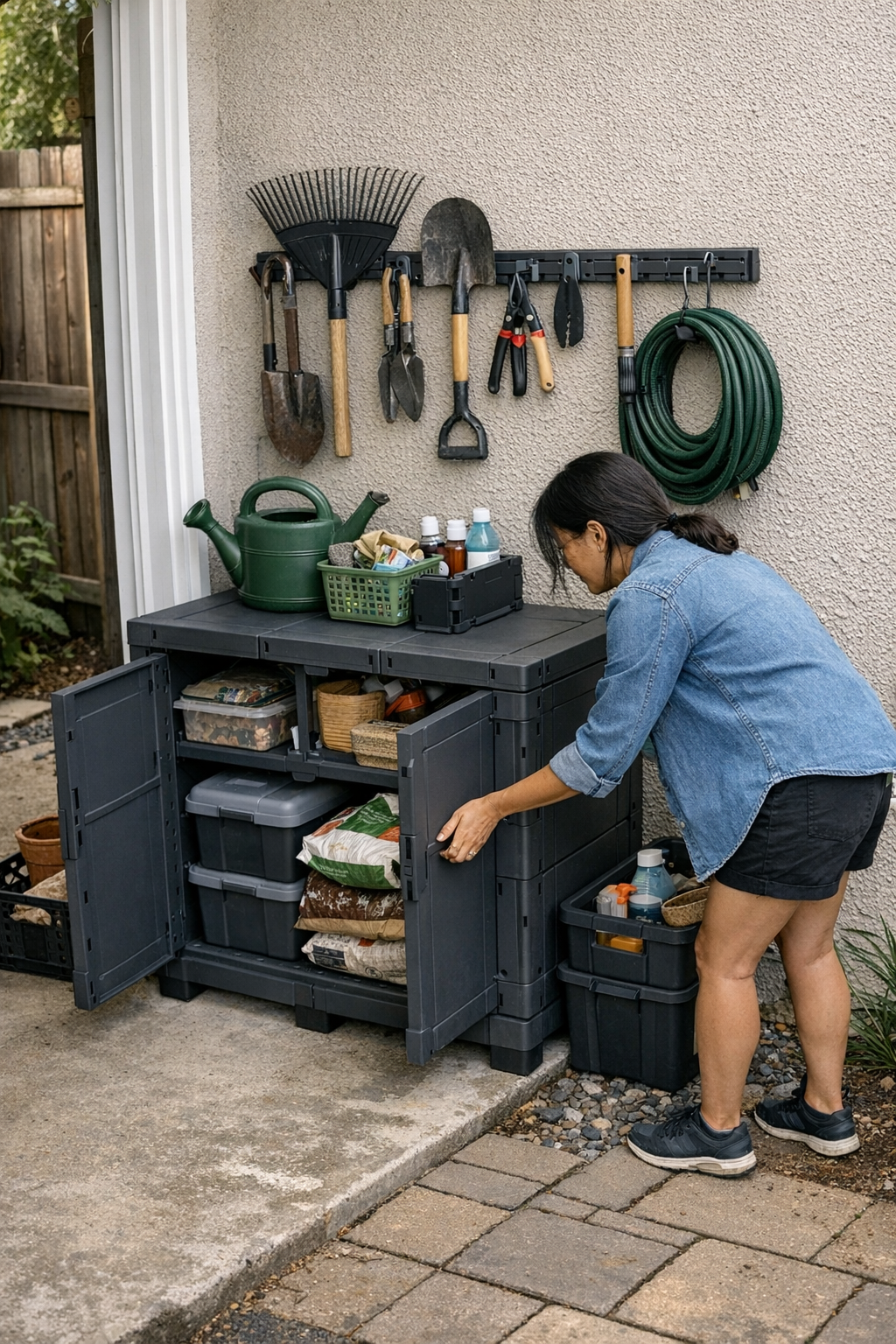
It starts with barely a shift: one rake slides out a few inches on the garage wall, a trowel gets dropped within toe-stubbing distance of the door, a shovel leans—almost asking to fall—into the everyday walkway. At first, these tiny out-of-place moves go unnoticed. But by Thursday, the entry’s been choked narrow enough that you’re squeezing sideways, tools silently multiplying into the footpath, and what was meant to be effortless “grab-and-go” has turned into a recurring shuffle—move this, dodge that, hope nothing topples. Suddenly, the entire garage edge or fence-line feels less like a storage solution and more like a slow-motion collapse into clutter.
How Setup Friction Becomes the Daily Obstacle
Hang everything up. Keep the floor clear. Done, right? That’s the myth most outdoor wall storage starts with. For a few days, maybe a week, your system works—the pruning shears are in the open, the rake hooks are empty when you need them. But then routines kick in, family members return gear in the rush, and one by one, small tools crowd the edges while buckets wind up camped next to the exit. You don’t notice an immediate mess—just an invisible drag: pausing to sidestep a shovel, glancing around for space to hang something, swinging a wheelbarrow wider to avoid a gnarl of tool handles. A once-open route morphs into a slalom course, costing you steps every trip.
When “Organized” Wall Storage Fails the Real Test
Wall-mounted racks and open utility hooks look clean in setup photos, every piece spaced in crisp formation. But the minute you skip a reset—just once—it slips. One pair of awkward loppers shoves a broom aside. That hand trowel lands on a random hook because the usual spot is blocked. Maybe you squeezed a hedge trimmer against the last open space after wrestling with hoses out back. Within a week, what started as “every tool in its place” turns to “just make it fit somewhere,” and you’re back to foraging. Movement narrows, storage intent blurs, and the wall that’s supposed to make things faster now demands constant reshuffling. Efficiency doesn’t get lost all at once; it unravels, almost invisibly.
Scene: One Return, Three Problems
Picture the Sunday cleanup. You head for the garage to hang a hoe, but the rack’s jammed—pruners left crooked from yesterday, broom slid half out, shovel barely clinging. To hang your tool, you have to nudge two others aside, cramming handles tight and blocking your next grab for a rake. Later, you’ll spend extra seconds untangling the pile—or worse, knock something down reaching in a hurry. That original, effortless return flow? Gone. Instead, every drop-off is its own Tetris game.
Side Yards and Tight Zones: Small Slips Turn Critical
In the side path or at the edge of a narrow driveway, a few inches make or break the space. The first day, your shovel hangs flush. By the second week—after two rushed returns and a late-night garden tidy—it sticks out at shin height. That hand spade, “temporarily” left at the end, stays there until the next drip of tools fills in around it. Without strict routines, a five-foot-wide walkway halves itself, forcing each person to pivot, twist, or nudge something aside just to pass. Looking organized isn’t enough; the real-life use test is whether the zone keeps movement free—and most wall setups fail by the time the weather’s changed twice.
Practical Tweaks that Keep Floor and Wall Clear
Throwing up more hooks just means more room for mess. What actually restores usable space? Limiting what gets wall space and giving overflow a clear, confined home. Put a sturdy, covered bin just below the rack. Set the rule: fast-use, grab-first tools go on the wall; everything else—odd-shaped diggers, off-season hand tools, stuff you reach for twice a month—goes in the bin, no exceptions. With even one enforced reset per week, overflow lands in the bin instead of leaking into walking space. Monday’s sweep stays quick: pull the bin forward, drop the extras, restore actual movement room. The difference with this small shift? You can still move naturally through a busy zone two weeks after a hard-use weekend; wall and floor don’t morph into one blended obstacle.
Real Habits: What Stays Working, What Falls Apart
Most people cycle through the same handful of tools a dozen times before touching the others. An open rack is a time saver if you guard the boundaries. The second you let rarely used, bulky, or “maybe tomorrow” items sit out, the whole setup reverts to mayhem. Here’s what actually works: Every major use (not just the end of the month), scan the rack. Anything that didn’t move this week gets binned. No mercy, no exceptions. The small effort prevents the slow creep where less-used gear dominates, and guarantees your main rotation always has an open slot— so you never face a wall jam five minutes before rain hits or before the last mow of the evening.
The Gradual Mess vs. The Quick Reset
Disorder rarely explodes overnight. One tool too many—left just once, place uncorrected—trains everyone else to lower their own standards. “Just for now” becomes “always here.” Piles build quietly: a power tool box tucked beneath hooks, last month’s bulb planter sidestepping the sweep area, a spare stake that never makes it to the corner bin. Then, when you need real motion—a fast run to grab gloves, a kid fetching a soccer ball—every step includes another lift, shift, or risk of knock-down. Fixing this doesn’t mean rigid perfection. It means honest boundaries: “wall is for dailies, overflow has its bin.” Keep your system visible, contained, and open for real resets, not just for looks. Function returns; resets stop eating your afternoons; traffic lines clear up.
Find practical outdoor storage that matches your routine: TidyYard