
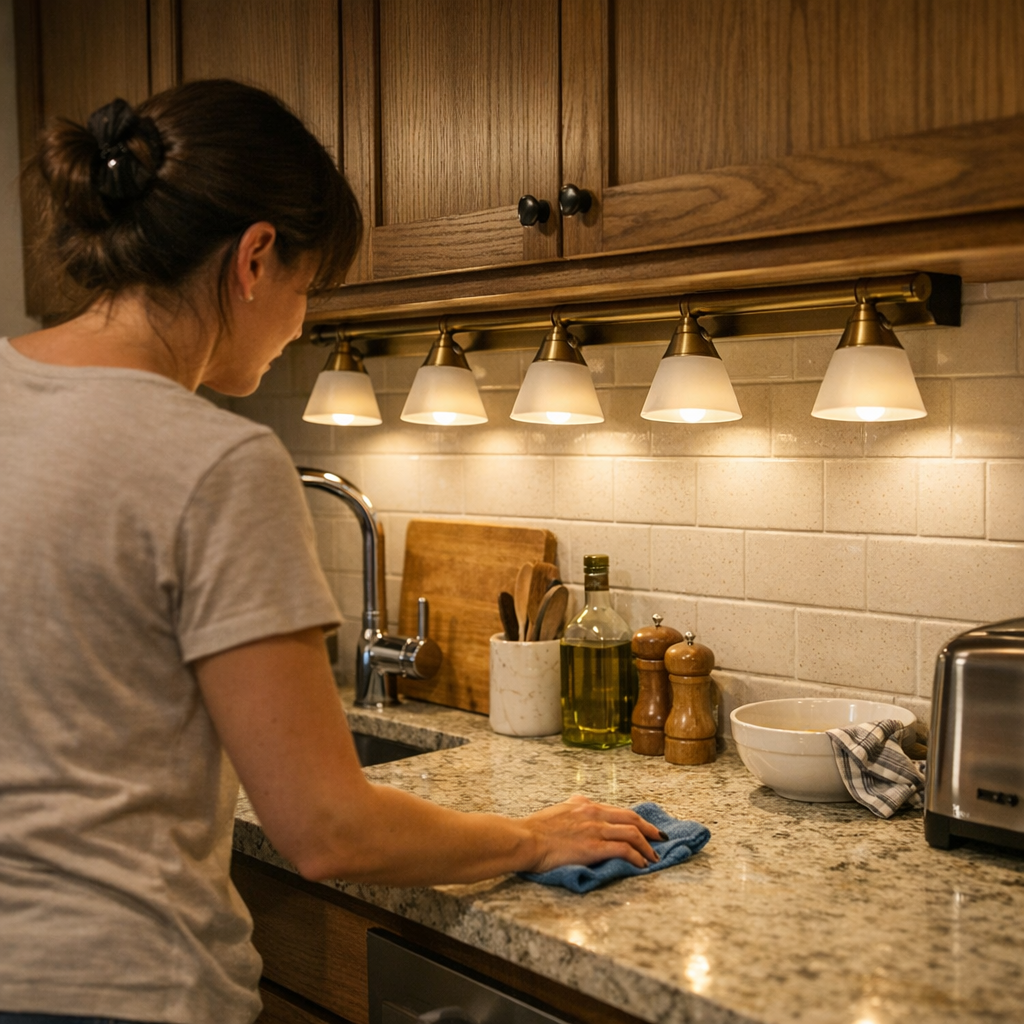
Every kitchen looks fine until it’s actually put to work. The ceiling light brightens the room, but stand at the counter after dinner—especially with cabinets overhead—and you’re left squinting at shadowed patches while cleaning up last crumbs or chasing greasy streaks along the backsplash. The flaw shows up the moment you reach under those upper cabinets: areas nearest the wall fall into darkness, requiring you to bend, crane, and even resort to a pocket flashlight to check for what the overhead light misses. The result is routine frustration—clingy shadows forcing awkward movements—and the quiet risk of missed messes, dried spills, or even bits of glass left hidden where nobody expects them. What looks clean from afar becomes questionable up close. The typical setup leaves broad light but unreliable detail right where hands actually work.
Where Overhead Lighting Leaves You in the Dark
Ceiling fixtures spread light, then stop short where it matters. As soon as cabinets jut out, or you lean in to wipe behind the faucet, your own body creates a moving shadow; counters darken right against the backsplash, exactly where splatter collects and crumbs settle. Along long runs or crowded corners, it’s the same: the room appears bright, but each task ends up in partial shade. Most nights become a loop of squinting, leaning, and double-checking edges—never quite sure whether “done” actually means spotless.
It’s not the amount of light in the room. It’s wasted direction—working light blocked, scattered, or simply not aimed where you’re scrubbing and slicing. You’ll go to bed convinced the kitchen’s clean, only to spot a trail of dried sauce in the harsh morning light. Or worse: a sliver of glass, invisible last night, now poses a risk that good lighting could have prevented.
The Under-Cabinet Difference: Lighting Where You Work
Under-cabinet fixtures don’t just add brightness—they target where the routine always stumbles. Switch on a strip under the cabinet’s front edge and the transformation is immediate. That “dead zone” at the back of the counter finally lights up. No more leaning, no more using your phone flashlight just to confirm nothing’s hiding along the wall. Grime becomes visible, crumbs stop escaping, and the anxiety of missed spots fades after one honest, well-lit scrub.
Cleanup gets faster. No more retracing the same patch because you couldn’t see the sticky outline the first time. Instead of circling back in the morning, you catch the problems—drips, coffee rings, or the edge of a spill—at night, when they’re simple to handle. The routine tightens, and the counter becomes genuinely usable, every square inch in play no matter how late or cluttered it gets.
Real Use: A Nightly Cleanup Scene
Post-dinner, the kitchen’s main light is blazing, but as you clean near the sink, a wide, dull stripe of shadow runs under each upper cabinet. It’s always there, regardless of bulb strength. You reach for a dish towel, lean sideways, and your own reflection in the marble amplifies the gloom. Messes disappear into gloom, only to show up hours later. Flip on an under-cabinet strip—aligned close to the cabinet face—and the entire counter to the wall is suddenly visible, every time. There’s no blinding reflection and no shadow following your hands. Cleanup becomes a single smooth track: visible, efficient, and free of awkward second-guessing. Crumbs stand out; cleaning moves forward without interruption.
Placement Matters: Avoiding Glare and Shadows
Adding more fixtures alone won’t fix everything. Placement draws the real line between usable and underwhelming light. Mount too far back, and glare bounces off the backsplash, blinding you or highlighting every speck of water. Too far in, and the crucial back quarter of your workspace is still dim. Cabinets aren’t all the same: shallow runs versus deep ones, textured or glossy backsplashes—each condition can amplify glare or shadow problems if the fixture isn’t positioned right. Set your under-cabinet strip near the cabinet’s outer edge, and the full depth of the counter finally lives up to its promise, without visual punishment.
Small Kitchens: Where the Impact Shows Up Faster
Compact kitchens, where space is tight and counters are barely deep enough for cutting boards and utensils, make the difference painfully obvious. A single misplaced bowl or elbow can send half the workspace into darkness if you’re stuck with ceiling-alone lighting. Under-cabinet solutions show up strongest here—smudges and sticky corners stop lurking; the entire surface is in play, and even hurried routines remain in full view. In a cramped setup, under-cabinet clarity isn’t a bonus; it’s the only way to keep pace with real-life messes and movements.
When a Room Looks Illuminated but Functions Poorly
The real test isn’t whether a room looks “bright”—it’s how it holds up when actual tasks begin. Overhead fixtures give kitchens a neat, well-lit appearance, but fail as soon as you need visual certainty—wiping, sorting, cleaning. Hesitation kicks in: you pause, shift, and run your hand along the counter edge just in case. Every repeated annoyance erodes the room’s reliability. “Bright enough” isn’t “ready for real use.”
Ceiling lights fill the air with glow, but hands-on tasks demand focused, directed light—right at the surfaces in play. Under-cabinet additions finally bridge this gap. The improvement isn’t cosmetic. It’s a day-to-day shift: late nights and rushed mornings both become less stressful because the space actually shows what’s happening, everywhere you need to look.
Practical Tips for Making the Fix Last
Continuous strips outperform spots in busy work zones: One uninterrupted light under each upper cabinet keeps shadow-bands out, delivering clean, even wash across every corner of the counter—no gaps to hide stains or spills.
Test placement under real conditions before locking it in: Temporary tape and trial runs during your messiest hour reveal where glare or dark patches sneak back in. If you see bounce-back on the backsplash or a lingering dim edge, adjust length and position now—before permanent install.
Why Good Lighting Makes the Routine Work
Lighting isn’t just about looking “done”—it’s what determines whether every late-night chore is a light-swept process or a hunt for details in the dark. Make every inch of counter truly visible, and the endless loop of missed stains, awkward pausing, and double-checking ends. Dishes, prep, sorting, or tomorrow’s breakfast—when light follows your movements, the kitchen finally fits how you actually use it. Not perfect, but reliable, task by task.