
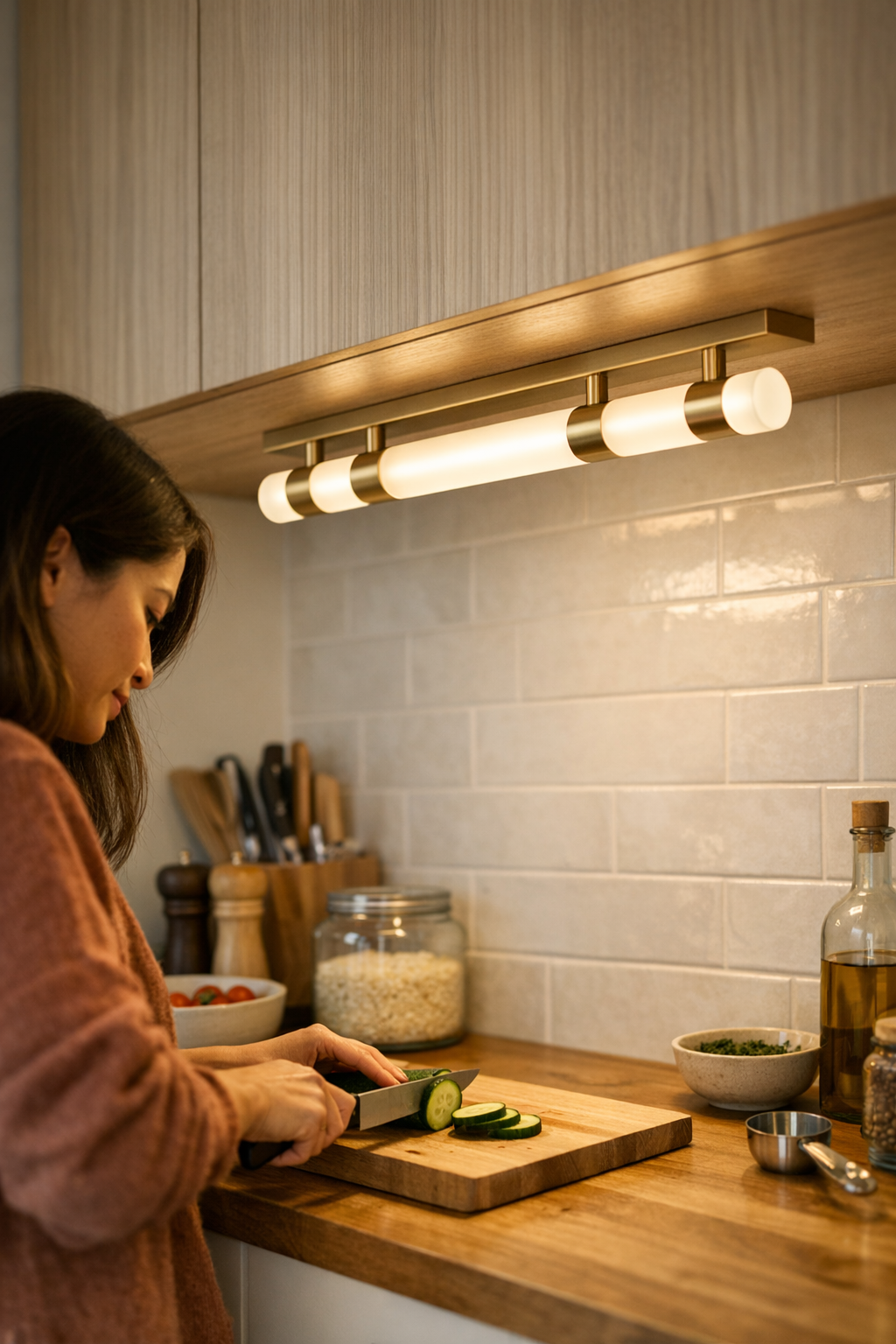
You spot it as soon as you start working—the kitchen counter looks bright, the desk feels tidy from across the room, the shelf glows under ceiling lights. But step closer, and the flaws surface fast: shadows pool at the back edge, your arm blocks the light, and every reach under a wall cabinet throws your own silhouette across what you need to see. The surface that’s supposed to simplify your routine now makes you pause, squint, or shuffle things forward. The disconnect is sharp—from a distance, rooms look resolved; up close, the task zone stays awkward. This is where typical overhead and wall lighting break down: you notice the gap every time you cook, fix, or read at the same spot, and the inconvenience compounds as the week stacks up.
The Everyday Struggle with Shadows and Glare
Each return to the same surface brings back the same friction. Overhead lamps throw your shadow over the work, so you lean sideways or twist your neck to get a useable view. Glare bounces off glossy areas—tiles, steel, even crumb-strewn counters—making cleaning and reading detail harder with every repetition. Ignore it, and the strain collects: missed edges when you wipe, crumbs left behind, fine print still in the dark. Add a plug-in lamp as a quick fix, and now there’s a new cable snaking between your tools, or a glare line catching your eye with every move—another problem traded for the last one.
The Hidden Cost of Imperfect Setups
Exposed or tangled cables break the illusion of a clean setup before anything even gets used. A bracket or stick-on mount that seemed steady when new starts to rattle after each cleaning session. A lamp nudged to reach one spot never seems to land back at the right angle, so small adjustments eat into every task. The routine shifts from simple work to small, repeating interruptions—things look organized, but every use reopens the same weaknesses.
Where Overhead Lighting Falls Short
A room can look crisp on a checklist—wall sconces, ceiling fixtures, clear desk edges—but as soon as work starts on a surface pressed against a wall or under a shelf, the limits show up. Overhead light simply vanishes at the hinged dark seam where work meets the wall or the underside of cabinets. No matter how bright the general light, the crucial back edge stays vague. You’ll catch yourself pulling items forward, chasing usable light. The space looks finished, but the dim zone never quite resolves—a real setback for any surface that’s meant for prepping food, reading small print, or sorting parts.
The Daily Reality of Shadow Zones
The repetition is impossible to ignore: slicing vegetables with your own hand casting a blur, searching for a screw at the back of a shelf by feeling more than seeing, juggling jars just to spot a label. Every time you adapt your position or bring in an extra flashlight, it’s a signal that the core lighting plan is outmatched by real routine. The friction is lived-in: workarounds become habits, comfort gets replaced by constant adjustment, and the best you get is “it’ll do for now.”
How Proper Under-Cabinet Lighting Changes the Game
Direct under-cabinet or under-shelf lights solve the missed spots that main fixtures can’t touch. Placement is everything: a slim LED bar or adhesive strip tight beneath the front lip of a shelf shifts light right where hands work and details matter. The difference is immediate—no more hand shadows, no more guessing where the counter’s edge stops, and far less shifting just to see. Instead of improvising, you see and reach with ease the first time, without dragging lamps or hunting for better coverage.
A Real-World Upgrade: Less Strain, More Clarity
The most practical fix is this: fixing a low-profile LED directly under your most-used shelf with its cable pressed flat and hidden. Before the swap, maybe a plug-in lamp hogged counter space—its cord pooling in puddles when the sink gets busy, or snagging every time you rearrange containers. With a permanent bracketed light, suddenly every inch of the surface reads clean, no cable chaos, no lamp to keep nudging back, no bouncing glare to dodge. Late-night tasks lose their hassle; you find yourself matching labels or measuring small pieces in one try, not a series of workarounds. The setup actually steps out of your way.
The Role of Support: Clean Holds and Cable Calm
Brightness alone doesn’t win. Support hardware—solid brackets, clean cable runs—keeps the solution working under pressure. Lights that wobble with each grab, or cables that drag through crumbs and catch on containers, turn a fix into another nuisance. Only with cables routed tight against the structure and a stable mount does the solution settle into the background—and stay reliable across cleaning, shared use, and everyday motion.
Most Common Mistakes—And Why They Matter Fast
If a lighting setup falls short, it almost always fails here first:
- Loose, visible cables: They trap dust, snag cleaning rags, and stack up distraction by the day.
- Shaky mounting or brackets: A single careless bump shifts the light, so you’re fussing with angles instead of working comfortably.
Weaknesses that seem minor on install become big annoyances after a week—especially if more than one person is reaching, cleaning, or moving things in the same zone. What looked organized on day one soon feels unreliable or cluttered.
For Lightly Used Spaces, General Lighting Might Suffice
If a shelf holds storage and rarely gets touched, or a counter is used once a month, the shortcomings of overhead-only lighting barely register. But for any spot you use several times a week—making lunch, charging tools, sorting supplies—a properly mounted under-shelf light, with secure support, changes the experience from make-do to actually smooth, saving your eyes and your time every visit.
From “Looks Clean” to “Actually Feels Right”
The difference is obvious after a week of real use: the space isn’t just visually finished, it works—no dark corners asking for improvisation, no cables or brackets breaking the flow, no rerouting your tasks around a weak edge. Solid support does more than hold up the light; it holds up your routine. It’s the move from “tidy on inspection” to “nothing gets in my way when I use it”—lighting and mounting logic designed for movement, for regular cleaning, for actual living. When everything stays easy week after week, you stop thinking about the setup at all—and start trusting that what looks resolved finally matches up with how you need it to work.