
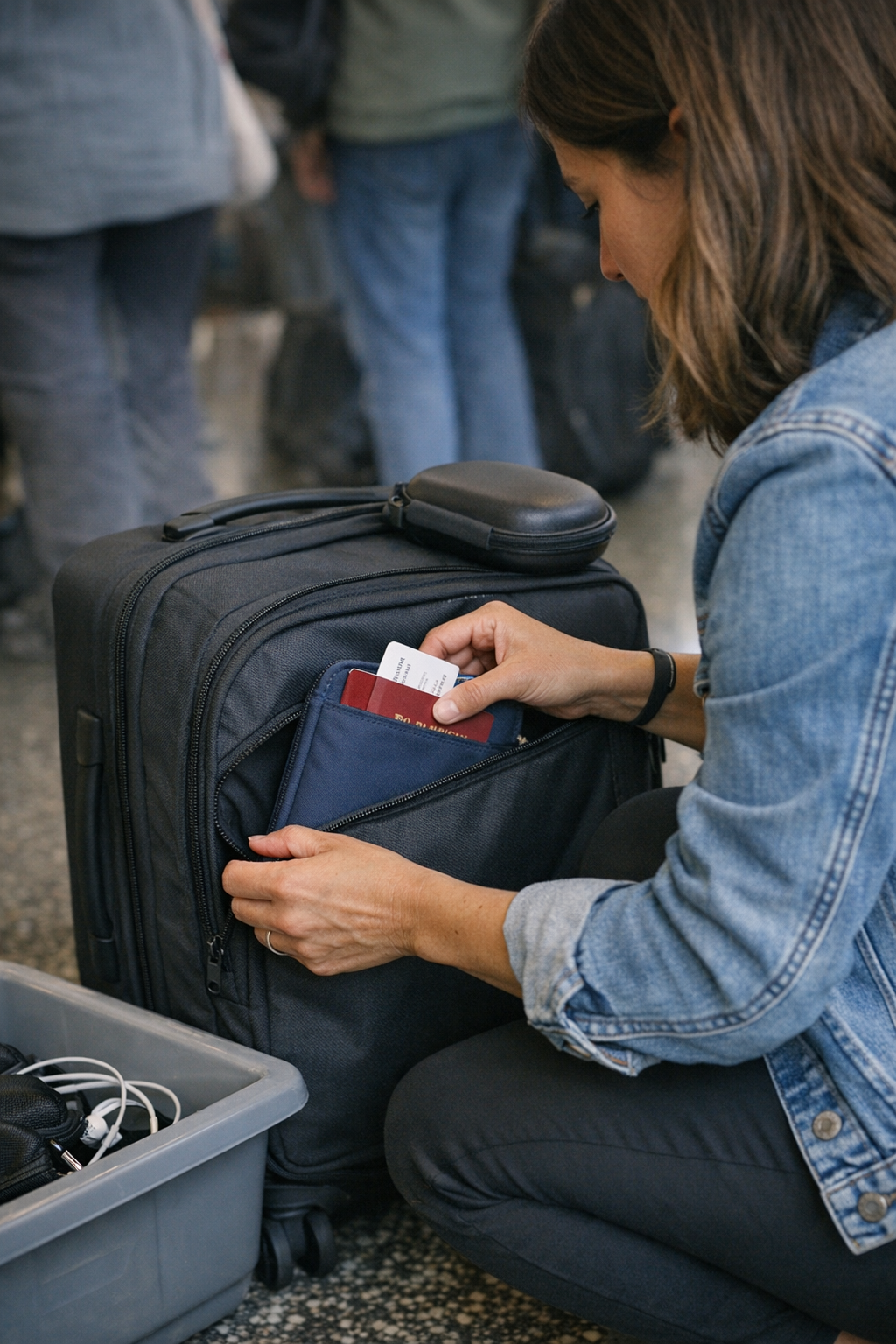
Every traveler has faced it: your carry-on looks neatly organized at home, but within minutes in an airport, that same setup becomes a liability. You’re sliding between strangers in a moving boarding line when security suddenly asks for your passport—and right then, your “packed to perfection” pocket system slows you down. Instead of a quick grab, you’re fumbling with layered pouches and hidden compartments, exposing the gap between home order and real airport movement. Organization that feels sharp in your bedroom often collapses under actual travel pressure, especially when document checks or seat entry happen faster than you planned.
When “Organized” Isn’t Enough in Real Airport Movement
A bag that looks orderly in your hotel room doesn’t guarantee smooth movement in transit. The real verdict comes at the worst moments: shuffling forward in a boarding queue, stuck behind a bottleneck at security, sprinting down a crowded terminal with a gate change ticking down. Visual neatness offers zero help if you’re double-unzipping, moving pouches aside, or repacking mid-flow just to get at your ID or boarding pass. The true test isn’t whether your bag looks ready, but how much friction you feel—repeated tiny holdups—each time your hand goes searching for something you actually need, fast.
That drag builds in silence. A neat setup at home turns irritating when you’re forced to dig, shift, or reset contents every time another travel checkpoint makes a new demand—while impatient travelers press behind you and the line keeps moving.
The Subtle Ways Pocket Design Trips You Up
Outer pockets seem helpful until they turn into traffic jams for essentials. It’s standard to stash fast-access items—documents, headphones, sunglasses—in the same “easy” pocket. But by the second or third attempt to retrieve something, you often end up rearranging the pocket to reach what’s at the bottom. Layering daily essentials together in the same exterior spot forces you to block and unblock your own path: a sunglasses case wedged in the way of your boarding pass, or charging cables half-covering your passport. Even well-intended segmented pockets can backfire as needs flip rapidly—security, then charger, then wallet, in a sequence that didn’t matter at home but becomes critical in the airport’s stop-and-go rhythm.
A Familiar Friction: “That Pouch Was Supposed to Help”
At first, nesting everything—tech, travel documents, chargers—into a single organizer or all-in-one pouch feels efficient. But that same pouch becomes a delay machine when, under travel pressure, you have to fish through cords for your ID, or move tickets aside for a charger. Each retrieval feels minor—until it’s repeated in every checkpoint, every boarding, every tray transfer. What started as a “clean system” becomes a repeated source of mild panic: headphones tangled with receipts, passport hiding under cables, the pouch itself now a speed bump instead of a solution. By the third or fourth interruption, small irritations accumulate into real drag, especially when time and space are tight.
Packing Order vs. Movement Order
There’s a cold truth: the bag that looks best lined up at home is often not the one that works best when you’re actually moving through airports and planes. Rigid lineup, stacked organizers, and tight compartments photograph well—but start to fail as soon as you enter the unpredictable pacing of a travel day. Stacked pouches stack your problems: one charging brick blocking a zipper, one “quick-access” slot stuffed behind other cases, an external pocket overflowing because the interior ones are too cramped. Packing order flatters your system in theory; movement order exposes whether you can actually reach, grab, and move on without pausing or reshuffling every time the sequence changes.
The “One Grab Turns Into a Pause” Moment
Picture rushing gate to gate. You reach into an outer pocket for your boarding pass, but it’s wedged behind headphones and yesterday’s sunglasses. What should be a one-motion retrieval becomes a public shuffle: pulling items out, setting them down, disrupting the line behind you. Suddenly, the arrangement that felt foolproof has turned on you, and you’re left remembering that travel exposes every layer of overplanning—and every shortcut that wasn’t built for reality.
How Two Dedicated Pouches Break the Cycle
The first real improvement comes from dividing, not stacking. After too many stops to repack mixed pouches, switching to two lean, purpose-built pouches—one for travel documents and essentials, one for tech—broke the old friction cycle immediately. The travel-doc pouch slid into a wide, no-fuss exterior pocket with a zipper that opened fully. Tech and cables stayed inside, no longer in the way. Every time a guard, gate agent, or attendant called for tickets or ID, you could target the right pocket once—no digging, no double-handling, no resetting. That single split cut down stress and forced pause time at every repeat use. Suddenly, interruptions didn’t equal total repacking—just a clean grab and on you go.
The difference shows up over and over: the pouch you need is reachable without unpacking a layer of gear, you repack fewer things each time, and your sequence stays intact. The pace of travel recovers—not because you packed for looks, but because you packed for how often real access is demanded under pressure.
What to Look for in a Truly Travel-Ready Carry-On
- Wide, single-action external pockets: Should unzip fully and show key items at a glance, so you’re not reaching blind or disrupting internal order.
- Dedicated, single-purpose pouches: Never force travel documents to share space with cords or chargers. Shared space means lost time at checkpoints.
- Minimal overlap between high-access items: Each item that competes for the same spot is a future bottleneck—split them early to avoid repeat slowdowns.
- Zipper paths and pocket depth matched to motion: A pocket that can’t be opened cleanly while standing, or a compartment that’s too deep for easy reach, becomes a mini-ordeal every time you’re called to move quickly.
How Packing Choices Are Exposed by Airport Reality
Packing order is just the starting line. Actual travel is built on access cadence—the rhythm of repeated reach, use, and return, often crammed into minutes while juggling bins, bags, and boarding slips. Each dig, unzip, and repack reveals whether your choices speed you up or quietly drag you down. What made sense the night before can slow you down at every checkpoint, aisle squeeze, or document request. These small snags pile up until that “perfectly organized” bag feels like a barrier, not an upgrade, and the visual order from home fails to translate into fluid movement in the real world.
Signs Your Current Setup Is Slowing You Down
- Repeatedly reaching for the same item, always finding it blocked, stashed beneath something, or off-sequence
- Needing to open two or three pouches to retrieve a single passport, charger, or boarding pass
- Feeling your progress stall in line or at your seat as you untangle or reset pocket contents
- Realizing your home packing “system” leaves you stuck, not helped, when access speed actually matters
Ultimately, there’s a difference between a carry-on that holds its shape and a carry-on that keeps you flexible—ready for every new checkpoint, line surge, or gate shift, no matter how many times the needs change along the way.
For more field-tested carry-on tools, visit CarryOnSupply.