
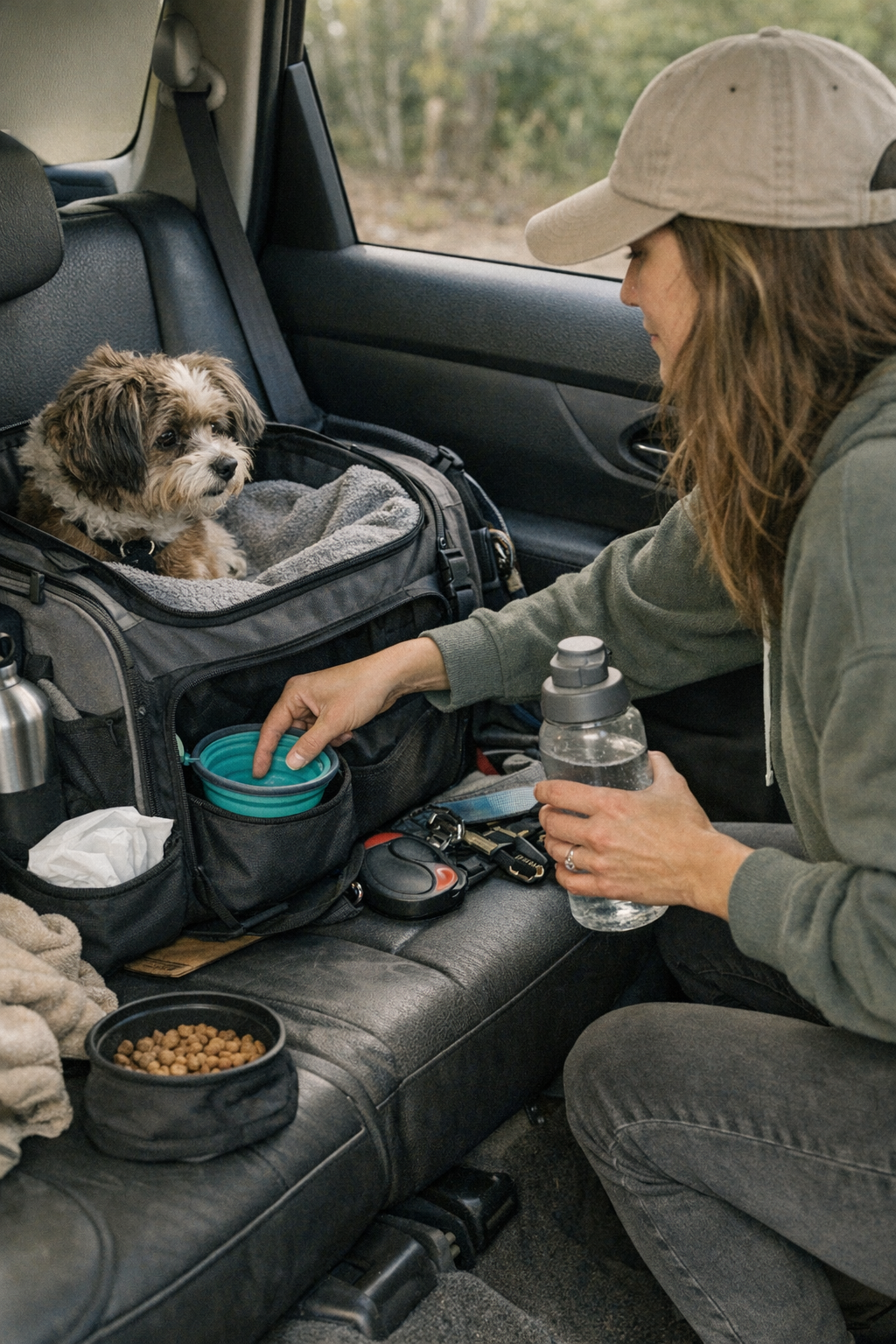
The weak link isn’t what you forget—it’s how many times you have to hunt for it on the move. The downside of most pet-travel setups doesn’t hit the first time you unpack—it’s exposed every time your pet tugs at the leash while you fish for wipes you know you packed “somewhere.” What slows you down isn’t missing gear, but the moments when routines break: leash clipped underneath the water bowl, wipes buried under comfort pouches, both hands full when you need one quick grab. Even a bag that looks ready in your hallway can become a stubborn obstacle in a parking lot, or with a restless pet pacing at the end of your arm. The gap between “organized” and “actually working” starts as a subtle tangle and ends with repeated awkward pauses that drag out travel instead of smoothing it. PawGoTravel’s world starts at that exact moment—when the setup’s supposed strength turns, stop after stop, into friction.
When “Organized” Isn’t Enough: Where Pet Travel Breaks Down
The illusion of control fades fast after the first stop. Sleek, compartment-rich bags seem designed to impress, but in real use, order doesn’t always mean access. The problem reveals itself with each motion:
- Leash trapped under a water bowl when your pet wants out fast
- Sanitizing wipes sandwiched between snack containers instead of ready at the top
- Comfort blanket zipped away right when your pet needs a quick calm-down
- Just the right pouch—locked behind a snap or zipper that costs you seconds every single time
These aren’t one-off annoyances. With every repeated stop—errands, appointments, or simple walks—each extra motion becomes a hurdle. It’s not a missing supply list, but repeated small delays that add up, with your pet growing impatient while you juggle the same awkward access, again and again.
Real-Life Mess: Travel Friction in Motion
Take a typical run of three or four stops. At first, your setup feels solid. But by the second errand, wipes are stuck behind an oddly stiff divider, leash hooks catch on bowl handles, and you’re propping the car door open with your knee while trying to unearth a harness. The deeper into the routine, the more obvious it becomes: every accessory was “organized,” just not for real movement. Contents migrate. Blankets settle in the least accessible place. Critical items seem to hide when you most need them—right as your pet leans, pulls, or starts to fuss.
Cleanup Delays Cost More Than Time
One trip: Muddy paws. Wipes, perfectly packed but locked under a snapped flap, require you to wrestle open a stiff closure while balancing both a leash and a dog anxious to bolt. Instead of quick cleanup, you get a fumble—mud wicking up seats and tempers running thinner. The bag’s order kept things “safe,” but safety costs you in minutes lost, stress added, and cleanup made longer by each layer protecting what you can’t reach.
The Comfort Setup Backfires
Comfort items are supposed to settle your pet. But when a comfort blanket rides at the bottom, you scramble and repack mid-trip, trying not to spill treats everywhere or crush a toy. In theory, the setup is organized; in motion, it’s an unpacking puzzle just to calm a nervous animal. The most calming item comes last—when you need it fastest.
Surface Order, Underlying Strain: Structure vs. Use
“Organized” setups focus on initial packing—a satisfying, camera-ready moment that’s over as soon as you start moving. The stress test comes with repeated reach and return: quick stops, seat-side pauses, real cleanup. Does your bag try to stay beautiful, or does it keep you moving through mess and repeat interruptions? If you have to dig, unclip, or dig again—even for essentials—the structure isn’t working. With each barrier between you and a needed item, the bag goes from protector to obstacle, slowing restarts, stacking tension with every interruption.
Designing for Real Flow, Not Just Looks
More pockets don’t fix slowdowns—rethinking which pocket you use does. Owners who’ve felt the drag shift strategies: bowls in open side pouches, wipes no deeper than the main opening, blanket on top—always. Access frequency trumps symmetry or packing logic. The payoff shows up fast: after a puddle or muddy walk, you reach once, not three times. Mud gets wiped, the dog calms down, and you keep moving without a reset drill.
Action-First Zones Make the Real Difference
Where things live in your setup matters—especially seat-side, where the first seconds count. One-handed flaps, open pockets, or a dedicated “always grab” spot for water or wipes remove seconds of fumbling each time. Owners sometimes break up even a beautiful carrier’s order on purpose, just to keep two highest-need items in chaos-proof reach. It’s less about maximizing space and more about minimizing restart friction. Leaving “empty” space next to main pockets isn’t wasted; it’s an investment in faster motion—and less frustration for both traveler and pet.
Why Problems Sneak Back: Old Habits, Slow Setups
Even if you fix your structure once, “visual tidy” habits try to return. The Monday bag, re-optimized for real stops, feels sluggish again by Friday if every item finds its “perfect” slot but loses flow. Real progress isn’t how good your bag looks at setup—it’s whether you can finish stop four without the old fumble. Watch for these warning signs:
- Needing to open the same pocket far too often for different essentials
- Pet grows more restless at each pause—a signal of slow routines
- Cleanup items hidden away so they always require two hands (never available for a quick wipe)
- Owner keys, phones, or snacks overlapping pet supplies—each grab rearranges something else
Practical Shifts: Rethink, Rearrange, Reduce Friction
You don’t need a new bag—change what goes where. Begin by:
- Pinpointing items you reach for every stop—make these move up and out
- Keeping at least one pocket always open or hand-width accessible
- Putting comfort and cleanup tools on top, not at the bottom, for high-urgency stops
- Avoiding matryoshka-style nesting—no hiding top needs under infrequent ones
- Leaving space at the main opening, so function wins over visual order
A setup that holds up to real movement isn’t finished when the bag is zipped—it’s proven when you can handle three back-to-back stops with fewer pauses, faster resets, and less pet impatience. Every repeated use uncovers whether your “organizing” is for comfort or speed. Flow comes from action-aligned structure, not just clever packing.
Friction vs. Flow: What Hits First, What Lasts
The best pet-travel setup isn’t the one that photographs well after packing. It’s the one that, halfway through a messy day, actually lets you grab, clean, and reset without a multi-step reshuffle. Real improvement shows when restart time drops on the third and fourth stop—not when you first step out. Structure that works holds steady under repeat, not just in theory. That’s the difference between just containing chaos and actually keeping pace with your pet—all trip long.