
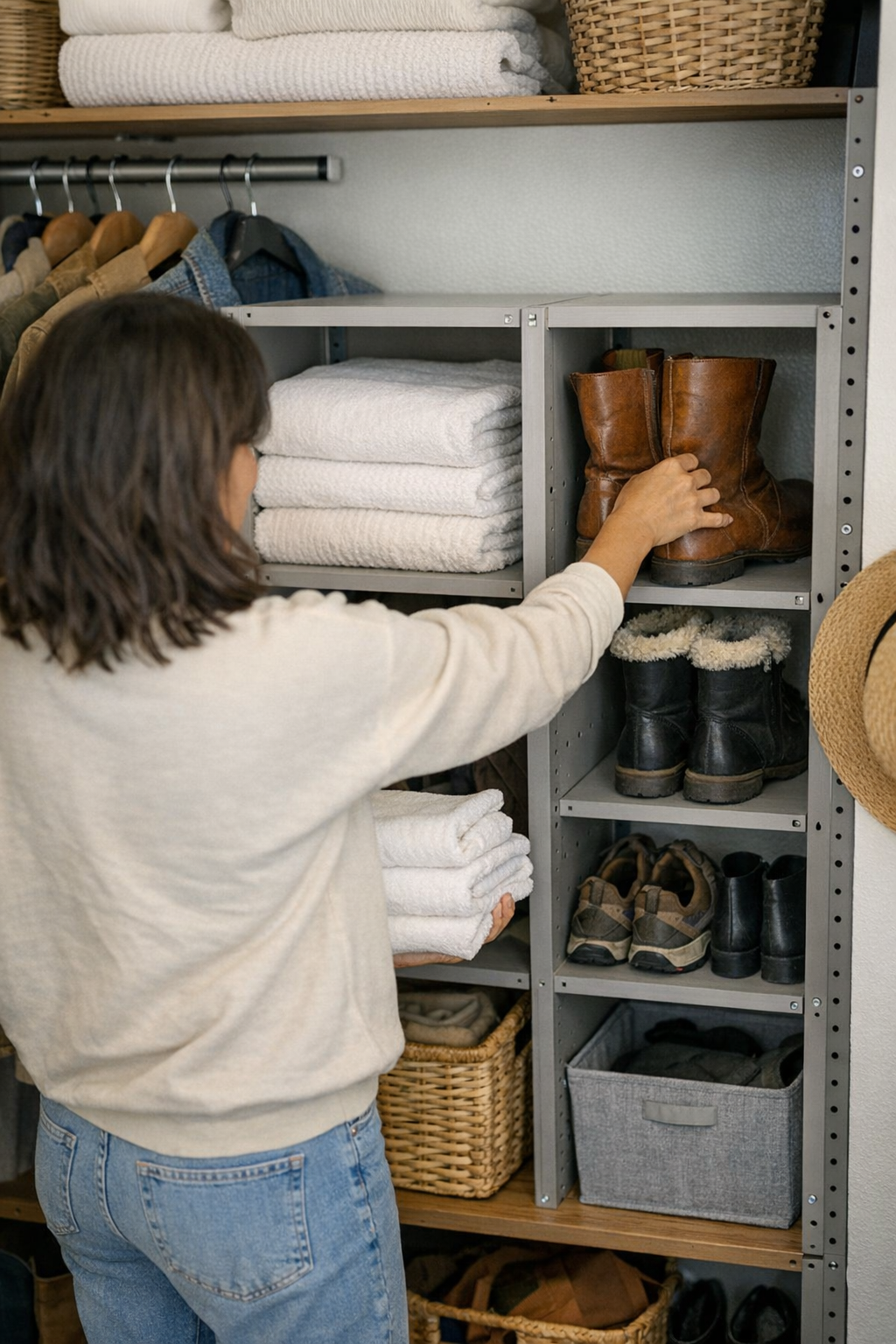
Every closet has that brief, hopeful moment—right after the big clean—when folded piles stand straight, baskets line up, and hangers point the same direction. It looks organized. You feel in control. But then, regular life sneaks back in. You dig out shoes hidden behind sweaters. A basket gets dragged out just to reach your work bag. By Thursday morning, the shirt stack collapses after one hurried grab, and that tidy feeling dissolves into quiet frustration. What looked organized doesn’t stay easy. In just a week, it’s obvious: the difference between “put away” and “works every day” is all in the design.
Where Storage Starts Failing—Subtle, Repeated Frictions
Real-use storage isn’t about perfect stacks—it’s about avoiding the need to touch, nudge, and restack just to get to something routine. When shelves hold more than one type of item, or family members share the same closet, friction multiplies fast. If you reach for a scarf and send two hats tumbling, or you have to drag out a bin and sift through mismatched socks, the system is wearing thin. These moments slow you down more than you realize—and signal what isn’t working.
Clutter on the shelf’s edge, corners that always seem “busy,” and piles that melt into each other aren’t just daily annoyances. They’re proof the setup needs a rethink, not just another round of tidying.
How Disorder Grows, One Grab at a Time
Mess rarely erupts in a single afternoon. Take a hallway closet doing double-duty: towels folded on one side, boots and gloves jammed on the other. Week one, it’s fine. By week two, the boots have muscled towels into corners, stacks slide inward, and midday grabs leave mittens on the floor. That shelf isn’t “messy”—it just demands fixing itself, constantly, for basic use.
Bedroom closets fall apart the same way. First, shelves fill too fast. Then, grabbing a T-shirt sends sweaters slumping forward. Suddenly, bins are mystery boxes—one mix of slippers, scarves, and last year’s pool float. The change is slow, but the friction is daily. These aren’t failures; they’re the lived-in proof that looks fade under real habits.
Resetting Shouldn’t Be a Project
If you need a two-step process to get to what you want—slide this, re-stack that—or find yourself folding towels just to make boots fit again, something’s wrong. The true red flag: when each “quick tidy-up” turns into a mini chore, and every grab requires a workaround. That’s not a sustainable system; that’s barely controlled chaos.
Every Category Needs Its Own Track
The most resilient closets don’t rely on stacks staying perfect. They rely on categories staying separate—with boundaries that survive through dozens of busy mornings. A system works when a quick toss or a single pull doesn’t blur the lines or tip the balance. But when shoes migrate into towel territory, or that “winter bin” absorbs whatever won’t fit elsewhere, the closet’s letting you down.
Sometimes, one divider makes the difference. Install a vertical panel between towels and boots: suddenly, pushing shoes in doesn’t squash folded linens, and towels stay upright through daily grabs. No more reshuffling. Resetting drops from five steps to one. The space stops asking for attention and just works—even when you’re in a hurry.
Spotting Warning Signs Before It All Collapses
Most storage headaches announce themselves early:
- Stacks toppling or oozing across shelf edges
- Categories blending every week until it’s just “stuff”
- Digging or reshuffling just to grab a single thing
- Baskets or bins filling up but not clarifying what’s inside
- Shelves running out of space, faster than the actual volume of your stuff
These aren’t personal defeats—they’re signals you need clearer inner boundaries or better-fitted tools. Often all it takes is a right-sized bin or a simple shelf divider to reroute chaos into a routine that sticks.
Small Adjustments, Big Improvement
There’s no one-size fix, but a few targeted changes overhaul most closets:
- Simple Dividers: Stop boots from bulldozing towels, keep bags from toppling sweaters. A vertical panel keeps items in their zone—even after a clumsy grab.
- Purpose-Built Bins: Assign bins to a single item type and keep them that way. If a bin eats shoes, hats, and old receipts, it won’t sort anything—it’ll just hide the mess.
- Hooks for Habitual Grabs: Scarves, handbags, and jackets tossed on hooks are instantly accessible—and don’t topple anything else when you reach for them.
Even a minor shift—raising a shelf to use dead vertical space, or designating a defined drop-zone for shoes—can deliver a smoother morning. You shouldn’t have to “prepare” your closet every week for it to work; when categories keep their lane and daily use runs smoothly, the storage pays you back every time.
The Real Test: Living with the System
Looking organized isn’t the same as living organized. Closets prove their worth by surviving daily habits—not just surviving the first cleanup photo. The space that lets you reach, return, and reset with one motion is a keeper. The system that asks for constant correction isn’t offering clarity; it’s just performing order.
Don’t settle for storage that holds, but doesn’t help. A closet that makes you adjust, re-stack, or search with every use falls short—no matter how tidy it once looked. The real upgrade is when fixes fade into the background and routines get faster, even on the busiest mornings.
For storage solutions designed to work with how you actually live—dividers, fitted bins, smarter shelves, and simple hooks—find options at ClosetWorks.