
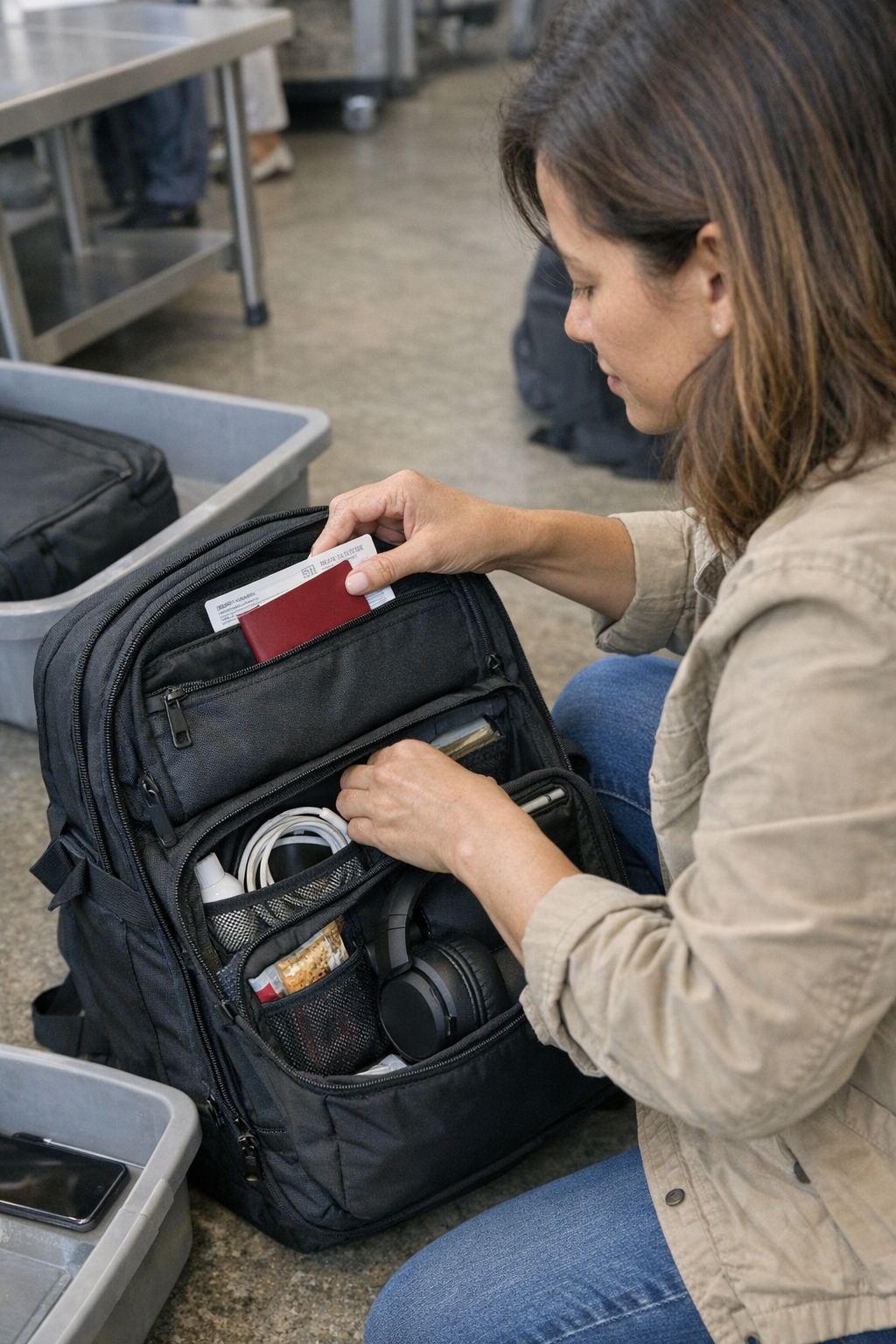
Most travelers don’t realize their “organized” carry-on is primed to fail until airport movement turns simple pockets into friction points. At home, it looks ready: lines neat, compartments zipped, everything in reach. But the moment you’re in a real queue—security trays moving, agents watching, people pressing behind—a micro-delay reveals itself. Zippers snag on pouches that slid since you packed. Boarding passes wedge behind charging cables, or quick-access pockets jam up with whatever you stuffed in last. The illusion of order vanishes under live conditions; the bag that promised control instead drags at your every stop.
When Visual Order Collides With Real Travel Pace
The bag on your entryway bench might look dialed in: tech stacked, paperwork visible, snacks tucked away. But a travel rhythm exposes design flaws—reachable at rest isn’t the same as reachable in movement. You reach for your ID and a charger shoulder-blocks it. The “quick-access” pocket? It’s full of mixed cords, and you’re stuck unzipping the wrong pouch—twice. With each line, fresh obstruction: a zipper blocks a pass, a passport scrunches under wrappers, headphones come out knotted and cost you another five seconds. These interruptions aren’t embarrassing, but they’re relentless. Every fix chips away at your pace, especially when you hit the same hitch at every checkpoint.
The real strength test isn’t first glance—it’s mid-rush retrieval. If grabbing what you need under pressure means negotiating overlapping compartments or shifting contents, the structure fails. What starts as small re-adjustments becomes a loop of slowdowns—passport tangled in cable, headphones buried beneath pouches, boarding card stuck behind chargers. Each pause is minor; the frustration is that it shouldn’t be happening at all, much less on repeat.
Scene: The Security Tray Stall
You’re finally at the x-ray belt, bag on tray, about to show your boarding pass. Simple—except the pocket meant for it is pinched tight with two cables, stuck to a half-eaten snack. You root around, produce a power bank instead, shuffle again—the agent is waiting, the queue is closing in, and a pass that was “on top” an hour ago now costs you small bits of dignity. These aren’t single-trip surprises; they’re repeated frictions built into a setup that looks fine at rest and fails under even modest airport pressure.
When Every Five Seconds Repeats
The pain point isn’t a dramatic failure—it’s the low-grade hassle that keeps happening. Over and over, you dive for the same document, repack the same pouch, hope something stays where you left it only to meet the same resistance. Fresh city, old problem: ID buried again under snacks and tech. One fumble is nothing, but by the third, fourth, or eighth search in a day, your patience wears thin and the compounding drag becomes real travel fatigue.
Static Packing, Dynamic Friction
That color-coded, compartmentalized system built at your kitchen table unravels after the first real shake. One snagged cord yanks a wallet free; an overstuffed charger pouch compresses your documents. Arrive at your seat to find headphones strangled by a toiletries kit, forcing a repack that blocks the aisle and draws side-eye from the boarding line. Airports punish static structure: it never matches up against the bumps, pulls, and seat-side twists of the actual route. Most travel mess isn’t dramatic, just constant: every extra zipper to open, every scavenger hunt in a crowded gate area, every retracing to find something you should already have in hand.
Carry-on frustration rarely arrives as chaos; it’s built from the burden of micro-corrections. Each time you double-back on your own setup—two zippers instead of one, three pouches to rifle for the usual passport or pass—you burn momentum and draw out the awkwardness for yourself and the people behind you.
The Structural Test: Movement, Not Appearance
On the packing table, separation and order look perfect. But the real pressure test comes mid-transit, after you’ve been through three checks, a gate change, and a hotel reset. Suddenly, the aesthetic decisions—passport nestled with tech, chargers floating with snacks—start failing. By the afternoon, “organized” just means you’re always repacking after every retrieval. You’re not operating from flow; you’re patching the same holes, grumbling as you dig through sliding layers of gear for the item in heaviest rotation.
When “Neat Enough” Is Nowhere Near Smooth Enough
The difference between a functional carry-on and a photo-ready one is only clear when interruption persists. If your setup demands repacking after almost every access—if every “quick” grab means stopping to sort, dig, and reset—the visual order is just masking routine interruption. Each minor rummage signals a bigger design fault: tidy lines mean little if your travel beat is always getting tripped up.
Small Adjustments, Real Efficiency
Strict separation turns theory into practical flow. Carve out truly distinct homes: one flat, open slot for your boarding pass (never shared, always top-facing); a pouch exclusively for chargers and headphones (cable snags, gone); snacks with snacks, documents with documents. Suddenly, retrieval is tireless—you don’t break movement or pace, even with a last-minute gate change or another ID check. Yes, abandoning the “unified, sleek compartment” has a superficial cost, but the functional payoff is immediate. You grab, use, and return everything with predictable ease. Repetition isn’t dreaded; it’s managed. Nothing migrates or tangles by mid-trip.
True improvement surfaces when the zipper you reach for behaves exactly as expected: it gives you the one thing you need, not a mixed handful or another retrieval step. Headphones go back to one spot. The passport is always right side up, never knotted to cords or buried under emergency snacks. These edge-of-movement tweaks are lightweight, but over the life of a single trip—or a dozen cycles in and out of gates—they mean you move forward, not sideways, at every handoff.
What a Better Carry-On Structure Actually Delivers
The gain isn’t showy; it’s revealed by what you no longer notice. No boarding pass hiding under your power bank. No impulse repacking at your seat. No five-second delays at every turn. Instead, your travel rhythm holds. Checks, pulls, tray transfers—they all happen without friction, without wasted motion, and without costing you another minor apology to the boarding line. Your carry-on finally works like an extension of your plan—not an ongoing patch job you need to monitor and tweak. Over the course of a real journey, this carries more weight than any “unboxing” moment or perfectly square interior photo.
A truly workable carry-on isn’t perfection at rest—it’s low-friction reliability in constant movement. When structure matches the pace and signals of real travel, you stop repeating fixes and start moving with more control, every step and stop in between.
Find tools and organizers that make this difference at CarryOnSupply.