
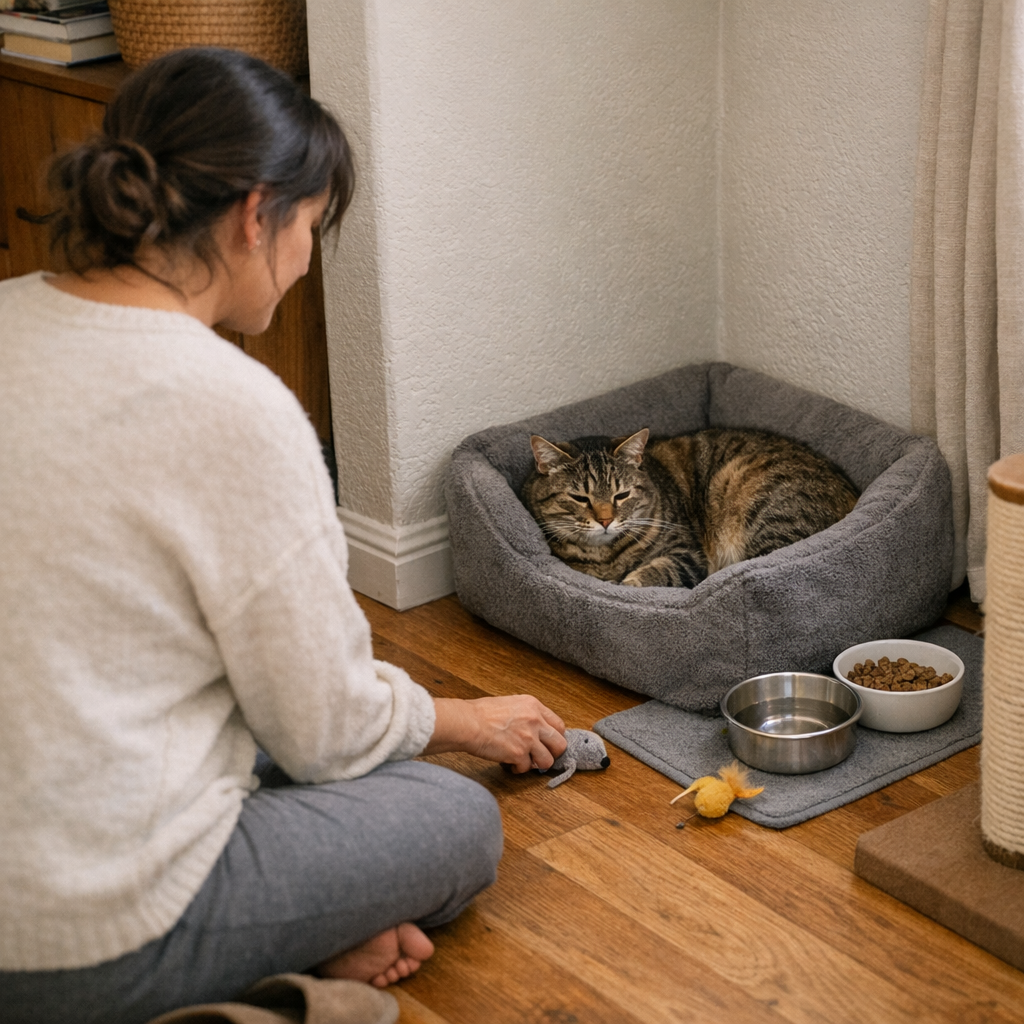
The “perfect” cat rest spot has a shelf life. That plush box or calming mat looks solved for about a week—until the reality of feeding resets, spilled water, midnight dashes, and repeated cleanups corrupts the quiet. A bed in a tidy corner always looks good on day one, but real use—with hallway traffic, uneven routines, scattered toys, and persistent fur—unravels that order fast. The most repeated pain points? Bowls tipped off the mat after a startled exit, a toy disappeared beneath the couch for the third day running, and a thin coat of fur collecting near doorframes no matter how often you sweep. Looking organized is no guarantee that the work is actually over. StillWhisker’s setups may blend in, but only if you get the location logic right from the start.
When “Looks Settled” Isn’t the Same as “Stays Tidy”
Most cat owners don’t spot the real problem until it’s routine. Each night you straighten: water bowl back in line, mat edge uncurled, stray toy hunted from under a radiator. But by morning, fur is already dusting the baseboards and the bowl has inched outside its zone again. There’s rarely a dramatic “mess”—just relentless, invisible resets. Every seemingly settled space is hiding extra labor: piles to wipe, edges to refit, bowls to nudge, and missing toys wedged out of reach. The work keeps coming back because visual order doesn’t guarantee a friction-free setup.
The surface may look calm, but maintenance habits keep surfacing underneath. That’s the trap—with rest zones deployed along busy walkways or near noisy rooms, you spend more time in low-grade upkeep than you realize. It’s not the product failing; it’s the room exposing the weak point, again and again.
The Abrupt Exit Chain Reaction
Nothing unravels a cat’s rest area faster than being startled. One clang from a pot or a family member rushing through the hall is all it takes. In a second, you get a high-velocity bolt straight out of the bed: bowls scraping out of place, mats bunched, toys launched into never-seen gaps, and fur drifting into every crevice. It never feels catastrophic in the moment, but a week of repeat dashes turns your “reset” routine into chasing tiny undoings—re-centering bowls, flattening mats, retrieving toys from impossible angles—rather than real cleanup.
Real-life pinch point: Picture after-dinner kitchen clean-up. You clatter cutlery, your cat—previously curled in a box near the archway—rockets away, jolting water out of the bowl and delivering her toy mouse three feet behind a shoe pile. Multiply that by five nights and the cost in constant micro-corrections adds up. These aren’t dramatic disasters, just the real texture of indoor cat routines.
How Everyday Routines Expose Setup Weakness
The slip shows up slowly at first—every abrupt exit leaves comfort undone and the setup half-unraveled. Night after night, the same clutter patches appear. Blame falls on the cat or the products, but the true culprit is usually placement: the intersection of your cat’s zone with the rhythm, noise, and movement of daily home life.
For example: Is that corner catching fur at double speed? Are you excavating the same three toys from beneath the radiator, thanks to near-nightly dashes out of the rest area? Has the water bowl migrated again, needing a wipe beneath it because an edge slipped off the mat? All of these hint at a rest spot that “contains” the mess, but simply moves the repeated work around. It fixes nothing unless it makes resets easier too.
Why Rest Zone Location Matters—More Than the Bed Itself
Placement trumps design—every time. Even the comfiest cat box, plopped right beside the living-room traffic lane, becomes a chore generator. If it sits within easy range of family steps or next to a fridge’s daily rumble, you can count on frequent startle-outs, bowl tip-overs, and toys scattered out of reach. Fancy bedding helps nobody if the location keeps throwing the cat back out.
Matched colors and smooth mats may photograph calm, but unless the area is buffered from sudden entrances, appliance noise, and social bursts, entropy wins. The rest area “looks settled” but becomes a site of invisible daily repair—repeated realignment, endless toy rescue, and recurring wipe-downs. It’s not a bedding function failure. It’s exposure, amplified by use.
What Real Fewer Startled Dashes Feels Like
Small layout changes change everything. Shift the rest spot out of the walk zone. Give it two solid backing walls and only one open front. Keep line-of-sight to main activity low, and buffer out the clang and chatter from kitchen or family space. The difference shows in a week:
- Mats stay in alignment: no more nightly edge-flattening.
- A single toy gets lost all week, not a fresh search party every cleanup.
- Fur and water scatter are down when you reset—fewer traces to wipe or sweep.
When a raised box edge absorbs panic motion, the boundaries hold steady, and your routine resets become quick—no more kneeling for ten minutes rescuing toys. The net effect: comfort isn’t just visual, it’s operational, and the repeated work drops away.
Placement Versus Product: What Actually Changes Your Routines?
Changing the bed—even upgrading to a fully enclosed dome—won’t banish micro-mess if the spot is poorly placed. Some cats favor a low wall in a shielded nook. Others want just enough visibility for comfort—never full exposure. But no enclosure or padded surface eliminates chain-reaction chores if dinner clangs, hallway parades, or open doors keep triggering fast exits and scattered clutter. High-spec products won’t cancel out a setup that lives underfoot.
Poor placement multiplies chores. If you’re refitting mats, chasing bowls, and collecting toys four or five nights a week, stepping around a “solution” that lives in the problem zone, the fix isn’t a product swap. It’s moving the setup out of the crosshairs of daily disruption. Labor signals structure weaknesses.
Signals That Setup Location Isn’t Quite Right
- Toys appear in new, distant spots each time the rest zone is disrupted.
- Mats or bedding require repeated reshaping after sleep, play, or guest visits.
- Fur tracks develop along the same walls right after noise spikes or movement.
- Water bowls stray from their original spot, always after a rapid retreat.
- You find yourself nudging the setup back into position multiple times a week.
These aren’t marks of a messy cat—they’re structure errors revealed by your real routines. No home is immune, but tolerating slow-drip busywork just because an area “looks fine” is optional. Placement tweaks pay off in minutes reclaimed, not just a cleaner look.
Making a Rest Spot That Holds Up: Practical Adjustments
The endless reset cycle is rarely about mats, boxes, or bedding—it’s about whether the designated spot can actually survive normal disruption. What shifts the balance?
- Pull the box out of foot traffic. Even slight shifts away from main walkways reduce stress to both cat and setup.
- Use real corners as defense. Two walls give both protection and predictability—less chance for surprise means fewer upsets.
- Limit open sides. One approach line lowers the cat’s stress and the odds of scattered flight.
- Audit appliance proximity. Silent fridges and dishwashers get noisy at the wrong times and spike outflows or bed exits.
- Time your own reset. If you can’t clear toys or straighten mats in a minute, the arrangement is blocking as much as it’s helping.
Each room lands differently. But the real sign of success? Reset time shrinks; annoyance fades. Placements that genuinely reduce repeated chores—not just mask them—are worth the adjustment. Product only wins if structure lines up with your real traffic and cleanup flows.
Competing Needs: Cat Comfort vs. Human Room Use
Compromise is constant—owners edge beds closer to human paths so cats feel connected, and inevitably trade away calm for convenience. Week after week, that “included” box ends up the silent source of more shed fur, nightly toy retrieval, and unfinished sleep. Shared spaces always look a bit neater with everything in its place, yet only the right location leads to fewer invisible chores behind the scenes.
If your clean look costs daily maintenance, reconsider how comfort and function are separated—or aren’t. The goal isn’t pretty calm, but a setup that nearly disappears from your routine. The best signal is the one you stop noticing, because your day isn’t shaped around little interruptions.
When to Rethink: Signs It’s Time for a Placement Reset
Some signals you shouldn’t ignore:
- Zones that “look fine”