
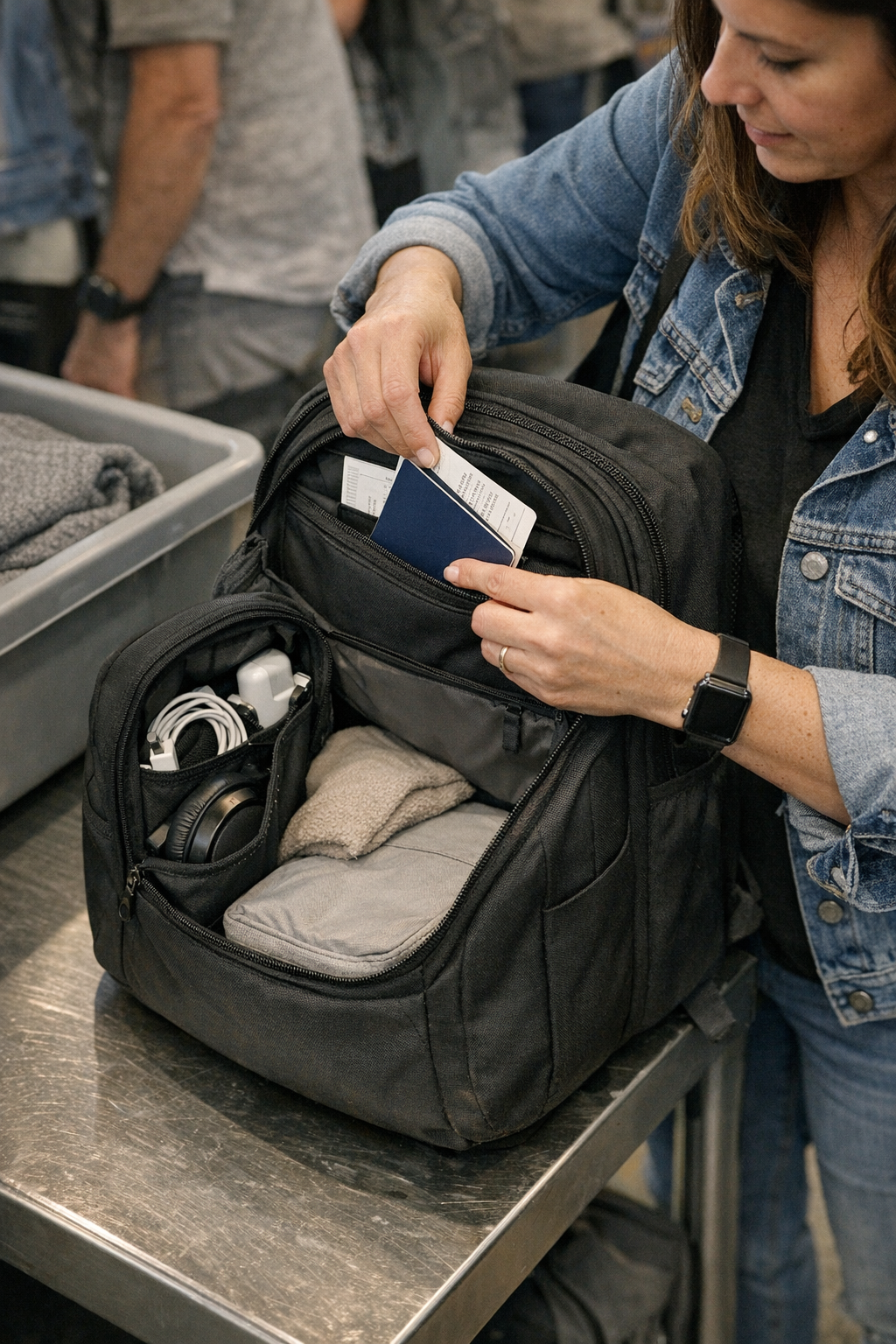
The real test isn’t at home—it’s in motion: Your carry-on might look sorted the night before, pockets zipped, cubes aligned, everything with a home. It feels under control right up until you step into the airport. That’s where neatly packed turns into slow-to-use—where you reach for your passport at security and instead fish out a charger, or unzip one pouch too many before finding your boarding pass, with the line behind you growing restless. The friction isn’t about laziness; it’s about how an “organized” carry-on collapses under repeated, real-world travel routines. The difference isn’t just visual—it’s whether your bag lets you move, reach, and repack at airport speed, or traps you in its own tidy grid the moment you need something fast. This gap is where nearly every carry-on setup—no matter how sharp it looks—starts to fail or succeed.
When “Organized Enough” Isn’t Actually Enough
Frequent flyers know this pattern: At home, packing makes sense. But when the boarding line lurches forward, you’re suddenly squinting at zipper pulls, feeling for IDs while phone charging cables tangle between fingers. What seemed smart on the bedroom floor—the pouch layout, the all-in-one organizer—falls apart when seconds matter. Grab the wrong zip, dig an inch too far, shuffle through tech gear that’s drifted into document space, and now you’re blocking the flow.
This isn’t about not caring or planning. Travelers invest effort for that Instagram-order shot, but on the airport floor, movement—not appearance—matters. The moment routines speed up—tray offloading, doc checks, in-seat prep—an “organized” setup exposes its weak points: items lost to overlap, pouches that resist quick return, and small mistakes that repeat on every segment.
The Trouble with Overlap: Real-World Scenarios
Security Checks Change Everything
Security trays reveal design failures fast. Try pulling your laptop from a side pocket—only to yank out a clump of charging cords and a power bank. A jacket snags on the tangle. Suddenly, you’re side-stepping to re-coil wires, blocking the belt, wishing you’d sorted tech away from documents. Every second spent untangling, nudging snacks aside, or flattening a boarding pass that’s bent under headphones is a consequence of categories crossing in your bag.
Boarding Lines: Underestimated Pressure Zones
Boarding feels routine until you need your ID again or the flight attendant asks for your boarding pass on the jetway. If those essentials share space with snacks, receipts, or stray pens, extraction turns into a minor performance—quickly searching while balancing what not to drop. The rest of the queue is waiting, and your “compact” organizer is actually forcing another slow scene every time your item isn’t at hand.
Seat Entry and Overhead Bin Moments
Think your bag is streamlined? Now you’re stalled in a tight aisle, craning to reach headphones or a pen—yet a clothing cube blocks access. Forced to pull the bag down, unzip, and rummage, what looked efficient at the hotel becomes a seat-side bottleneck, with each “quick” access followed by on-the-fly repacking and disrupted order. A setup that packs neat but overlaps categories guarantees you’ll feel this drag two, three, or ten times per trip.
Why Looking Organized Isn’t the Same as Moving Smoothly
Perfect at rest, failed in motion: pouches seem aligned, cubes stack sharp, but repeated use exposes the flaw. By the third retrieval, overlaps—boarding passes fighting headphones for zipper space, slim organizers blocking key paths—start grinding your efficiency down. Each attempt to grab an essential becomes a repeat interruption. The bag’s main problem isn’t volume, it’s friction at pressure points: the exact pocket where charger wires invade the doc slot, or where stowing a pen interrupts document flow every time you shift terminals.
Simple Fix: Assign Clear Zones for High-Frequency Items
Real trips prove one upgrade works: clear, category-based separation for every essential. That means:
- One zipper pocket for travel documents—passport, ticket, ID—completely free from tech gear invasion.
- Side pockets or soft dividers dedicated only to cords, chargers, and headphones, away from paper or snacks.
- Comfort and medical items corralled in a labeled pouch or obvious divider, never mixed into fast-access panels.
Obvious? Maybe. But the change is measurable: when zones stay single-purpose under repeat use, grabbing or returning an item becomes a reliable, two-second motion instead of a decision every time. No more restoring order after every tray check. No more quiet unraveling after each “quick” grab. When you refuse to stack categories, retrieval pace climbs, mistakes drop, and the bag keeps its order even when you’re rushed.
Packing Tactics That Stand Up to Real Trip Cycles
Start Before You Leave Home
Assign zones before you go. Handle the items you’ll reach for in transit—doc, pass, device, pen—each gets an uncongested pocket. Use outer zones for only these, never tech or comfort items. Avoid creeping overlap from last-minute changes or just-in-case stashing.
Limit Each Pocket to Its Most Critical Use
Packing to the max often means pockets end up as catch-alls. Don’t. Give one slot only to what triggers the most routine checks—a passport and pass together beat a confused pile of “maybe useful” stuff that only gets in the way when time is tight.
Stay Honest During the Trip
Mid-trip chaos tempts shortcuts—a charger shoved in with your documents, a pen landed atop your tickets “just once.” These blurs create ongoing drag: what’s quick now causes future fumbles, turning your system into a slow-ticking mess. Strong separation rewards you with self-correcting order; blurred lines multiply costs every time the airport routine starts over.
Small Adjustments, Noticeable Results
Here’s what changes on a real trip: Security done, you drop a passport straight back into a top slot—done, no reshuffling. You reach for headphones before seat entry—they’re where you expect, no cubes to unpack. Every “just a sec” stop vanishes because zones hold their own. Packing order isn’t just protected, it advances: the bag becomes easier to handle each time instead of slipping into miniature chaos after each access.
The surprise? Cleaner separation rarely feels dramatic at first, but within two or three pressure cycles, your bag works faster, your hands land where they should, and you stop dreading routine checks. One category, one pocket—it’s a small adjustment, but for carry-on travelers, it’s the difference between fighting your own order and actually gaining speed in real airport flow.