
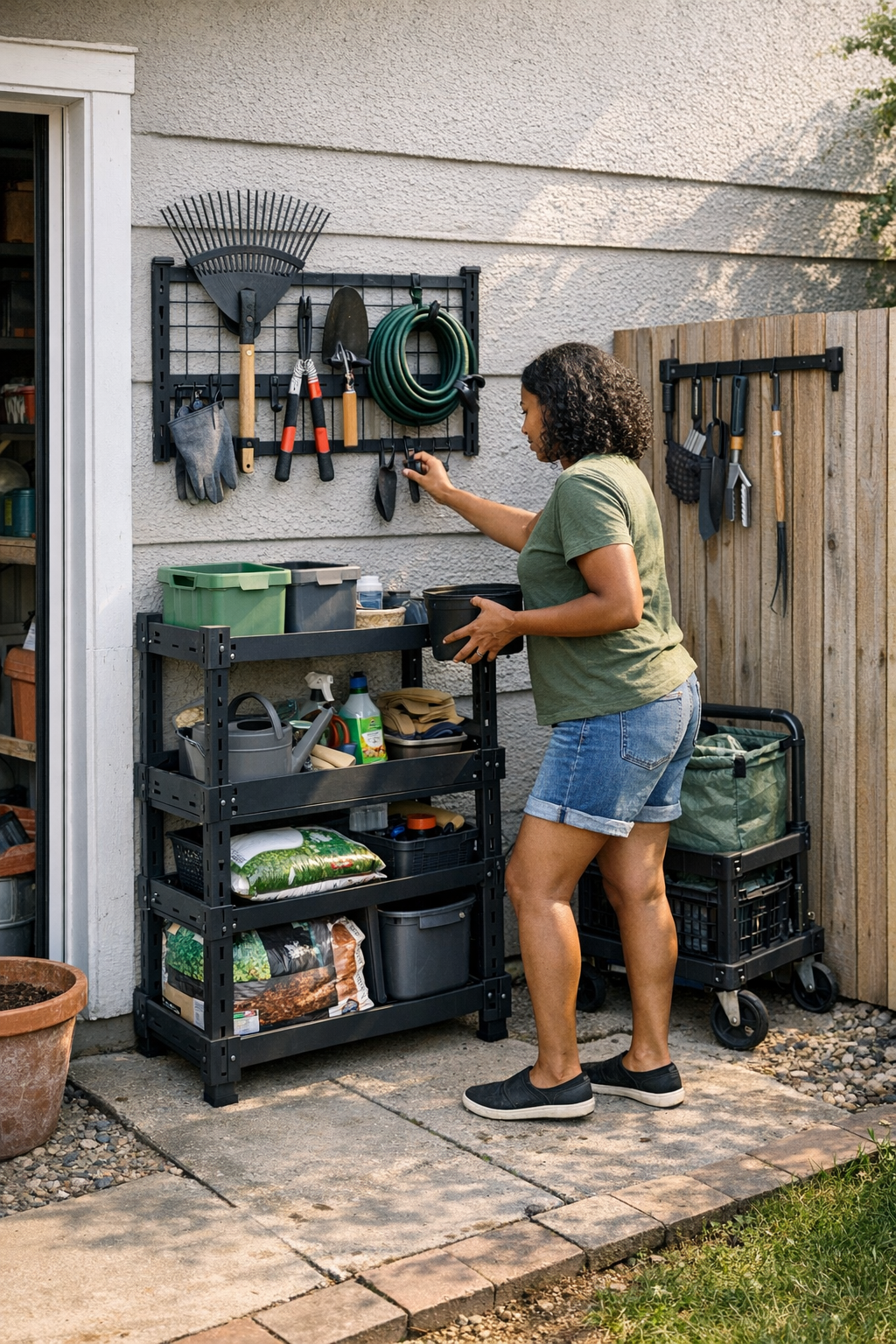
The satisfaction of a freshly organized deck box or storage bench is always short-lived when real life returns. That neat little setup by the back gate, along the garage, or wedged into a patio corner will pass the “looks good” test for exactly one rainstorm, one busy Saturday, and three half-finished projects. Then the cracks show. Now the “organized” space is stalling you out—tools clatter under pool floats, garden gloves pile up against winter salt, bin lids need prying, and suddenly getting one thing means moving three. What used to feel under control now feels tight and slightly sabotaged, like the storage is quietly running out of patience before you do.
The Subtle Shift from “Organized” to “Obstacle”
The problem never announces itself: it just creeps in. Three weeks of normal Saturday yardwork and the walkway is narrowed by an “extra” tote, the garden bench traps the trash bin, and that fence-line chest becomes landfill for every “just this once” drop-off. This isn’t random mess—it’s the slow, relentless friction of storage that doesn’t adapt. What looked smart for a static photo becomes a speed bump in actual use, making you reshuffle and route around your own setup with every visit.
The bins and boxes aren’t failing—they’re just building in resistance, step by step. Every time you “just put away” one thing, it blocks something else. Deck boxes become a game of unpack-the-closet. Wall rails become clutter displays nobody touches. Over time, you don’t beat clutter—you just reshape its path, letting it rebound in new corners and behind new lids. Daily movement gets slower, more awkward, and subtly more annoying, even if the space still looks fine from the patio door.
Where Good Setups Break Down: Real Moments in Outdoor Storage
Retrieving One Tool Blocks Access to Another
You step onto the deck to grab a hand pruner—simple. Except the pruner is under a tarp, squeezed beside three gloves and last week’s hose. You dig, dump, and finally unearth it, only to realize you’ve started two new piles outside the box. Routine chores become minor projects, and in a few days, unused tools stay out just to skip the hassle. The “system” works—if you never change it or rush it.
Wall Space: Used, But Not Always Useful
Wall racks arrive looking efficient, but if half the hooks are behind the storage gate or set above your line of sight, they quickly turn into untouchable displays. The gear you actually use—pruners, loppers, sturdy gloves—drifts right back to chairs, steps, and door handles. The grid promises easy access, but if you need to dodge a ladder or rearrange hanging tools for one rake, the wall is just another obstacle, not a solution.
Overflow Finds Its Own Zone
Every setup has that inevitable overflow zone—the patio’s awkward far corner or the trunk of concrete behind the compost bin. It’s where “just for now” piles live indefinitely, where folding chairs and sand toys linger after a storm, and where bins dragged away from the main path quietly become permanent. Once overflow claims a spot, gear leaks out along the fence line and piles start rerouting traffic—dead space breeding more dead space.
When the Layout Interrupts the Routine
True frustration builds when storage asks for more work than it saves. Returning the trimmer shouldn’t mean rolling back a storage bench. Putting away the hose shouldn’t force a deck box reshuffle. When resets demand extra steps, even small ones, your outdoor routine unravels: tools stay out, hoses snake through footpaths, gloves pile up on any chair within reach. It’s not neglect—it’s a layout that never matched your pace in the first place.
Give it a season and you spot it everywhere: there’s a fence chest on week one, but by July, the fence line is a parade of bikes, tools, and leftover planters. The piece that “fit perfectly” now asks you to slide, lift, and nudge just to reach what you use daily. Each return becomes a detour.
Designing for Access, Not Just Appearance
The Value in Open Storage and Smart Walls
Deep deck boxes and closed benches promise to contain mess but often become the black holes that create it. Open shelving or wall grids look busier but keep your essentials both visible and instantly reachable. These setups aren’t showroom pretty, but they spare you from routine obstruction: grab, store, done—without reorganizing half your setup just to return a pair of pruners.
When high-use tools live on a slim rail at standing height, you move right through the job—no bin unstacking, no puzzle-box resets. A mobile caddy that rolls out beside you and tucks instantly away can keep project clutter from trailing into every yard corner. On busy days, these choices determine whether a quick trim is a ten-minute chore or a drawn-out session wrestling with your own storage.
One Thing at a Time: The Rule for Reset Speed
If your storage setup demands three moves for every return, it isn’t built for actual use. Retrieval and return should mirror each other: one grab, one drop, zero rearrangement. Wall hooks at arm’s reach, bins shallow enough to see everything, and modular trays that prevent over-stacking all speed up the flow. Anything that tacks on extra steps will quietly start collecting “waiting-to-be-put-away” gear—and that’s how setups fail, even if they never technically run out of room.
The Real Test: Return Flow
The difference between a space that works and a space that nags is never the first week—it’s the fifth evening in a row when you have to cram in a fast cleanup or reset. The best setups bend to unpredictable routines: spring mulch days, late-evening tool drops, gear trashed by rain, last-minute tidy-ups before guests. They keep footpaths clear, push overflow back to the fringes, and make tidying as simple as tossing gloves on a hook or rolling the caddy out of sight.
Watch for this pattern: If the same item lingers out three times in a week, your storage isn’t the problem—you’re just being honest about how much work it asks. Move high-use gear to grab-and-go positions: eye-level pegs, easy side rails, shallow bins. Save the closed bench or deep box for things you rarely need—holiday lights, rainy-day tarps, backup hoses. Let your flow shape the storage, not fight it.
When Setup Matches Routine, Outdoor Work Gets Easier
The goal isn’t flawless order or magazine-cover neatness—it’s a setup that forgives the blur of real outdoor use. You’ll still find a spatula on the fence post or a stray trowel on the patio, but you won’t have to wrestle your own system just to put things away. Strong setups don’t eliminate clutter; they shrink the effort required to reset. The real win is a space where outdoor projects stop feeling like a battle against your storage, and tomorrow’s reset still feels possible—even after the busiest day.
Find practical ways to build outdoor setups that can actually keep up with you at TidyYard.