
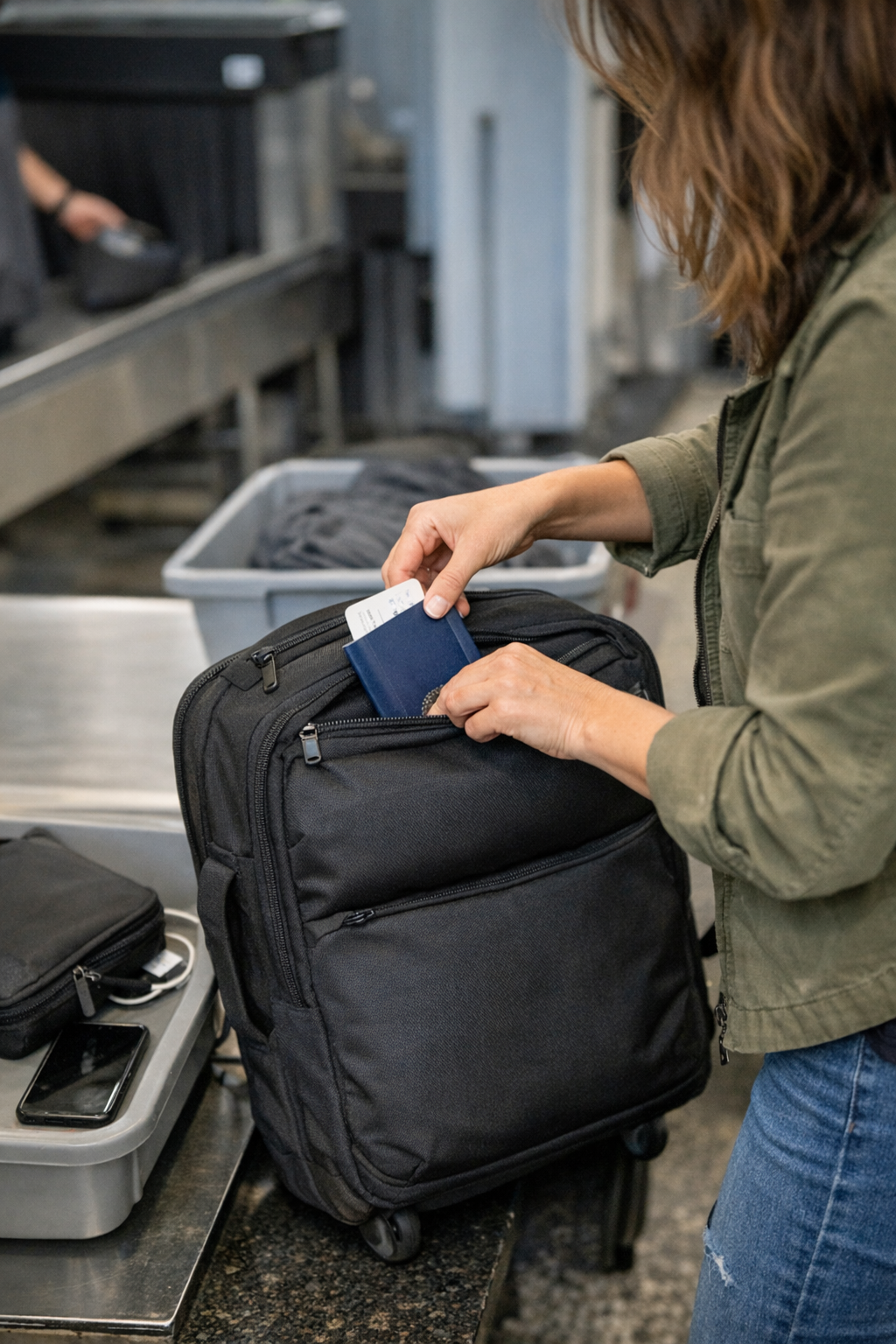
What slows down carry-on travelers isn’t usually baggage weight—it’s design friction, especially when time or movement matters most. Zip a bag perfectly before the trip and everything looks in order. But as soon as you start moving—security lines, sudden gate changes, crowded boarding—small delays pile up. Instead of a confident pass through security, you’re stuck wrangling tangled zippers, shifting out-of-place pouches, and searching for boarding documents lost under layers. The bag that seemed so “ready” in your hotel room can unravel the moment you’re forced into repeated access.
When “Organized” Isn’t Fast: The Trap of Visual Tidy-Up
It’s easy to mistake neat packing for good travel flow. At security, you reach for your ID, only to realize it’s pinned under power cords and snack packs. A single document pull turns into full-bag shuffling with stressed eyes behind you. That organized grid of pouches means nothing if it scatters on the first tray, or if you spend every checkpoint re-stacking items that should’ve been instantly accessible.
Well-packed doesn’t always mean well-designed for movement. Most carry-on plans work until you need speed: pulling out a passport at a gate, checking a ticket in a crowd, or grabbing tech before the tray hits the belt. The weakness isn’t cosmetic—it’s in how many steps it takes to extract a single item.
The Subtle Slowdown: Micro-Delays Add Up
Every time you fumble for a boarding pass buried under travel gear, you’re feeling a flaw in your carry-on’s logic. The problem isn’t obvious after the first quick search—it builds up with each terminal and checkpoint. After a layover, you find yourself hesitating, double-checking pockets, and shuffling items around every time you need something small. Multiply that by four or five “quick” retrievals, and the lost moments break your flow, forcing you to reset your bag mid-journey instead of breezing through.
Security Trays: Where Packing Choices Are Exposed
The airport security tray exposes the difference between quick-access setups and slow, “tidy” ones. If your passport or laptop hides behind pouch layers and secondary zippers, each check becomes a minor project. Remove an item, rearrange, fight the zipper, and repack—there’s a visible strain as the line moves. The cost isn’t a dramatic scene; it’s in the repeated small slowdowns and the uncomfortable sense you’re falling out of step with everyone else.
Gate Waiting and Boarding Lines: Retrieval Under Pressure
Boarding lines highlight the weakness of “nested” packing. When travel documents or headphones are stuffed beneath other layers, you can end up digging around while others press forward. With every extra unzip or accidental spill, your packing starts working against you. The crowd feels tighter, your motions get more frantic, and what started as “plenty of time” shrinks to “hurry up.” That slowness is not an illusion—it’s the result of setup habits built for appearance, not movement.
Overlapping Compartments: The Hidden Projectors of Delay
Stacking multiple pouches or stuffing everything into layered zones seems efficient, but these overlaps become friction points. The impact is subtle but constant: every reach for a document means disturbing tech cables, snacks, or unrelated gear. You’re not just accessing—you’re clearing obstacles. The bag looks sorted, but its structure interrupts you again and again at each checkpoint and boarding squeeze. Each disturbance adds mental drag, turning every “quick step” into an avoidable slowdown.
One-Step vs. Multi-Step Retrieval: The Deciding Factor
The real shift happens when travelers dedicate a one-step route to their essential items. A single, immediately reachable outer pocket makes passports, boarding passes, or key tech easy to grab—no digging, no detours. This isn’t about adding more pouches; it’s about separating high-frequency items from anything you won’t touch until arrival. When you can unzip, retrieve, and reclose a pocket in one motion, your bag stops being a bottleneck. Routine checkpoints go faster. Repacking is minimal. You spend less time reconstructing your bag and more time actually moving through the airport sequence.
The improvement sneaks up: after only one or two trips, you stop asking, “Where did I put that?” and simply act. No more reflexes wasted on re-organizing. The tension in line fades, because you trust the setup and the order holds under pressure.
Real Repeated Use: Where Tidy Structure Crumbles
Carry-on systems reveal themselves over repeated use, not on the first run. The pristine “order” of your first segment unravels after the third security check or boarding hold-up. Fatigue creeps in, crowds thicken, and a well-laid row of pockets ends up jumbled. Repeated adjustments aren’t just annoying—they underline that visual order can’t substitute for access during present-moment travel. Rushed repacking, tiny misplaced items, or a buried pouch all become headaches that multiply over the course of a single day’s travel.
Carry-On Access in Tight Spaces: Aisles and Overhead Bins
Nothing exposes setup faults faster than trying to get your earbuds or wallet while blocking the plane aisle. One zipper stall turns into holding up boarding; grabbing from a shared pouch tips the whole bag. The inconvenience isn’t just lost seconds—it’s the uneasy attention of others, the awkward angle of lifting a bag from the bin, or fumbling for a hidden compartment under pressure. As trips stack up, these aren’t isolated blips; they’re recurring signals that your system isn’t handling real movement well.
Reducing Friction: Design for Movement, Not Just Storage
Reducing travel friction means building your carry-on setup around transit, not only storage. The most consistent fix is a truly separated, external pocket or document slot just for high-frequency items—travel documents, IDs, phone, headphones. Assigning each critical item its own direct-access space (and refusing to stack unrelated gear within) streamlines every phase: security, gate boarding, seat entry, and hotel arrival. No split-second search under pressure. No accidental mixing of snacks, chargers, and passports. Each motion is simpler, faster, and doesn’t require a mental repacking reset after use.
This isn’t about shrinking your packing list or adding organizer after organizer. It’s control by subtraction: fewer access layers, no overlap, and a setup that flexes for movement—not just for looks. Every time you move, the bag delivers exactly what you need in the order that you need it—minimizing those familiar, friction-filled moments with each trip segment.
The Practical Payoff: A Bag That Moves With You
Switching to a purpose-built, quick-access outer system reveals its value within a single airport run. Documents pulled without unlayering, zippers running without jams, and every repack needing just a single motion. Even as schedules change or crowds grow, your setup holds. The real gain isn’t a still-life of “perfect order.” It’s not losing your rhythm—resetting from each access without breaking stride, keeping your head in the journey instead of in the bag.
The best proof: momentum. Travel routines repeat, but the delays don’t have to. By making smarter setup choices, you skip the mistakes—micro-repacking, buried pouches, traffic-jam zippers—and build a carry-on that actually supports in-motion travel, not just storage on a bed.
Visit CarryOnSupply for practical travel tools designed for real carry-on movement.