
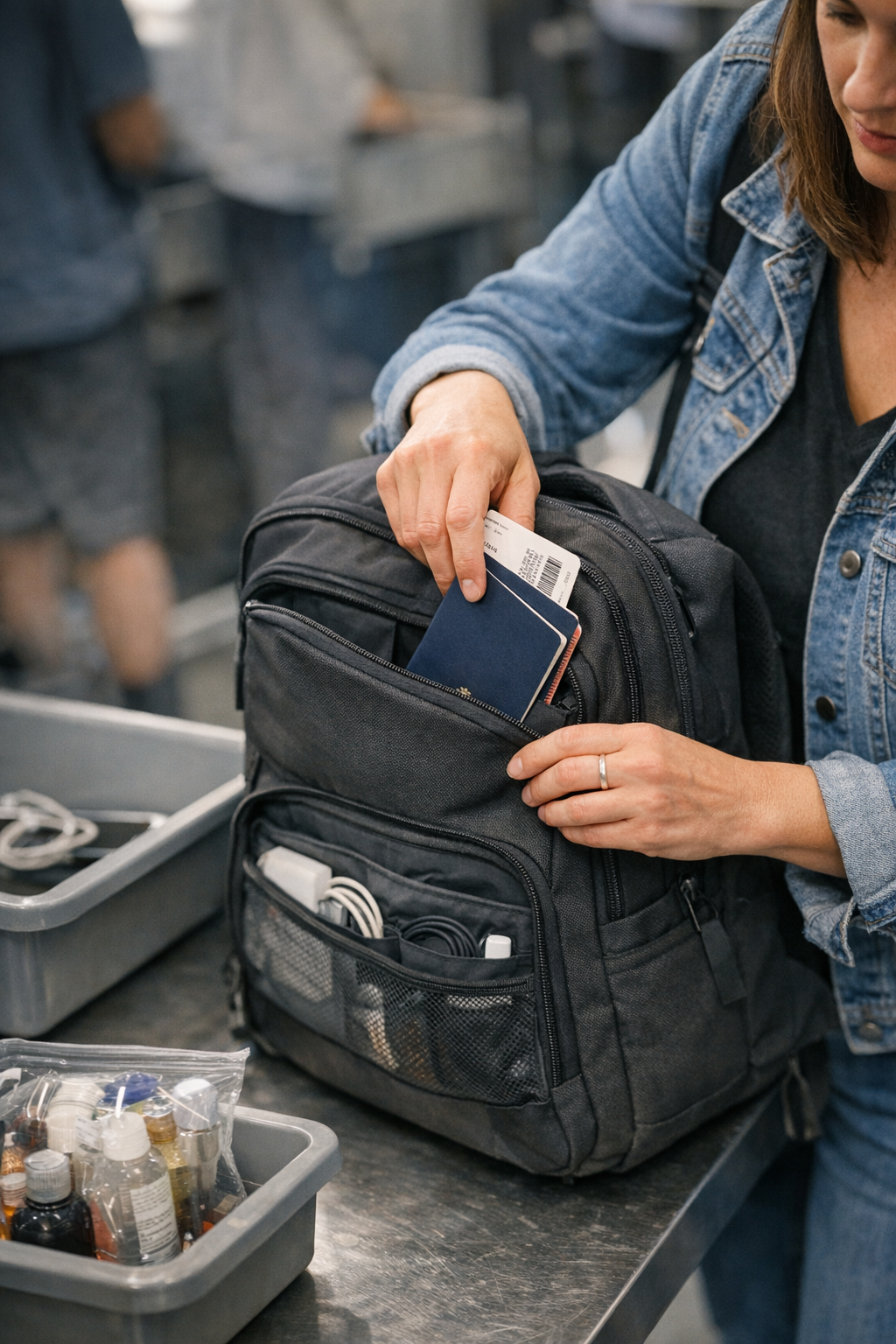
The warning sign your carry-on isn’t built for real travel doesn’t start with scattered mess—it hits when you freeze at airport security, digging for your passport as the line grows impatient behind you. What looked “sorted” at home—documents tucked, chargers zipped, everything squared away—suddenly unravels the first time you’re pushed forward in a crowded queue. One move to retrieve your boarding pass pulls a tangle of cables with it. That outer slot you trusted swallows your ID behind a power bank. Travel order collapses, not in a pile, but in moments: each repeated reach slowed by something always one pocket deeper. That’s when the divide appears—organized on your bedroom floor isn’t the same as friction-free in the airport fast lane.
When ‘Packed Neat’ Fails Under Pressure
Your bag may still look composed—pouches zipped, pens slotted, toiletries sealed. But by your third TSA checkpoint or second gate change, every illusion of order is stress-tested. The first snag is minor: a document hidden under toiletries, a charger blocking your one-move passport pull. But velocity matters in an airport; tiny delays stack up. Each forced unzip and re-pack after fast retrieval leaves you repacking the whole section, all while gate agents and other passengers close in behind. You repeat a simple pattern—grab, fumble, reshuffle—revealing how little “at rest” order matters compared to in-motion access.
The Real Source of Travel Slowdown: Blocked Access
Chaos rarely overtakes travelers; blocked access at a crucial second is the real enemy. A carry-on that looks streamlined sitting still can break down the moment you need one thing quickly. Consider where it goes wrong:
- Lifting your bag to the overhead bin, you suddenly realize the headphones you need are trapped under a jumble of tech cables.
- In a moving boarding line, retrieving your boarding pass means unzipping two sections and holding up everyone else.
- At security, TSA signals you to remove liquids, but they’re sandwiched below layers in a deep pocket—forcing a full unpacking on the spot.
- Mid-aisle, you’re asked for ID, but it’s barricaded behind snacks and chargers—so you block the aisle, emptying pouches onto your seat.
These aren’t dramatic meltdowns. They’re subtle, endlessly repeated. A neat internal layout falls apart the fourth or fifth time a document is called for—each cycle adding a layer of low-grade frustration. The drag isn’t about visible disorder. It’s about small, accumulating barriers that never clear up on their own.
What Actually Fixes Travel Flow?
Airport-proof setups put one-move access above tidy visuals. The most functional change isn’t a new bag—it’s rethinking how you lay out what goes where, based on real travel flow.
Use frequency, not just category, to guide item placement. Anything you need in line—passport, ID—deserves an exterior spot reachable without unfolding your whole setup. Chargers and tech cables go in their own clearly marked pouch, not layered with boarding passes or hotel printouts. Liquids live at the very top or in a side compartment, always two-finger reach from a half-zip. This does more than cut time—it pulls friction out of the system by keeping every quick-access item clear of lower-use stuff.
Visible Difference: A Carry-On That Lets You Move
On a recent multi-leg trip, a small structural change re-wrote my entire flow: the outermost pocket held only documents and ID, nothing else. Chargers went clipped inside a side pouch. Every boarding pass stayed visible—never buried. When the gate changed, reaching my ticket required just one zip, no digging. Four boarding checks later, I hadn’t once had to reshuffle cables or fumble for ID while shuffling down the aisle. Each re-pack was a reset, not a full reset: a move back, not a hunt for lost order.
The Unseen Tax of “Shared Space” Packing
All-in-one pouches—a catch-all for everything from headphones to sanitizer—promise less mess but deliver more interruption. At security, if pulling a boarding pass also means shifting a power bank and a toiletry kit, every check multiplies into a multi-step fix. In your airplane seat, getting your headphones without dumping snacks and chargers becomes a balancing act that frays patience. These overlaps announce themselves through friction—revealed only when access happens in repeated, time-pressured cycles.
The Trap of “Looks Sorted” but Uses Poorly
An organizer that holds everything neatly in place deep down the main compartment doesn’t automatically earn its keep. If every retrieval requires undoing a puzzle—and you notice yourself repeating the same dig-and-repack pattern before every gate or check—you’re not saving time, you’re just hiding your frustration under layers. A single slim pouch for high-frequency items delivers better flow than a beautifully ordered, over-compartmentalized bulk pouch you rarely open without chaos.
Small Adjustments that Reveal Big Payoffs
Improving your travel day flows starts with main pocket assignments: outer pockets purely for reach-often items (passport, ID, tickets); interior areas for only those things you need once or twice; and iron walls between tech and travel docs. After a few trips, new patterns show up—like needing your charger out in the gate or your ID at three different hand-off points. The right packing order places those things ready to be grabbed, not hunted.
One practical change: use two separate, shallow pouches for tech and toiletries instead of relying on a single deep well. Smaller, dedicated spaces keep everything anchored. When security asks for your liquids or you want your charger for a quick top-up, you don’t risk spreading other items across the airport floor or burying tonight’s hotel confirmation under last boarding’s snack bar.
Test Every Setup Through Real Airport Moves
If you want to know if your carry-on actually works, forget how it sits at home—focus on transition points: pulling it down for bin check, unzipping with one hand while queued, accessing the right slot with people pressing behind you, recapturing your passport in a packed aisle mid-flight. The first time you notice retrieval getting slower or returning items makes other things harder to access, your bag has found its pressure point. Good structure proves itself not by avoiding visible mess, but by keeping friction out of every repeated move and every forced repack during your travel loop.
The real test isn’t how your bag looks before you leave—it’s how much it lets you move, reach, and reset without losing flow the fifth time you’re asked for a document or the next tray transfer hits. You don’t need the perfect organizer. You need a structure that lowers interruption and delivers easy access in the airport, on the plane, and after landing—trip after trip.
Visit CarryOnSupply for practical carry-on travel tools and solutions