
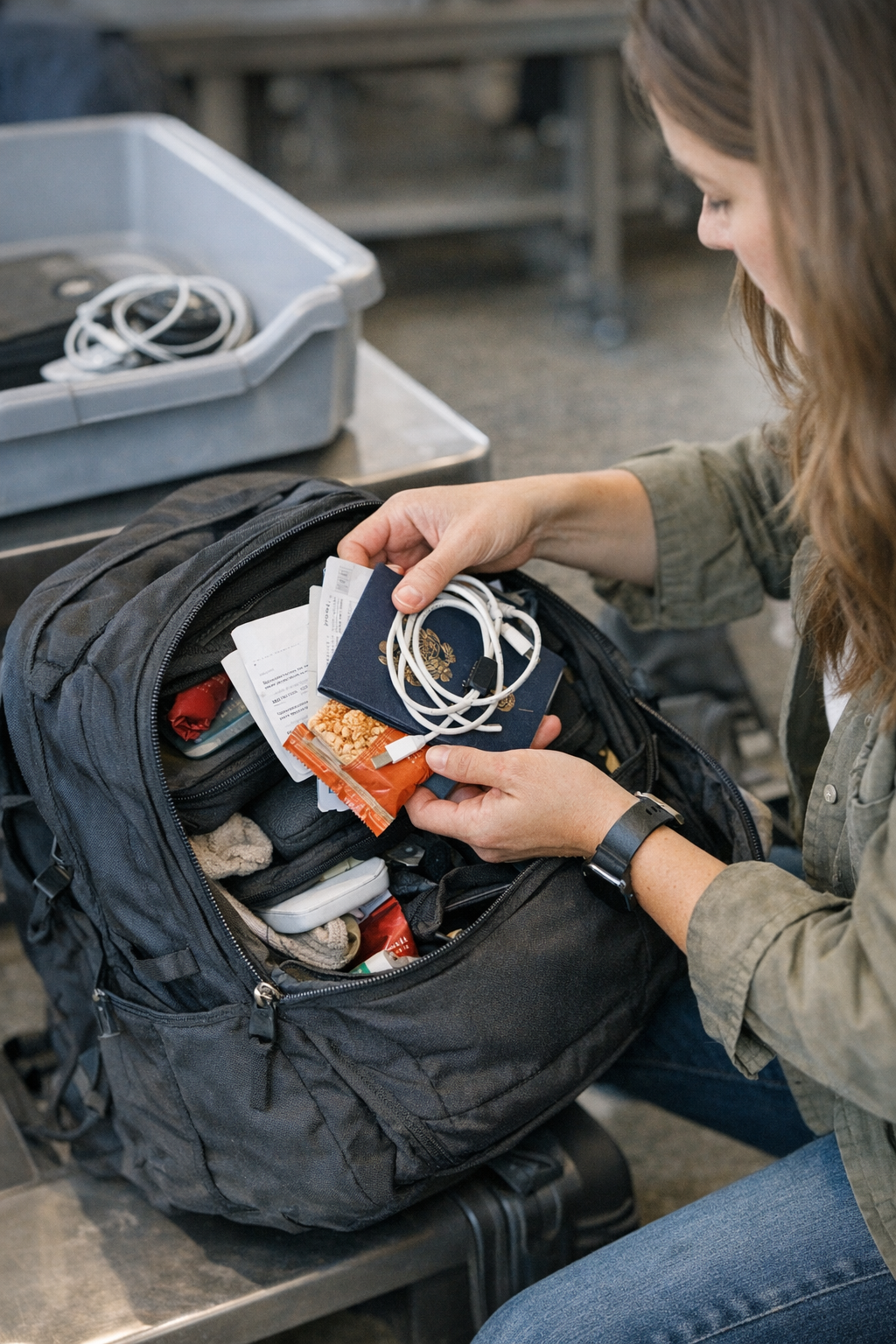
The difference between a carry-on that works and one that just looks organized shows up in real airport movement, not on your living room floor. Many travelers mistake tidy compartments and lined-up packs for true readiness—until their first security line exposes how slow “neat” can be. That careful packing routine breaks down fast when you’re reaching for a document that’s shifted, opening the wrong pouch mid-rush, or digging past snacks just to get at your charger. What looks under control at home often becomes a repeated hassle the second travel friction starts.
Why “First-Glance Order” Fails When You’re Moving
Most travelers don’t lose momentum due to visible mess—they get slowed by hidden friction. A bag that looks squared away invites confidence, but the first test—boarding pass check, snack grab, charger reach—reveals the design’s weak spots. At every step, you dig past something you didn’t mean to move. Pouches slide out in the wrong order. Headphones emerge with pens knotted through their cords. And when someone behind you in the queue starts shuffling, each second lost to bag confusion feels more costly.
Familiar signs the structure is failing: pulling a pouch for headphones and finding receipts instead, dropping travel documents deeper while reaching for gum, or misplacing your ID beneath loose chargers. These small stutters add up—especially when you’re squeezed between other travelers, hustling to clear a security tray, or ducking into a tight seat row before the last call.
Airport Security: The Stress Test for Any Packing Plan
The plastic security tray exposes what your packing actually does under pressure. Each time your charger slips beneath your boarding pass or your phone ends up blocked behind a toiletries pouch, you burn time you can’t afford. Neatness at home vanishes in the face of real motion—a slot designed for your passport won’t help if it’s blocked by items you had to dump in during a rushed repack. No one behind you sympathizes if you fumble through two extra zippers at the scanner. Multiply this by every leg of your trip and the friction is no longer minor—it’s the main thing you remember about your own setup.
After the tray glides away, you’re left repacking fast on a narrow bench. A bag that looked “organized” on a table forces you to reshuffle layers to get even one critical item back into place—slow, awkward, and definitely not what you pictured when you packed those clean pouches together.
Rushed Boarding, Aisle-Blocked Entry, and the Repacking Shuffle
Security isn’t the only place these stress points appear. When you heave your carry-on from an overhead bin to grab headphones during a flight delay, only to find they’re jammed behind a scarf or missing among scattered receipts, you lose time and attention. In the aisle, even a three-second pause as you search for a boarding document feels magnified by impatient eyes—and often, the quicker you try to be, the more your careful packing falls apart.
Seat entry is another test: you expect your snack to be right on top, but it’s buried beneath tech cables. Your pen, needed for landing forms, is lost in the shuffle of repacking under pressure. The delays start small but accumulate: every retrieval becomes another reshuffle, inching your carry-on further from “neat” and closer to a running inconvenience you’re forced to manage the entire trip.
Packing Looks Impressive—Until Routine Use Changes the Game
The gap between organized appearance and working real-world structure is what trips up most travelers. At home, it’s satisfying to sort gear by category—chargers stacked together, snacks in a pouch, documents sandwiched flat. But in transit, these lines blur. High-use pockets end up stuffed with receipts, wrappers, and things you swore would stay separated. Pouches “for one purpose” mix together under pressure: cords tangle around your passport, documents are half-draped by open snacks, and everything you need seems just out of immediate reach.
Typical travel moment: You’re checking in and grope for your passport—only to move aside a charger that drifted loose or shift an organizer that’s blocking the slot. Each time it happens, you realize this isn’t a one-time slip but a repeated pattern that won’t reset until you’re back home. Every checkpoint ups the odds of missing something small, making even well-packed setups feel unreliable in the moments you need them most.
The Value of Assigning Pockets by Retrieval Sequence
This is where the practical fix starts: arrange your carry-on not by groupings that look tidy, but by the actual sequence of access during your routine. If you hit passport and boarding pass often, they only belong together in a fast outer zone—nothing else mixed in, no “just in case” snacks or pens crowding the spot. Every item you access on the go—headphones, chargers, snacks—gets its own fixed home, with barriers (and temptations) for casual repacking removed.
It can feel strange at first to split these things up. But the change speaks loudest when travel pressure hits: you know exactly where each must-grab item is, you skip the accidental reshuffle, and you sidestep the silent “where did I put that?” panic that makes every checkpoint feel longer than it is.
What Changes with This Approach?
- Security lines move faster: You reach for your ID or boarding pass without rummaging; no other pouch, sleeve, or cord is in your way.
- Boarding routines get easier: Each reach is one motion, even when pushed forward by the crowd or wedged in a tight row.
- Repacking becomes minimal: Instead of reorganizing pockets after every grab, items always go back to a fixed spot—repetition makes your bag smarter, not messier.
Common Mistakes: When Order Creates Its Own Friction
Travelers often ruin quick access by letting outer pockets turn into dumping grounds. Mixing pens, snacks, paperwork, and plugs into one area ensures every urgent grab turns into a hunt. One bad habit—tossing receipts or wrappers near travel documents—means even a “zero mess” setup will grind to a halt after a busy airport transfer. If your most-used items crowd the same space, friction is guaranteed to return, usually faster than you think.
And it’s not just mess—well-packed layers can block each other. A charger perfectly placed under a boarding pass is still an obstruction, even if it matches your ideal home layout. The more items play musical pockets every time you move, the more drag and delay you feel along the way.
How Small Choices Add Up During Your Trip
These are not isolated annoyances—they’re recurring interruptions that shape your entire travel experience. When your system lets you recover instantly after each move—and you genuinely know what pocket holds what—it’s not about perfection, but about removing friction where it counts most. You feel this improvement clearly when chaos breaks out: a surprise gate change, another security checkpoint, or a cramped seat that forces fast repacking. Fewer pauses, fewer missed grabs—suddenly, your carry-on isn’t a stylish block, but a silent advantage you notice only when everything else around you is failing.
If your bag’s structure wasn’t built for the actual flow and repetition of travel, you’ll know it by the second time you’re slowed down. A neat-looking carry-on that’s slow and awkward is a liability, not a solution.
Resetting the Approach: What Actually Helps?
The real improvement comes from ruthless separation—protecting your fastest-access zones for single functions only, not just for looks. Build your layout around use sequence, audit whether a pocket has turned into a catch-all, and judge your packing plan by how it performs after you’ve been through two real-life airport routines. The result isn’t perfect, just less interrupted. That edge—less repacking, less searching, less delay—stays with you when the rest of travel throws new friction in your way.
Explore carry-on travel tools tested for real use at CarryOnSupply.