
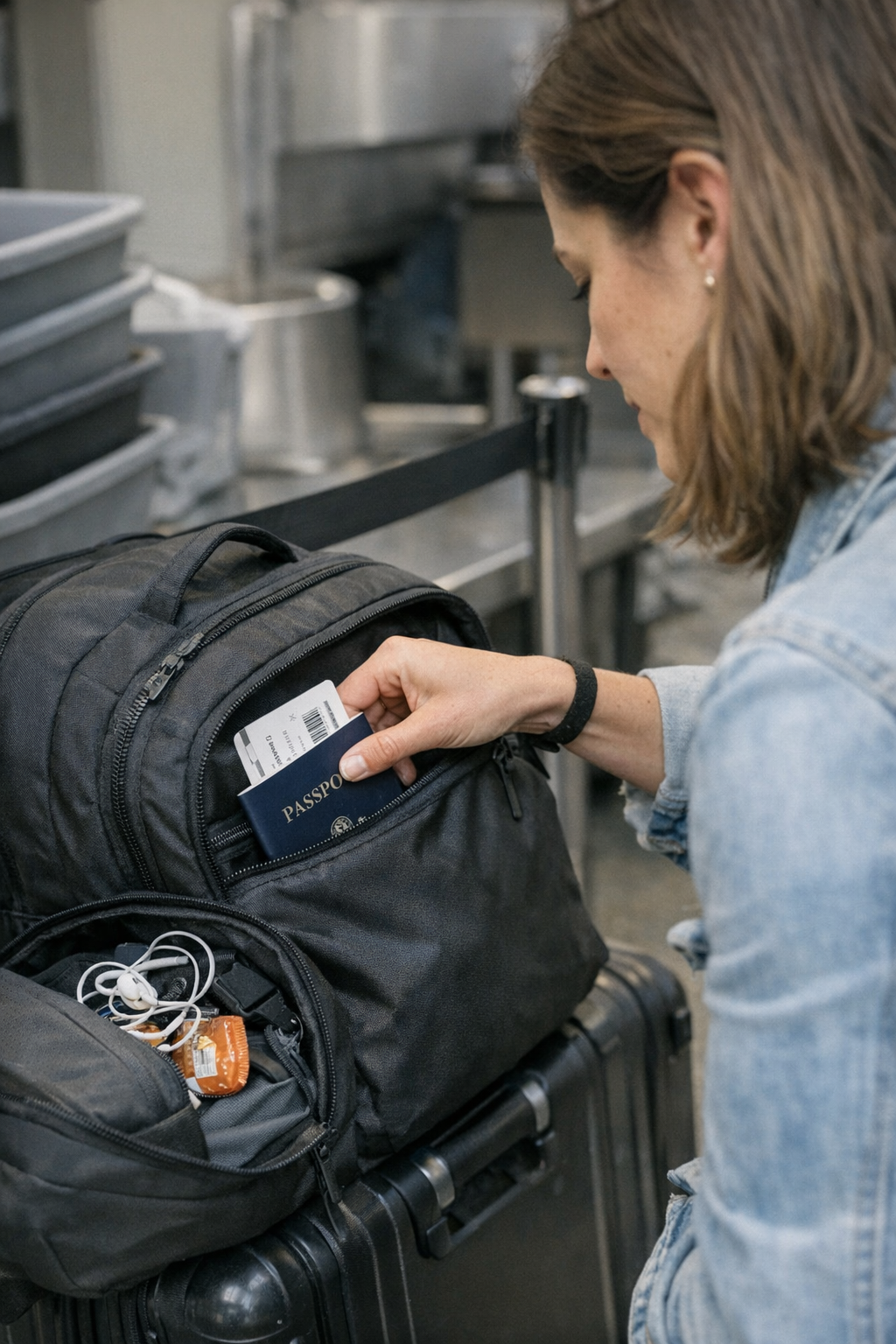
Reach for your passport midway through security, and if it’s pinned under a mesh of cables and loose wipes instead of ready to grab, you know instantly: the “order” you built at home collapses the moment you need fast access most. What matters isn’t how sharp your packing looks before you close the bag—it’s whether your carry-on’s actual structure works, again and again, as you move through checkpoints, repack at the jetway, or wedge into a narrow airplane row. The difference shows up fast: a tidy setup on your bed transforms into a series of small access failures under real airport pressure. Each interruption—each slowed reach or awkward dig—signals a larger flaw in how your bag is built for movement, not just layout.
Organization That Works—or Doesn’t—When the Journey Actually Starts
A carry-on stacked with perfect pouches and zipped compartments might pass for “organized”—for a few calm hours. But real travel isn’t static: the moment you hit your first security scan or a surge at the boarding gate, your clever sorting turns messy. Suddenly, a boarding pass hides beneath headphones, or a sanitizer slips to the lowest pocket. Every time you dig for a document you swore was within reach, the fiction of lasting order falls apart. A headphone case blocks your ID. A snack bar slides between your passport and your phone. What looked under control at home now demands a fumble and a rush in public, again and again.
Where ‘Everything-in-a-Pouch’ Fails
Pouch systems promise discipline: one for tech, one for snacks, one for paperwork. But as soon as you’re forced to rush—pulling out documents in line, stuffing them “just for now” into the nearest opening—the boundaries blur. Security checks scatter contents across trays, quick grabs jumble layers, and your most-used items wind up shuffled with the least-used. Cables bury documents, sanitizer migrates, and when you finally need your passport, it’s wedged between a power bank and a protein bar. Instead of less digging, every compartment becomes a new hiding spot—and you’re repacking in the aisle, feeling slow and exposed every time the system can’t keep up with the pace of actual travel.
Real-World Travel: Where Setup Meets Friction
You don’t need showroom-perfect minimalism. What you need is a pocket system that keeps your highest-frequency items—passport, ID, tickets, phone, sanitizer—truly separate and instantly reachable, even as your carry-on absorbs the rough-and-tumble of repeated handling. That’s the actual line between calm and aggravation: not how neat the original packing was, but whether you can reliably reach the same essential items on the fifth checkpoint as on the first.
Quick Access Becomes Critical at the Worst Moments
Picture the routine: you’re handing over your boarding pass for the fifth time, the line compressing behind you. Your “streamlined” compartment instead offers up a ball of cables. You dig, one-handed, with people watching, as the pressure climbs. Or you’re blocked in the aisle, elbowed by passengers, lowering your bag from the overhead only to realize the wallet’s buried under two layers of “organization.” These aren’t major disasters, but they drain time and focus—over and over—reminding you that good packing on paper rarely survives real airport flow unless built for friction, not just for looks.
The Tradeoff: Tidy at Rest vs. Fast in Motion
Internal layouts that look elegant in a quiet room become liabilities under travel pressure. A main compartment’s neat grid slows you when it forces two zippers and three pouch moves just to produce a boarding pass. The best-working bags break that tradeoff: a quick-access outer pocket for high-use items might look less pristine, but it means every security stop and seat change needs only one smooth reach, not a reset. Each friction-free retrieval isn’t just faster—it saves you the low-level stress that piles up with every awkward pause, especially when you’re on your third airport handoff of the day. It’s not about keeping everything perfect; it’s about not having your flow broken by your own organization each time you need something routine.
Compounding Annoyance vs. Carry-On Calm
The cost of a slow access setup is real: extra minutes at each checkpoint, more double-checking, more small “where did I put it?” moments when you can least afford them. That fatigue compounds. By your last gate change, a setup that was tidy at first now feels like a series of interruptions—tiny, frustrating, and wholly avoidable had your essentials stayed isolated from the shifting bulk of chargers and snacks. Every checkpoint, another forced reshuffle. Every seat change, another scavenger hunt. The risk isn’t total disorder; it’s repeated drag on your pace and focus as items migrate just out of reach.
Scenes That Reveal the Real Carry-On Weak Points
- Security tray scramble: Half a pouch emptied into a plastic bin just to get your passport free, with a line of travelers watching as you repack loose cables and squeezed sanitizer tubes.
- Boarding pass buried mid-queue: Inching forward toward the gate, then stepping aside to dig under a mix of snacks and headphones for a single document—while eyes in line track every second of your search.
- Overhead bin access, again: Bag comes down, zippers go wide, and your wallet is still blocked by three travel pouches—each retrieval turns into a miniature unpack-and-repack session you didn’t plan for.
- Arrival repack as routine: After each checkpoint, your previously arranged order dissolves, forcing another stacking, another reset, as items slide and mix the moment your bag moves a few feet or tips sideways.
What Actually Changes When You Restructure Your Carry-On
On recent trips, shifting all high-frequency essentials—passport, tickets, phone—to a single, clear outer pocket, away from the roaming mess of other travel gear, changed the experience immediately.
One zipper, one reach: Every time a document was needed, a fast, single-pocket grab replaced the old, tense rummage. There was no after-action scramble: pocket opened, item out, pocket closed. The rhythm of travel started to feel predictable. Instead of “where’s my ID?” chaos, you could lock eyes with a gate agent or push ahead in line, knowing the next step was just one move away—even as the rest of the bag quietly took hits from handling and repacks.
Separating these essentials didn’t cut down what I carried. It cut down how often a routine moment turned into a reset. A properly designed quick-access pocket—real top or side reach, not just a decorative zip—blunted the rising stress of travel interruptions. The setup wasn’t pristine by trip’s end, but the point wasn’t perfection; it was making carry-on movement less about repairing chaos and more about steady, repeatable access at every pressured checkpoint.
Small Decisions That Pay Off in Real Movement
It’s easy to believe initial visual control will translate to smooth airport movement. In reality, the only setups that hold up are those structured for interruption: highest-frequency items separated, ready for every security pull, gate check, in-flight repack, or bin stow. When your bag’s design matches the repeated, specific demands of airport flow—not just the fantasy of fixed order—travel gets faster, less anxious, and, frankly, more forgettable (in the best way).
Ask yourself: does your current layout actually fit your movement through security, boarding, seat entry, and arrival? The smallest decision—like switching document storage to a true quick-access spot—yields immediate, visible results when the trip speeds up. Surfaces that look tidy rarely guarantee smooth retrievals. Real travel exposes every weak pocket and slow zipper, one friction point at a time.
Looking for tools, pockets, and organizers that don’t just tidy up but actually change how you reach, retrieve, and repack? Explore practical solutions built for repeated, real carry-on use at CarryOnSupply.