
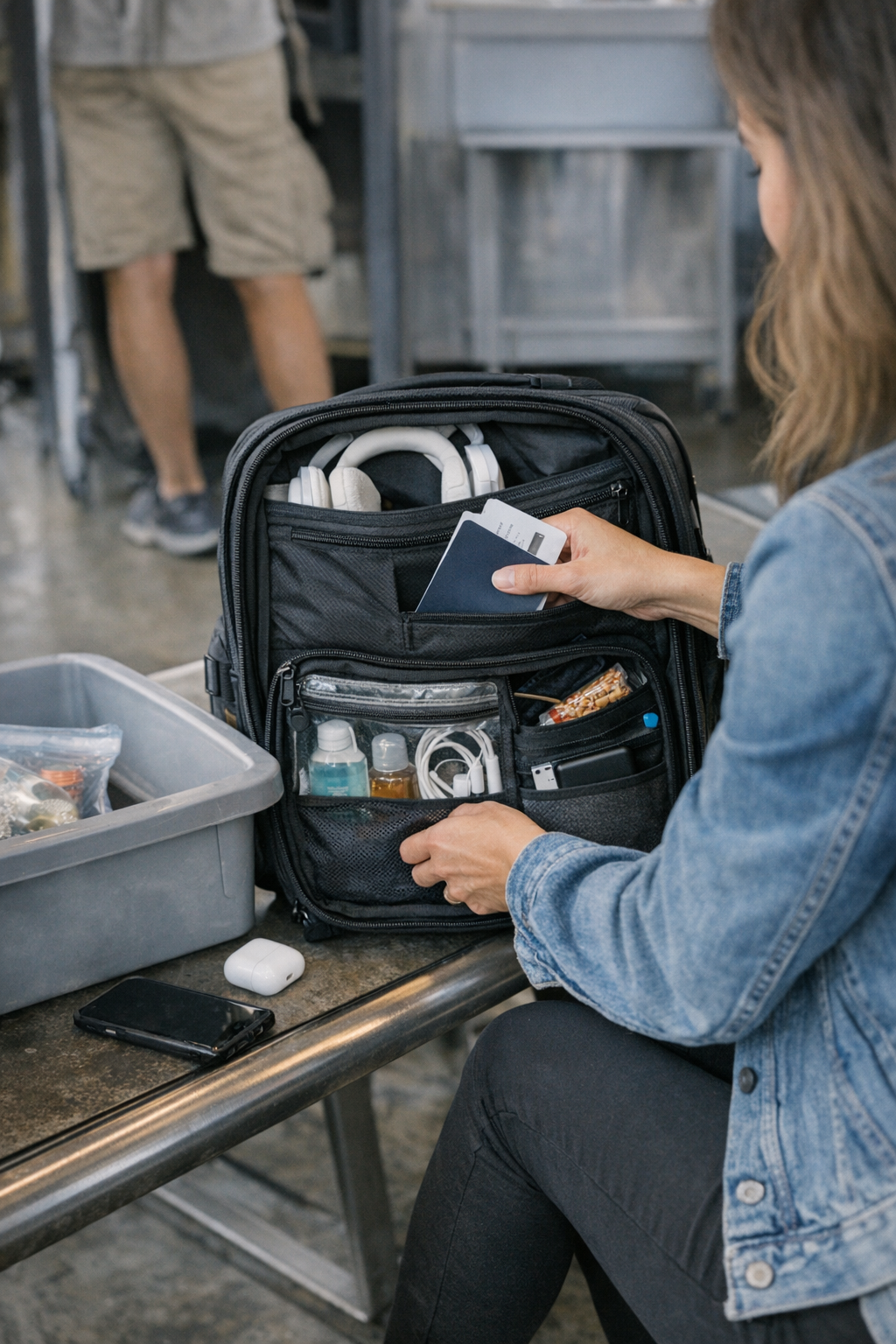
A carry-on bag that looks organized in your bedroom can turn into a series of stop-and-go hassles by the time you reach your fourth airport checkpoint. The real weakness in most so-called “organized” setups isn’t visible until you’re actually moving: lines forming behind you, a zip that snags, a boarding pass hiding under your snacks. At home, stacking cubes and lined-up pouches feel satisfying. On the ground—when you need to grab documents, shift trays at security, or pull out headphones with one hand—those same setups become slow, awkward, and frustrating. The gap between looking neat and moving smoothly costs real time, especially as pressure builds at boarding, security, or forced repack moments. This is where most “organized” bags start breaking down, no matter how carefully you packed.
When an Organized Layout Breaks Under Pressure
Order falls apart fast when your bag’s structure creates hidden jams. You know the pattern: you set every item in its place, cables looped, pockets zipped, convinced you’re ready. Then the first tray at security sends you pawing through a jumble of “organized” pouches, because your toiletries are behind chargers or a hard-to-move jacket. You planned ahead, but now your boarding pass is bent between tissues and granola bars, sliding further out of reach each time you drop your bag to the floor. Suddenly, what felt efficient at home shows its real friction at every small retrieval on the move.
Every access becomes a mini-reset, not a quick action. When the only way to grab your passport or a charger is to shift cubes or reroute a zipper path, the hidden drag builds rapidly. It’s not the first or second reach that exposes the flaw—it’s after you’ve walked half the terminal, when repacking for the third time becomes a slow-motion scramble. A visually “perfect” structure rarely survives five cycles of real airport flow without costing you time, attention, or both.
The Real Slowdown: Repetition That Wears You Down
Airport routines don’t reward decorative neatness—they punish access friction. No one times you repacking at home. But at security, at a crowded boarding gate, or after a red-eye, you start to see which decisions hold up. Most carry-on slowdowns aren’t about messy bags; they come from setups that force you to repeat the same clumsy sequence—unzipping, shifting, reshuffling—each time you need something that should be simple to grab.
True-to-Life Carry-On Headaches
- Security tray, round one: Your tablet is under a jacket and snaked cables. Dismantle half the stack, try not to drop loose items, reload while others stare—repeat on the return side a few moments later.
- Boarding bottleneck: Scan for your pass, find it wedged with wet wipes and a snack bar. One-hand shuffle, lose your spot, get rushed before you even clear the threshold.
- Seat squeeze: Go to grab noise-cancelling headphones for takeoff; realize they’re hemmed in by yesterday’s snack pouch and a roll of chargers. Everything comes out, aisle traffic waiting, order must be rebuilt just to sit down.
- Mid-flight drift: Reach for a charger: it’s buried bottom layer, requires moving toiletries, then repacking, then squeezing the pouch back into a now-misaligned pocket. Each repeat drags out longer, no matter how well you packed the first time.
Why “Looking Organized” Doesn’t Mean “Moves Smoothly”
The biggest drag isn’t visual—it’s functional. Packing cubes and color-coordinated pouches might hide the disorder, but they can quietly encourage overlap. When your sanitizer and passport compete for the same cramped pocket or your cables live with high-turnover snacks, you’re forced to perform a mini-excavation every time you need a single item. Neat lines at home become a slow cascade of rearrangements at every point of use.
This drag isn’t just about seconds lost; it’s a compounding series of tiny slowdowns that chip away at your focus. The carry-on that needs constant reshuffling, or makes every retrieval a multi-step interruption, becomes a silent stress source—especially when you’re already navigating crowds, tray transfers, or tight seat changes. If your layout breaks the airport rhythm, your “order” is costing more than it saves.
What Actually Changes Repeated Use: Direct Access Structure
The biggest improvement comes not from carrying fewer things, but from building direct, repeated access into your bag’s structure. Instead of stacking everything to look tidy, reshape your layout around how—and how often—you reach for certain items. Priority goes to the high-frequency, high-pressure needs: fast document checks, electronics at security, grab-and-go snacks, and quick sanitizer pulls.
How Real, Use-First Structure Shows Up
- Boarding pass & ID: Alone, slotted in an outer or side-access pocket—never buried or pressed in with “occasionally needed” extras.
- Chargers & headphones: Top-layered in a dedicated zone or travel tech pouch, with a single, frictionless zipper path—not squeezed under a book or double-packed behind clothing.
- Clear-view toiletries: In their own grab-and-slide case, sitting directly inside the main opening; ready for instant X-ray tray transfer, with nothing to move first.
- Snacks & sanitizer: Isolated in flippable pockets or side sleeves—never bundled with cables or deep within storage cubes.
This setup eliminates forced interruptions. The crucial detail: “one move, one item.” No stopping to repack or reshuffle because high-use things stay separated from low-frequency bulk. The speed difference is real: instead of adding hesitation at every gate or tray, the structure vanishes from your attention—the ultimate test in repeated use.
The Subtle Trap: Overlap Creeps Back In
The friction returns when boundaries blur again. You tell yourself it’s fine to toss boarding documents alongside cables for speed—or that stacking chargers and snacks conserves space. But once you’re en route, the same pouch gets emptied, dumped, re-zipped, and repositioned with every reach. Overlap pulls you back into the loop: one use, many moves, and a mounting risk of leaving something half-unpacked or out of place.
The real sign of a functional carry-on? You can retrieve anything after five or ten cycles without disrupting the rest of your layout. In daily practice, this means:
- No pocket-rummaging for the same docs throughout the day
- No cascade of items to reload after a simple access
- No digging at the overhead bin for tech, or stalling the aisle because of a buried water bottle
If you’re repeatedly resetting the bag after simple, routine moments, “home neatness” has failed to translate to in-transit usability. Durable order is shown by how little you have to think about your bag when your attention is elsewhere—or when time is tight.
Security vs. Speed: Access That Matches the Real World
Should outer pockets hold valuables? Only if you’re absolutely tracking every access point. In real travel movement, outer-access pockets work best for low-risk, constant-use items—tissues, snack bars, wipes—while your passport, wallet, and key electronics demand zipped, less-obvious but still rapid access. Create a setup where you lose less time at every checkpoint but don’t tempt a quick grab by a passerby. The sweet spot: speed for the replaceable, better-sealed layers for what you can’t risk losing.
Subtle Upgrades: The Fastest Payoff
You don’t need a packing overhaul—just one structural shift can make every checkpoint and aisle squeeze smoother. For most travelers, switching from all-in-cubes or flat-pouch stacks to distinct vertical or slot-based sections instantly cuts down on overlap. This isn’t only about a crisper-looking bag; it’s about fewer repacks, faster “hand-to-item” outcomes, and less low-level stress. The physical sensation of not having to search builds relief into the routine—you stop thinking about the bag and start actually moving through the airport as if the setup is finally working with you, not against you.
That’s the hidden difference: a carry-on that seems perfect on the floor doesn’t matter if it crumbles in line. The proof comes from quick retrieval, silent access at clutch moments, and a flow that holds up after every repeated-use stretch. Structure beats neatness—especially once travel rhythm takes over.
For realistic tools and clever solutions designed to make repeated carry-on travel easier, visit CarryOnSupply.