
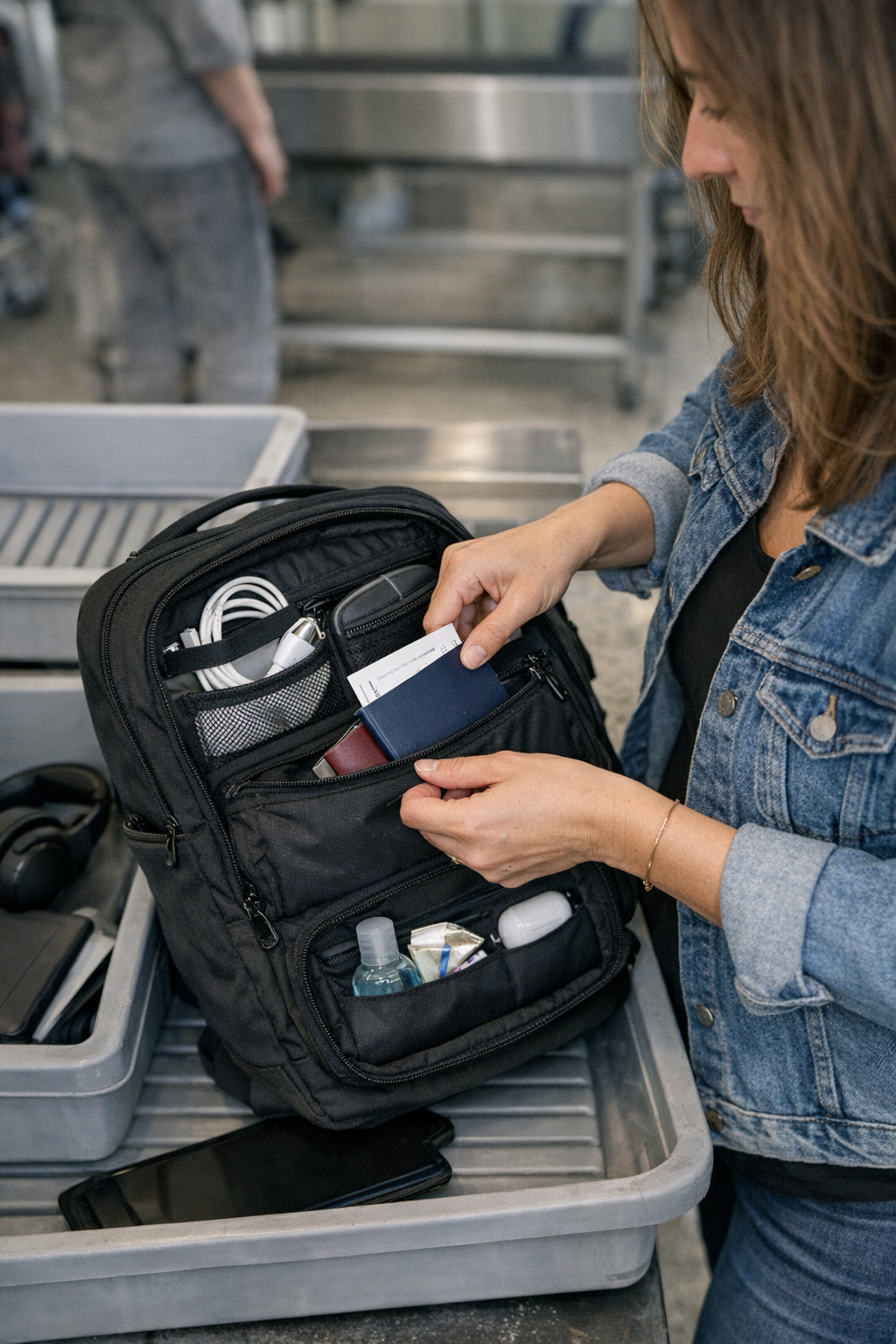
Every frequent traveler has hit this wall: your carry-on seems perfectly organized when you leave home, but by the time you hit airport security or fumble for your ID in a boarding line, the “order” that looked efficient turns clumsy. You reach for a passport and brush past tangled charger cables, shuffle through so-called quick-access pouches, or pull open neatly zipped sections that fight you every step. The bag looks calm from the outside—but one badly placed pocket or a cable covering your travel documents can completely stall your flow at the worst possible moment.
When “Visually Organized” Isn’t Actually Easier
It’s easy to mistake a tidy carry-on for a practical one. The dividing line shows up in the micro-moments: stuck in a slow-moving security line, one hand balancing your bin, the other hesitating at a zipper that’s blocked by loose contents. You go for sanitizer but knock earbuds loose. A pouch meant for essentials turns into a snag point for every cable or receipt you collect mid-trip. What slows you down isn’t a chaotic mess, but a system that quietly resists you during the actual trip—forcing repeat stops, extra unzips, or awkward pauses while everyone behind you waits.
It’s not spilled mess that signals the problem—it’s “order” that interrupts your access rhythm. A bag that photographs well can still force you to dig past unnecessary layers, unstack small items just to reach your boarding pass, or repack out in the open after each quick retrieval. By the third check, what looked organized at home becomes another slow-motion obstacle.
Why Sequence Matters More Than Category
The big mistake: organizing by gear type instead of by the order you actually use things. Lumping all your cables, chargers, and devices together works for storage, but in transit, you rarely need all tech at once. The cord you use once in-flight shouldn’t block you from grabbing headphones three times before you’re even airborne. Grab for a charger, out come tickets. Snag your passport, half your pouch contents spill into your lap. Each time, the “category” system unravels—and you pay the price in lost seconds, missed rhythm, and growing tension as you double back in lines or reach for a forgotten item from your seat.
Travel sequences—security, boarding, seat entry, takeoff, mid-flight, landing—move fast. If your bag’s setup doesn’t follow this rhythm, you’ll keep pausing, repacking, or apologizing to strangers as travel order devolves into repeated micro-friction.
Where Friction Builds, Even When the Bag Is “Neat”
- In the boarding queue, balancing a bag on your shoulder, the gate agent asks for your ID. You dig into an outer pocket, but receipts and loose cables block your way. The pause feels longer—and so does the impatient line behind you.
- On the plane, you placed headphones “on top” for easy reach—but turbulence and seat shuffling bury them under snacks and pouches. Now, just finding music means repacking your bag, tray table, and seat pocket in view of everyone nearby.
- Security bins are sliding away. You unzip a pocket for liquids, only to find sanitizer jammed beside your e-reader. Sorting them exposes your private things to everyone, slows down the line, and leaves you scrambling to close zippers before your tray is gone.
Small Zones: Packing by Use Timing, Not Just Item Type
The fix isn’t more organizers or ultra-tidy mesh pouches—it’s drawing real boundaries inside your bag by function, not just by what fits together. One zipper for just travel documents (and nothing else), a fast outer pocket for inflight needs like earbuds and sanitizer, a padded zone for electronics you only touch once seated. Each zone is purpose-built for a specific travel action, so you’re never forced to rummage through unrelated gear, or repeat the same disruptive search for a single item.
The result: sanitizer comes out on cue without disturbing your passport or device, and grabbing a boarding pass doesn’t send snacks tumbling. Over even a few cycles—boarding, inflight, arrival—the outcome is tangible: less thinking about your bag, fewer exposed contents, lower risk of errors when outside your comfort zone, and faster returns to “ready” status after every routine interruption.
The Usability Drop-off After Repeated Access
Big compartments and deep catch-all pockets look neat on the first pack, but they don’t recover well once you start moving. Drag out a document, and you’re stuck sifting past cables or balancing piles on your knees. Two or three retrievals later, perfectly stacked items are bent, lost under flyers, or need reordering before you can even zip the section closed. Even if nothing spills, you notice that every new access point makes the next one slower—especially during the public moments, like reclaiming your bag from an overhead bin or moving quickly out of your row after landing.
The more you repeat these motion cycles, the heavier the system feels. By the time you reach your hotel or switch gates, the “order” that worked at packing time has faded—just as pressure to move fast is highest.
Troubleshooting: Repeated Frictions Reveal What’s Not Working
- Do you pause for the same item at every gate or checkpoint—never quite sure which pocket is right?
- Are you opening, then closing, several sections just to do a single action?
- Does your bag’s “organized” setup seem to degrade after a few security or boarding cycles, losing all reliability?
- Does grabbing one small thing (like sanitizer) make it twice as hard to keep your boarding pass or headphones in place?
Each of these is not just a quirk, but a real design signal: your carry-on is arranged for looks or categories, not actual travel sequence. A shift to smaller, clearly defined functional zones rewires the whole experience. You’re packing for the way you move, not just for a tidy Instagram swipe.
Practical Adjustment: How Real Zoning Changes the Flow
Instant improvement doesn’t demand a bag overhaul—just field-tested adjustments. A slim, outside zipper for ID and documents (and only those). Chargers and tech staged deeper, safely ignored until your seat. A low-profile pouch always loaded for fast-grab basics—lip balm, sanitizer, earbuds—handled with zero impact on the rest. This isn’t about making every move “perfect.” It’s about reducing those friction points that turn lines, trays, and aisle transitions into slow-motion stress tests. One less zipper per routine, seconds shaved every time, and a repeated sense that your setup is keeping pace with actual airport pressure rather than creating new burdens.
When you stop repacking on the fly or scrambling for a missing cable in front of strangers, you notice the difference: your motion feels less exposed, your contents less at risk, your overall pace more consistent. Even as long-haul flights or tight gate changes stack up, the pattern holds—and the trip feels lighter at its most demanding moments.
The Real Payoff: Structure That Stays Reliable Under Pressure
The best carry-on setup isn’t about surface order; it’s about invisible flow. A bag engineered around how you actually move—boarding, passing checkpoints, shifting seats, lifting to overhead—means quick, silent retrievals instead of public disruptions. The difference becomes obvious when your setup survives not just one leg, but the entire journey, letting you reset headphones with one hand or extract a boarding pass in seconds, no matter how crowded your space or tired you get.
The gap isn’t visible when you zip the bag shut at home. It announces itself in security lines, at congested boarding doors, and every time “order” falls apart in motion. If your system makes every retrieval a mini struggle, or lets one misplaced item block another, that friction is real—and worth fixing for good.
For carry-on tools and smarter travel pouches that actually fit the way you move, see what’s working now at CarryOnSupply.