
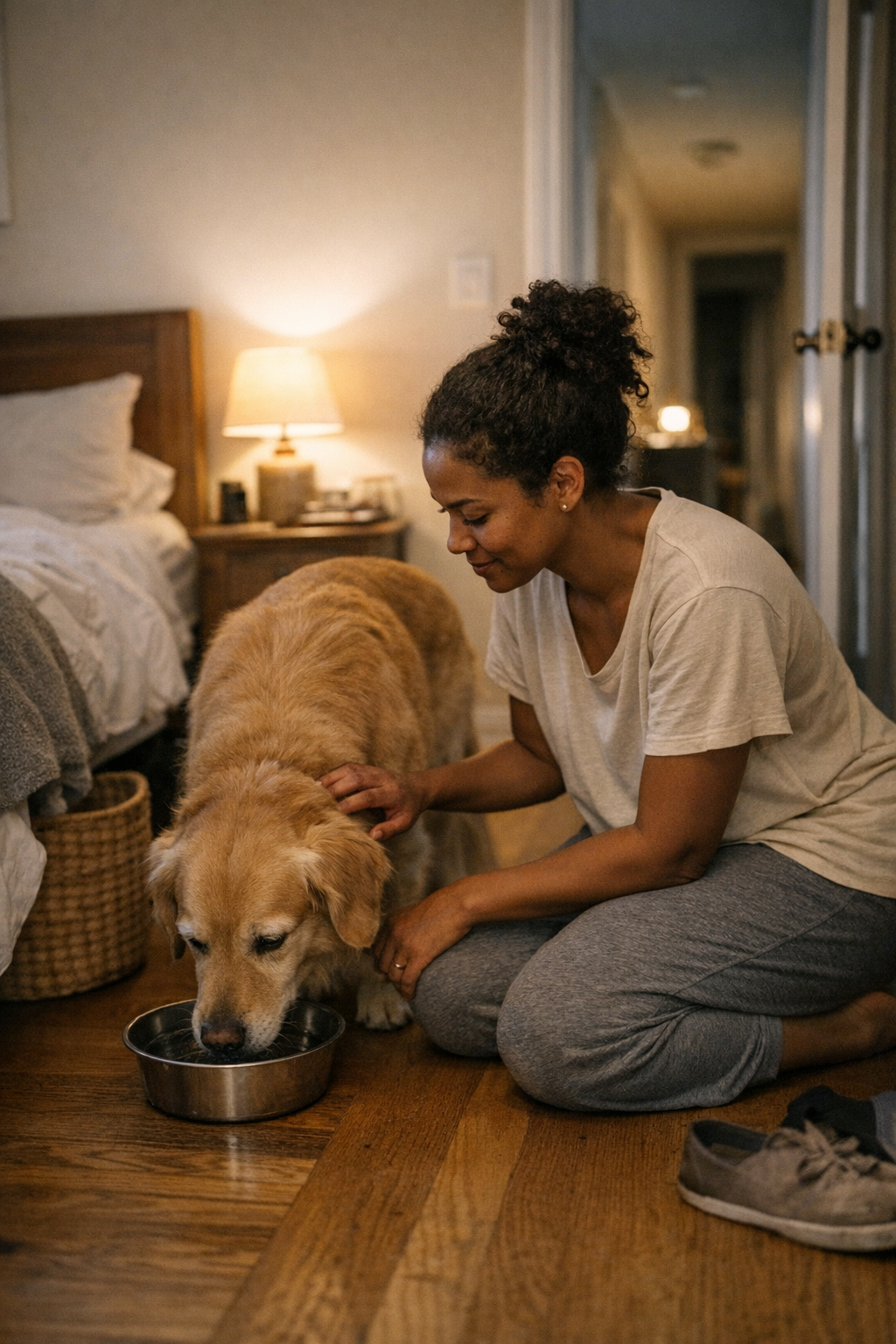
The last quiet hour before bed: it’s supposed to wind down, but for most dog owners, it’s where the day keeps snagging. You organize the bowls, gather up toys, wipe muddy paws—then notice your dog pacing the hallway, hesitating by the water bowl, or giving you that expectant look near the bedroom door. These aren’t random quirks. They are friction points that keep popping up, forcing you to shuffle cleaning rags, step over spilled chews, or make a second trip for that bowl you thought was already in place. When the routine feels “done” but your dog keeps hovering, you know tomorrow’s morning will start on shaky ground—featuring an amped-up dog, awkward leash grabs, or a feeding scramble before you’ve even had coffee. Surface calm hides a restless cycle that builds up, not down, making every reset just a little heavier.
Unrest That Doesn’t Shout—But Still Wears at the Routine
Pre-bed tension isn’t explosive, but it lingers. Maybe it’s a dog restlessly circling the hallway, or stalling between water checks and the bedroom. One night it’s an extra lap, the next it’s standing in the way as you try to drop your keys. Over and over, the same friction: you step around a bed placed just a stride too close to the door, or fumble for a towel that’s tucked behind a bag. By the third morning, you’re coaxing your dog out—a pull at the leash or a scramble for the bowl means the “routine” isn’t smooth at all. This dull friction adds up. It isn’t dramatic, but it drags every part of the reset sequence.
Not All Calm Means Restful
Even when your home looks dialed in—water fresh, toys gathered, bed fluffed—fragmented signals show through: your dog gets up to double-check the bowl, repositions close to your movements, or pauses just outside the light. It reads as calm, but underneath is a fidgety tension carried into morning. The result: you’re running interference from the jump, already managing a dog who never switched off—and the whole day starts slower, requiring more adjustments from you at every step.
Where Most Setups Quietly Miss the Mark
Putting every item “in place” looks like the finish line. But most setups fail at flow, not organization. A water bowl shoved against a high-traffic wall seems neat but blocks the quick pass to bed. A soft, out-of-the-way bed requires an awkward detour for the dog. Toys clustered by the entryway only to spill into the walkway after lights go out. Over time, it adds up to a routine that looks good but keeps pulling you—literally—back for another adjustment, and keeps your dog guessing about what comes next. A setup that’s photo-ready isn’t always routine-ready.
Repeating Friction Hides in the Edges
You rarely spot the real issue until it’s routine: you’re double-backing for leashes, nudging aside bowls, or picking up a towel mid-hallway while your dog waits, half-settled, for the next move. Each small loop—extra water checks, edge pacing, toys in your path—signals the system isn’t working for the actual nightly flow. It’s less “my dog won’t settle” and more “my setup keeps asking for fixes.” Over days, the result is the same: unsettled sleep, unsettled start.
Small Nighttime Signals with Next-Day Consequences
Spot these signals—they’re easy to ignore, but they build:
- Dog returns to the water bowl after lights-out—despite just drinking
- Pausing in hallways, especially in doorways or at bedroom thresholds
- Repeating circles before settling, instead of flopping down and staying
- Shadowing you during end-of-day tasks, tail thumping lightly or eyes fixed for a cue
No single moment is dramatic. But put together, they create leftover energy—restlessness that spills over into morning. This is how you end up juggling an early leash tug, racing through breakfast, or tripping over toys you’d “put away” the night before. The wrong setup doesn’t cause chaos, but it reliably steals smoothness from your next day.
When the “Quiet Hour” Isn’t Actually Quiet
It becomes clear after a string of choppy mornings: you’re grabbing at a leash wedged under a stray towel, dodging a dog waiting in the hallway as if still expecting to go outside, or finding a water bowl blocking the doorway while you try to slip back to bed. Even when everything looks organized, the routine still resists. Your dog’s “wait” is really a stall, their rest is interrupted, and your supposedly end-of-day calm keeps requiring another fix. Underneath the order, the setup is working against you.
The Missing Reset: Why Access and Placement Matter
It’s not about having the right items—it’s about where and when they’re put to use. If the bed is in a dead corner but unreachable without crossing your own path five times, or the water bowl is in the main walkway, your dog must choose between comfort and access. Each awkward pause, stall, or redirected path is a missed reset. Dogs react to these spatial blocks in real time—with hesitations that ripple into your next routine. Routine friction isn’t about the number of supplies; it’s about the flow they allow or block when the same steps are repeated nightly.
One Setup Change—A Real Routine Shift
Think about a hallway water bowl, always accessible—but only by running interference with the rest of the house. Move that bowl a few feet to a quiet, open corner thirty minutes before lights-out and suddenly: your dog checks water once, pads calmly to the bed, and doesn’t double back or pace. For the owner: there’s no sidestepping bowls, no leash tangles, no blocked exit during bedtime cleanups. The shift isn’t about adding more—it’s about stopping the need for repeated shuffles. Over the week, this small fix removes the root of morning rust: fewer pre-dawn interruptions, less scramble, and a dog that resets without leftover friction.
Not About More Steps—About Fewer Sticky Transitions
Most owners try to patch tension with more: extra treats, longer wind-down, added cues. But what works is removing the drag points: that bowl in the main crossing, the pile of toys in walkway spillover, the crate with the tricky latch facing the wrong way. Dropping friction means fewer sticky transitions—your dog stops looping the hall, you stop rerouting routines. The evidence is in the shift: one clear movement from water to rest, fewer circles, no last-minute pacing. The setup supports default calm, not ongoing adjustment.
Recognizing and Responding to Routine Clues
Problem setups show up as clusters, not one-offs. Watch for:
- Increasing evening pacing after what should have been a calm day
- Your dog blocking, waiting, or lying across doorways before bed
- Leash moments getting clumsy—snags, double backs, tangled hands
- Feeding times inching earlier because your dog is already pushing for reset
These clues mean your setup isn’t matching real routine flow—it looks neat, but works against lived experience. Friction repeats until the arrangement allows the night to move forward without extra signals or repeated interruptions.
Everyday Example: When Organization Isn’t Enough
Picture your routine: post-walk, keys and leash into bins, towel by the door. But the water bowl sits in a high-traffic zone—your dog hovers right where you’re putting shoes away. By the time the house goes quiet, your dog isn’t settled, just tracking your moves, ready to get up when you do. The space looks managed, but every step feels delayed. These mismatches aren’t obvious at first—they show up after nights of repeating the same awkward dance.
What Actually Shows Progress? Small Pattern Changes
Don’t look for dramatic scenes. The proof is:
- Your dog checks water once, then chooses a spot and stays put
- Less hallway crossing, fewer late laps, more direct movement to bed
- Morning transitions feel smoother—no rushing, fewer leash standoffs, feeding without a scramble
- The sequence becomes repeatable: bed, water, settle, done—without negotiation
You won’t notice a magical drop in mess. You’ll notice tension slipping out of your routines, fewer backtracks, and a system that finally supports how you and your dog actually move through the day—not just how the area looks at night.
Better Setup, Smoother Days
There’s no need to chase a perfect evening. The win is in finding and breaking the repeating friction—the bowl in the wrong place, the rest area always in the cross-traffic zone, the toy pile spilling into the walkway. Every time mornings