
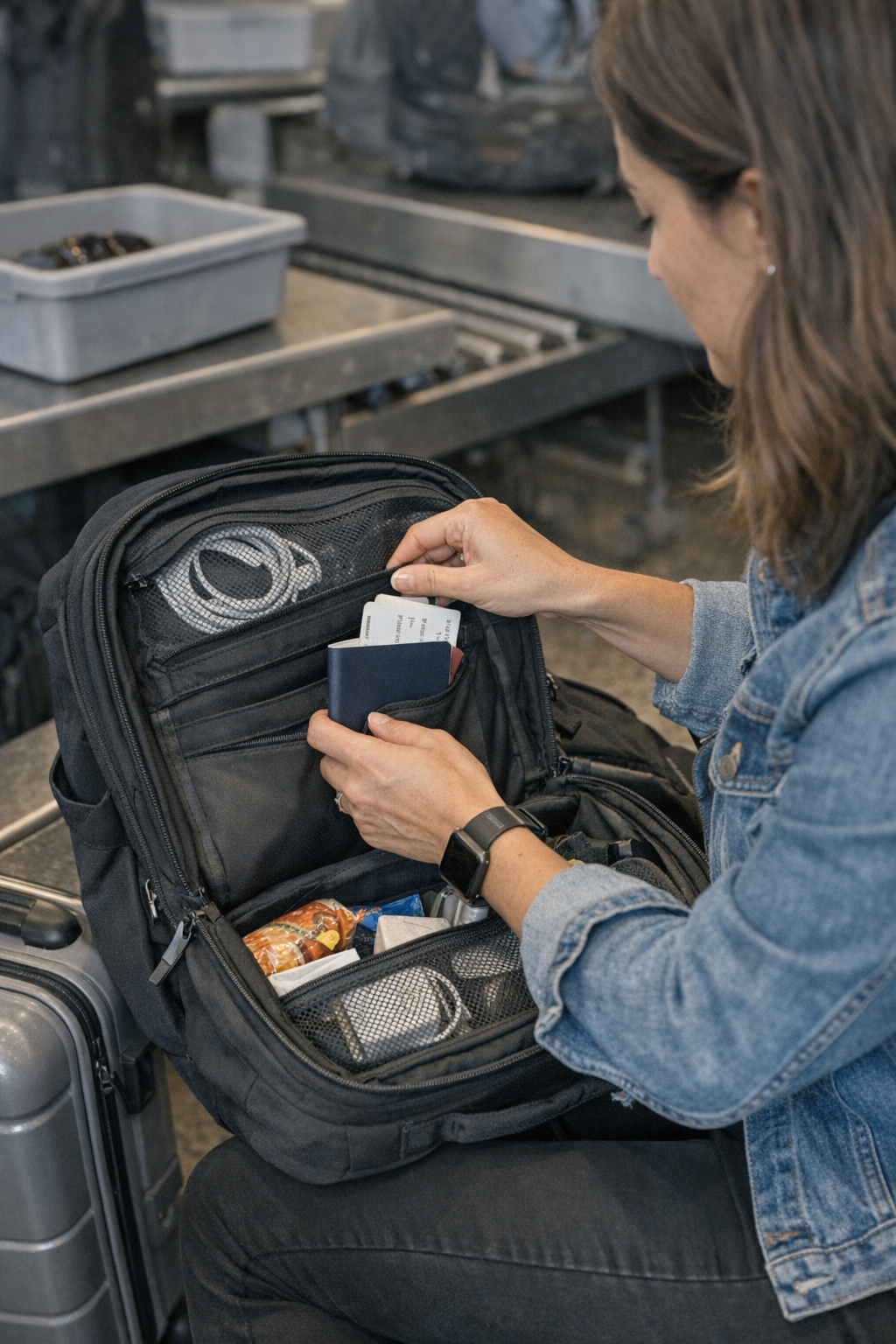
Your carry-on bag never shows its real character until you’re in motion—standing at security, boarding, or pressed against the line for another document check. That neat, sorted setup you zipped shut at home will be tested the moment you need your passport, charger, or boarding pass for the third or fourth time. What seemed “organized” in your living room can turn slow and frustrating under airport pressure: each repeated reach reveals new tangles, new interruptions, and the same pockets forcing you to repack on the fly. A real carry-on system isn’t judged when it’s closed but by how it handles relentless, in-transit access.
When “Organized” Still Slows You Down
The trap is familiar: color-coded pouches, slim sleeves, everything snug in its compartment. But at the first checkpoint, quick-access pockets become bottlenecks. Digging into an “organized” outer pocket, you’m forced to untwist a charger from your passport or slide a boarding pass out from beneath your headphones—one grab derailing five minutes of home sorting.
Essentials packed together break down in real motion. What promised fast retrieval as you packed instead means every rummage nudges documents into creases, cables across pockets, and comfort items into the security tray by accident. Suddenly, the single “quick grab” spot you relied on turns into a mini-repacking station—especially when you’re shoeless at security or maneuvering bins with one hand.
Small Moments, Repeated Friction
Actual inconvenience isn’t dramatic—it’s the fraction-of-a-minute lost each time you dig for what you need. Leave security, and your carefully stacked pouches have shifted; by the third document check, you’re fishing out not just your passport, but a tangle of cables and snacks you thought were stashed away.
This is where visible order collapses beneath real demands. Mixing tech, documents, and creature comforts causes new friction every time you reach, turning each retrieval into a minor repack cycle. What seemed efficient now creates an unpredictable pile—reliant on luck as much as planning to stay sorted until your destination.
The Subtle Cost of Overlapping Zones
Airports magnify every overlap. Place a charger and passport in the same accessible spot, and you’ve introduced a silent tax: every retrieval is slowed by something blocking or tangled around what you actually want. The stop-and-search rhythm of travel—gate checks, x-ray trays, surprise boarding calls—brings out the fault lines in “general access” setups.
Retrieval delays aren’t theory—they’re the moment you pull out headphones and spill a mask and granola bar on the jet bridge, or unzip a packed pocket in your seat, only to spend three trips resealing it as each movement re-scrambles its contents. Your bag isn’t emptying, but functionally it’s becoming messier and slower with every checkpoint.
How Good Setups Break Down Under Real Use
The common oversight: what looks efficient at home chokes under routine travel motion. “Tidy” falls apart as trip rhythms demand access in places and moments you can’t fully plan for.
Cluster all your “need in a hurry” items in one outer pocket, and it’ll only take one security scan for things to slide, shuffle, or block each other. By boarding, that surface-level order is gone—a charger pressed against your passport, receipts and headphones mixed in. Every retrieval builds more disorder, compounding micro-delays into real stress as the journey drags on.
Real-Life Adjustment: Separation for Reliable Access
The fix usually isn’t stricter organizing—it’s real separation where it counts. Move travel documents into a dedicated holder with a side-zip, and suddenly they’re not buried. Throw headphones and chargers into their own mesh pouch, and you can reach them without pulling up paperwork.
This isn’t theory—it’s a proven tweak: on an ordinary multi-legged journey, going from three zipper movements per document check to just one changes the tone of every airport stop. Without overlap, tech tangles and accidental “extractions” disappear, and routine retrieval becomes a matter of one clean motion—not rummaging and repacking before rejoining the flow.
The Cycle of Open, Retrieve, and Repack
Travel drag comes as much from putting things back as from taking them out. Drop your passport into a mixed pocket, and returning it means a fumble against wires and wrappers—inviting new mess every time. Overlapping “quick-access” zones ensure each return causes another pile-up, so by landing you have predictable chaos to sort out.
Dedicated paths—one lane for documents, one for tech, another for in-flight needs—rebuild the rhythm you started with. Retrieving and returning stops feeling like negotiation, and bins, trays, and seat pockets all work better because nothing is hidden, blocked, or shifted by another category’s gear.
Why Recovering True “Quick Access” Matters
Visual neatness promises peace, but it’s the bag that can take ten unzips, ten grabs, and ten returns without losing structure that quietly changes your trip. The system that survives repetition, not just the first impression, is what you want walking into the next checkpoint queue.
No bag is immune to the occasional missed pocket or buried pen. But layouts that prevent categories from colliding and force nothing through a mixed zone—these let mistakes reset fast. Every retrieval feels intentional, every return lands right, and you stop treating each access like a small repack emergency.
Practical Takeaway: Structure for Momentum, Not Just Tidiness
The carry-on you want isn’t the one that photographs neat at departure, but the one you can still use efficiently by the fifth checkpoint and the end of a crowded flight. Compartmentalize: separate slots for passports and docs, pouches for tech, lanes for comfort, even a catchall for “just-in-case”—that’s how you cut slowdowns and keep airport flow on your side.
You’ll notice the change in the way lines move, how fast you clear trays, how easy it is to grab the next essential and put it back for next time. Your rhythm—the actual trip, not just the packing scene—becomes smoother because your setup works when it matters, not just when you close the zipper. Every reach, every retrieval, every repack feels like travel done right, no matter how many checkpoints remain.