
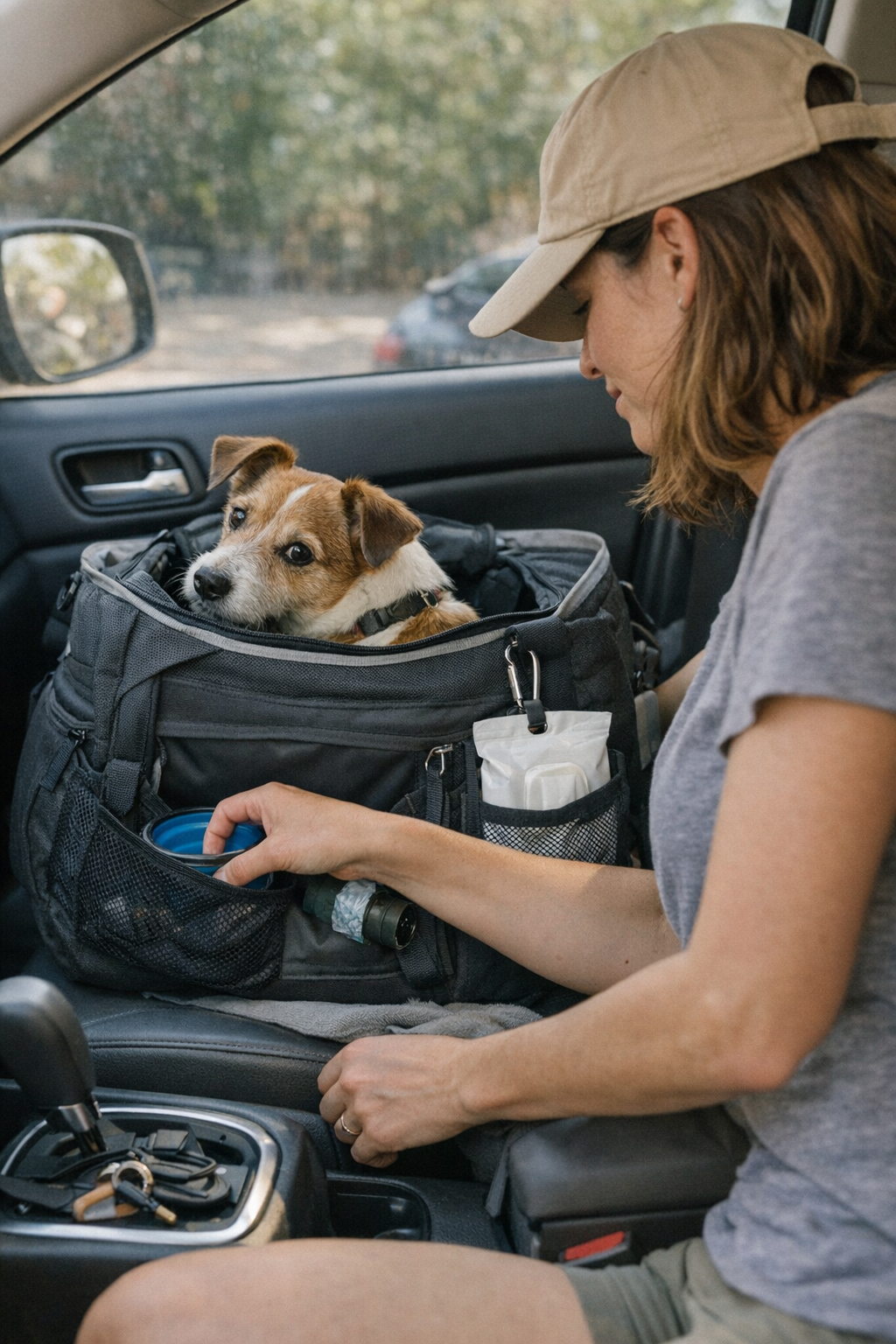
Even the most carefully packed pet-travel bag—pockets filled, zippers zipped, leash clipped and bowls nested—rarely survives the first real-world trip without trouble. What starts as an organized, seat-side setup crumbles fast when a dog lunges to see out the window or a cat shifts to curl up. Suddenly, the “ready” bag blocks the one thing you actually need: wipes jammed behind the carrier, treats buried under a twisted strap, or the leash tangled just as you reach for it. Functional in theory doesn’t mean reachable in motion—and the difference becomes impossible to ignore in the first few stops.
The Surprise Friction of a “Prepared” Pet-Travel Bag
Most pet owners have played out the same routine: load supplies, tuck the bag near the seat, drive off feeling ahead of the mess. But after one or two quick stops, cracks show. The neat loops and sections blur—leash clips not only tangle with bowl handles, but the bowl slides and lodges awkwardly against another pouch. Cleanup wipes, easy to spot when parked, get lost behind shifting carriers or blocked by a comfort blanket that slid out of position. What looked accessible suddenly requires a stretch, an awkward reach, or a partial unload just to fish out a single item.
This isn’t about mess alone. It’s about seat-side decision flow: can you, one hand on the pet, snatch the right wipe or treat while half-turned out of the car, or does every small movement spiral into a search-and-reset? If your cleanup or comfort item takes more than a few seconds to locate after a stop, interruption becomes the baseline. That’s real friction—when ordinary moments, like letting your dog glance at traffic, lock you into a routine-slowing scramble.
What Looks Neat at First, Stalls in Real Time
Pet travel exposes hidden weak points quickly. You pop the bag for a leash—only to find it snarled with treat pouches, or shoved under a blanket now blocking the opening. Bowls wedge against the corner with every red light. Cleanup bags positioned “within easy reach” slide down to the seat edge, now blocked by the carrier’s bulk. In practice, every time you shift attention to your pet, items slip and stack. You waste seconds on the wrong pouch, miss the wipe you saw earlier, or knock items loose in a quick grab. By the third short stop, these wasted beats—not visible mess—add up to real irritation and longer cleanup chores. Suddenly, the whole setup feels like it’s working against you, not for you.
The real breakdown isn’t visible clutter. It’s stalled access—when reaching for one item means shuffling through two others, or working around a handle stuck in the zipper seam, just because the pet or the road made your bag shift in place.
Allow Your Pet Freedom—But Expose Weak Points Early
Locking a pet in one spot can make travel easier for the bag, but not for the animal. Most setups break down exactly when you grant your pet normal freedom: letting a dog turn to watch a passing cyclist or a cat circle to get comfortable. Flexibility is good for the pet—and brutal on bad bag setups. Repeated test: every time your pet moves, does a clip, loop, or bulked-up corner suddenly block the tool or treat you always need at stops?
- Leash clips twist into bowl handles each time your pet shifts direction.
- Bowls slide beneath pouches or into the seat crack after a sharp turn or stop.
- Handles snag cleanup-bag zippers, or catch the seatbelt anchor, so nothing opens smoothly when you’re in a hurry.
Over time, the “almost organized” kit becomes a stubborn obstacle course. Fumbling for wipes takes longer, soothing items clash with access, and the tiniest misalignments after a single pet movement snowball into real, repeated slowdowns.
Why Shared Access Zones Cause Ongoing Trouble
Shared zones—where everything converges near bag openings or seat edges—are where most travel kits break down. If wipes, bowls, leashes, and baggies compete for one grab-spot, friction is guaranteed. Organized still photos mean little if, in motion, a bowl handle blocks the treat pocket, or a leash ring jams the main zipper. Each overlap isn’t just a nuisance; it’s a multiplying frustration during the only moments when fast, single-handed access is critical.
The real pain shows at restarts: returning to the car, trying to settle your pet, reach a wipe, or reclaim a leash. Instead, you’re hit with a hard block—a bowl wedged over the opening, a pouch caught on the seat edge, or a stiff handle pressing against the door. Resetting the bag creeps from quick routine to a multi-minute chore. Visual tidiness hides the fact that every “easy-reach” now sits behind another object, and the confidence from that neat packing is gone.
Adapting Your Setup for Flow—Not Just Order
After enough clumsy stop-and-go cycles, most pet travelers make real changes. For me, that meant yanking bowls from inside to a mesh side pocket, hanging wipes to a seat-side anchor where I could grab them with eyes never leaving the pet, and stripping the carrier entry to the single leash anchor. The actual difference didn’t show in photos—it showed in how quickly I could grab the needed item after my dog shifted for the third time in twenty minutes.
When wipes aren’t buried, you reach and go—no stall, no second-guessing the pouch. If bowls live outside the main zipper, no more accidental blockages from sliding handles. Cleanup zones get their own side, leash clips never cross over with comfort pouches. The end result isn’t a prettier bag, but a travel kit that returns to ready after every stop, not just the first one.
Practical Signs Your Pet-Travel Setup Needs Reworking
- You start by opening one section but end up finding what you actually need elsewhere.
- Cleanup wipes and bags are present, but never in reach at the most urgent moments.
- A calming blanket or comfort item causes jams or clogs the route to quick access items.
- Pet and owner supplies blend—with water bottles, keys, or phones slowing your ability to restart after stops.
- The bag looks more organized than last trip, but you’re still forced to reshuffle or pause at every stop.
How to Organize for Real-World Movement
On the road, function exposes flaws that packed photos don’t. The strongest setups keep job-specific “lanes” open: wipes fastened where you find them blind, bowls stowed away from entrance points, leashes anchored out of the main traffic zone. Exterior loops, side-mounted pockets, and segmented carriers aren’t just decoration—they mark the difference between a three-minute reset and another frustrating seat-side search. Every repeated use spotlights the “choke points” in your kit—if you’re slowed by the same overlap twice, it’s clear packing order doesn’t equal actual travel flow. Watch for which tool actually holds up under repeated movement, and rework the layout to suit stops, not just departures.