
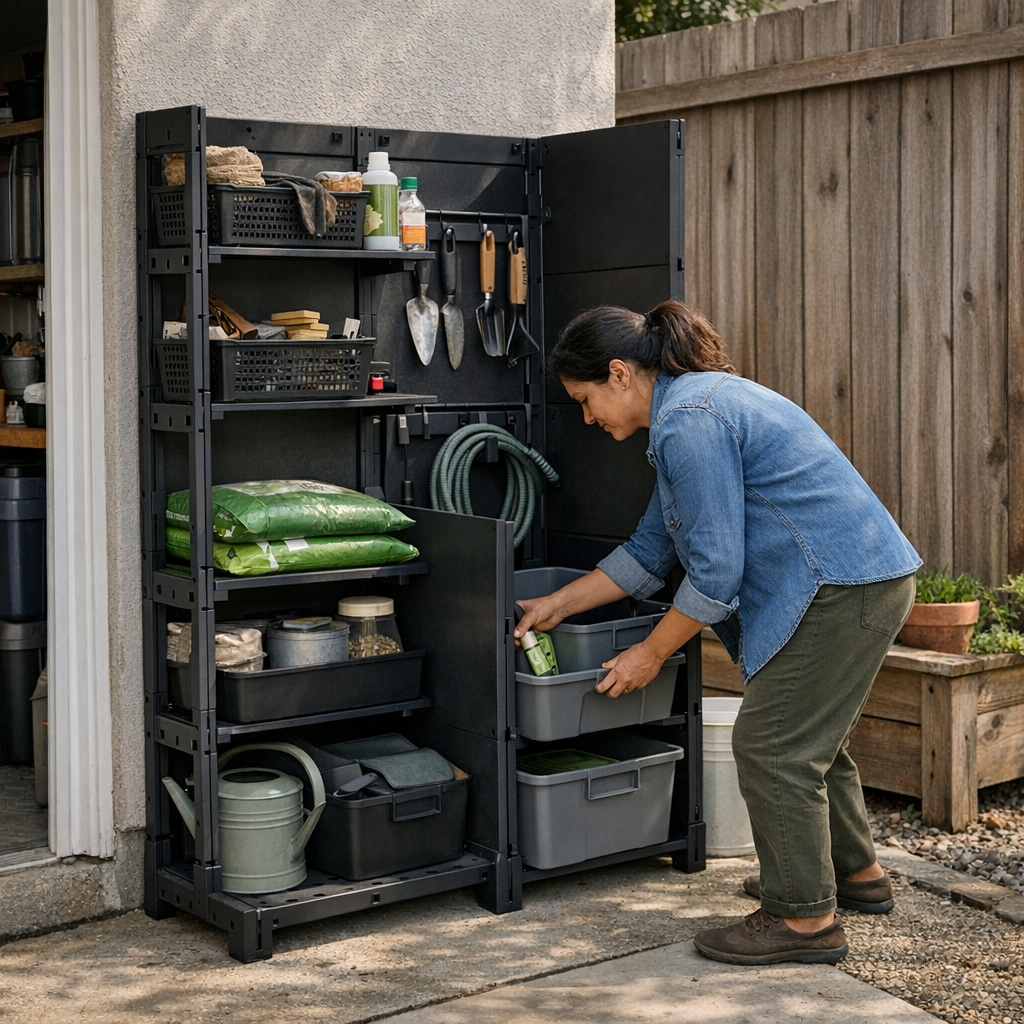
There’s a moment every backyard or side-yard setup hits—not the obvious crisis of “I can’t fit anything else,” but the slower grind where even your best outdoor storage can’t keep little gear and tools from drifting loose. In the real world, shelves and open bins always seem like the answer. You start with trowels hooked at arm’s reach, gloves clipped in sight, seed packets lined up, every item visible and ready. It feels under control—until the second week, when order collapses with barely a sound. The trowel buries itself beneath a bag of soil. Gloves slip behind boots, then vanish for days. Resetting turns into shuffling piles just to clear a walking path. Suddenly, the zone you counted on for smooth movement and easy storage is the one spot that slows you down, blocks your step, and makes you wonder where all the “efficiency” went.
Where Outdoor Efficiency Collapses: The Real Return Friction
The truth is, it’s not about square footage—it’s about the return. Not “Can I fit this?” but “Can I put it back, without blocking something else or derailing my next trip in?” Wall racks and open bins might look like a system built for ease. But after a handful of uses, what’s supposed to be simple access turns into chase-and-reshuffle. You grab the rake, toss it back five minutes later, but now it’s blocking the spade. By the weekend, every reset takes longer. Storage goes from fluid to fussy, never quite matching the rush and repetition of actual backyard routines.
This is the real test: After a week of working in the yard—watering, weeding, rearranging pots—can you return tools without shifting an entire row of supplies just to open space? If not, the system isn’t broken, but it’s quietly failing. One cluttered barrier at the edge, one pileup in a corner, turns functional setups into new snag points—forcing you to move leftovers out of the way, over and over, just to keep regular paths clear.
Open Systems: When Visibility Turns Into Scatter
Open racks and bins promise speed. Everything visible, nothing forgotten, every tool within reach. But spend a week with them in an actual side-yard or garage edge and the cracks show up:
- Hand pruners get tossed on top of seed trays, forcing you to rearrange both the next time you need either one.
- Light gloves slide behind taller shovels and don’t come out again until you empty the whole shelf.
- A giant fertilizer bag ends up collecting three unrelated trowels and a hose—blocking access and hiding daily-use gear.
The hardware isn’t the issue. It’s the way routines take advantage of every tiny opening. Without clear physical boundaries, “putting it back” just means dropping it anywhere there’s a gap. The more open the system, the more things start to scatter and drift—until the zone’s main job is hiding what you need, not presenting it.
The Pileup Zone: When Good Storage Becomes a Blockade
Picture it: that garage threshold you finally organized, a fence-line stacked with modular bins, spray bottles on hooks, extra planters in neat rows. For three days, it works—everything in its zone, every tool where you want it. But fast-forward another week. You’re tiptoeing around seed packets that slipped behind planters, stepping over trowels that somehow migrated to your walking path, ducking to retrieve gloves from underneath a crate. Bins with lids, instead of containing the mess, start swallowing it. Once something drops in, it stays there until you lose patience and dump the whole box to fish it out. The cost? Every trip in or out of the zone slows down, and the setup that was meant to keep things easy is now the thing you’re working around.
Partial Barriers: The Overlooked Fix That Holds the Line
Most outdoor storage failures have nothing to do with layout—they blow up when the return flow falls apart. Small, odd-shaped gear drifts, fills corners, and fills the first open “edge” it can find. The eye can see everything, but the hand still has to dig or move something else just to make use of the space. The fix is usually not sealing everything away, but putting up just enough of a barrier to catch the loose ends.
Swapping one open shelf for a partial vertical block—a simple 28-inch board along the edge—cuts down migration instantly. Small tools and slippery packets can’t wander past the soft edge. Strays land where they can be scooped up together, not hidden across scattered piles. Your most-used piece still stays grab-ready, but the daily mess clusters instead of spreads.
You’ll notice the change immediately: less stuff creeps across the floor, drop-offs gather in one manageable place, not all over your traffic lane. Cleanup shifts from half an hour of hunting under bins to a single-pass reset. The corner that gobbled up gear now becomes the holding zone you actually use, not avoid.
Let Routine Dictate Structure—Not the Other Way Around
Pay close attention to exactly where things pile up after a week outside. If you’re routinely stepping over the same drop zone, install a side barrier there. If the fence-line shelf always collects loose gloves and packets, slot an open-top crate right into the drift path. Make your storage stop and hold clutter at the cutoff, not invite it to leak into dead corners. No outdoor setup needs to look perfect—it just needs to steer your mess where you can find and fix it fast.
Closed Bins: Useful for Some Things, Frustrating for Others
On bad days, it’s tempting to shove everything into a closed bin or cabinet and call it done. For rarely-touched gear, that works. But anything you grab or put back more than a few times a month? Closed bins only trade visible clutter for invisible, slower resets. Layers build up—one quick drop, then you forget until it’s time to dump everything out. If you keep high-traffic tools sealed away, you’re just hiding the next scavenger hunt.
The trick is blending both approaches. Store seasonal, backup, or bulky gear tightly closed. Use partial barriers and open access for everyday hand tools, gloves, and the gear you handle most. This way, you never have to unearth last week’s mess just to hit today’s routine.
The Difference You Notice: When Setup Starts Helping You Back
You don’t see a storage system’s weak spots when it’s freshly cleaned. You spot them after a week of actual movement: pushing past a bucket in your path, having to free buried gloves, noticing one wall section keeps collecting more than it should. Setup isn’t about the “organized” look—it’s about function that survives repeated real-world resets. When structure gently pushes each tool and supply back toward where it belongs—and lets you clear the way in seconds, not hours—you’ve hit the sweet spot.
Outdoor storage is alive. It gets tested the minute you start slipping back into old habits—dropping gear, skipping perfect placement, working against weather and time. The systems that last aren’t the ones with the slickest layout, but the ones that shape your routine as much as the other way around. Look for structures that block drift, keep your highest-use sections open, and make regrouping a fast, visible move. That’s the difference between storage that “fits outside” and storage that actually works outside—day after day, reset after reset.
See outdoor storage and setup options built for real use at TidyYard.