
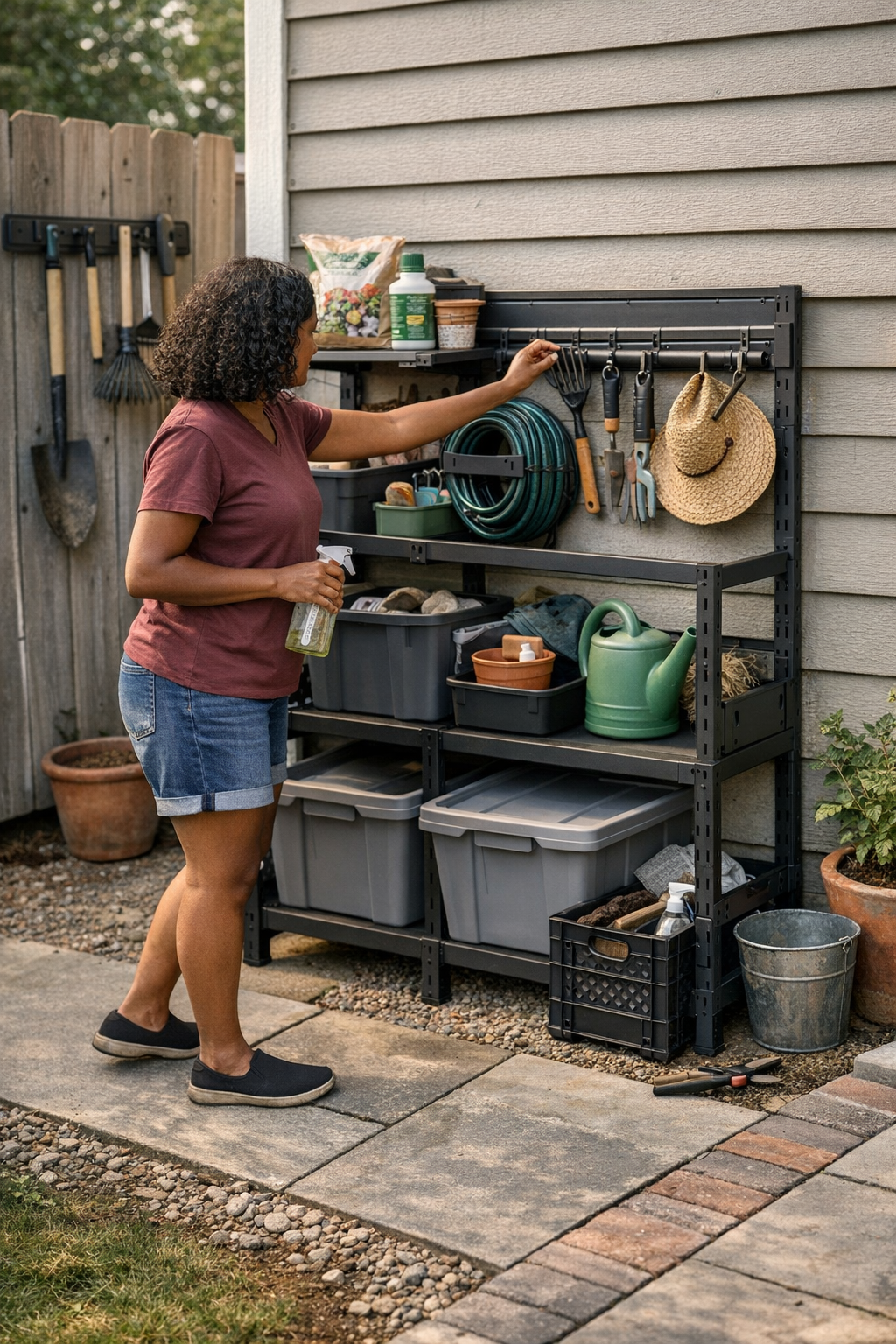
It doesn’t take much to send even a “tidy” backyard sideways. One weekend of real use—rain, rushed gardening, the kids tearing outside for chalk or a soccer ball—and suddenly the clean lines of storage bins and deep cabinets start failing in small, persistent ways. The problem isn’t always the mess you came home to, but how the setup slows your return: pop a lid, dig for gloves, squeeze everything back mid-routine, realize the thing you need is behind two others. Frustration grows quietly. You pause with wet pruners at the garage step, arms full and nowhere obvious to toss them, so you drop them by the fence and tell yourself you’ll deal with it “later.” Three days and a few minor rearrangements later, that later pile is a slow-motion blockage—always in the way, never quite resolved, so next time you do the same. Setup friction wins.
A Yard Only Works If the Flow Stays Open
What looks organized after a once-a-season clean-out rarely holds up in daily use. Outdoor life is all about movement: returning clippers on your way in, grabbing a soccer ball as someone’s unloading groceries, dropping muddy boots without sidestepping two crates and a hose. If the system expects you to wrestle a stack just to put away a trowel, most people will default to “temporary” piles—at the garage threshold, along a fence line, wherever there’s space but not actual storage. Those corners quietly capture overflow. Walkways shrink as bins migrate outwards, and a dead zone forms where things never quite get returned, just shuffled to the edge until it’s time for another big reset.
When “Organized” Means Unusable
Deep cabinets and matching bins line the wall. On day one, it looks under control—everything hidden, plenty of capacity. Then, midweek, you need the rake from the bottom bin and end up hauling out two layers to get to it. That watering can you use twice a week stands in front of the cabinet, always blocking the door. Putting away garden clippers means a juggling act with three other muddied tools that landed wherever was easiest last time. The more steps between use and return, the more likely you’ll just bail out and drop things wherever you can—especially if you’re hurrying, or if someone else is squeezing down the same path. Over time, you can map the friction: the sticky corner by the patio, the bottleneck at the garage entrance, the forgotten zone behind the grill where “temporary” now means “semi-permanent.” The setup that looked right on paper now asks for too many maneuvers and delivers too little flow.
Modular Outdoor Storage That Actually Keeps Up
What actually works isn’t more storage, but smarter, faster points of return. Open wall rails and shallow bins screwed up at eye level make it effortless to hang a spade or toss gardening gloves with one hand—no moving a crate out of the way, no fiddling with stuck lids. A side-yard strip, for instance: replacing those floor-stacked crates with a single open wire basket and a simple rail transformed the route from a bin-drag obstacle course into a smooth grab-and-store loop. No more shoving the mower over a half-blocked path; tools came off the wall and went right back after use, so nothing ever had a chance to pile up awkwardly. Overflow that once spread into the walkway now just… didn’t happen.
It’s not about hiding things, but about creating snap-return zones along the real lines of travel—at hip height by the door for shoes, shoulder height for handled tools by the side gate, plus an open bin for kid stuff by the patio. When the system fits the route you actually walk, resetting takes seconds instead of a whole Saturday. The testing points are unmistakable: If you have to put something down to open storage, you probably won’t; if you block access for every other return, overflow starts—all over again.
Scene: The Saturday Stress Test
Picture a real yard in motion: two people trading off yard work, teenagers grabbing bikes, the dog chasing a ball, shoes dropped mid-commute, someone squeezing a folding chair through the narrowest part of the side path. Every missed return adds up. Wire racks and rail hooks make it possible to snap things back with one hand, without blocking the only walkway. Every time someone had to pop open a bin, a spillover pile formed at the edge. But once returns could be done mid-stride—hook a shovel, toss gloves, set plant ties in an open basket—the pattern of overflow stopped before it started. Corners that always filled up kept their airflow. Entryways stayed passable without a cleanup marathon first. The difference wasn’t cosmetic, it was just less drag on every return.
Practical, lived tip: Put a no-lid, no-stack return point on every main route. Rail hooks or bins at areas of highest activity—the garage step, side gate, or near the fence—absorb real mess before it evolves into corner sprawl. The less decision it takes to put it back, the less reset you’ll need later.
Change the Routine, Not Just the Look
It doesn’t matter if a storage setup looks photo-perfect for five minutes after a deep clean. If it can’t absorb the constant shuffling of real life—tools used out of turn, gear dropped after dusk, overflow during family weekends—the mess cycles back faster than you want to admit. Every second saved on returns leaves more open space for next time. Flow feels natural, because even the busiest corners don’t get blocked or backlogged, and routines actually reset instead of repeat the same mistakes. Instead of navigating overflow, you see your yard as passable, usable, ready for immediate use—rather than “will be tidy after next weekend’s cleanup.”
No system erases mess entirely. There’s always one glove left behind or the single extra stake tossed hastily. But when small resets are built into the flow, these hiccups stay isolated. You’re not facing a project every time the yard gets real use—just a loop around the path and it’s done. That’s what organization looks like when it actually works outside: less fighting the setup, more moving through it. Find more practical outdoor storage ideas at TidyYard.