
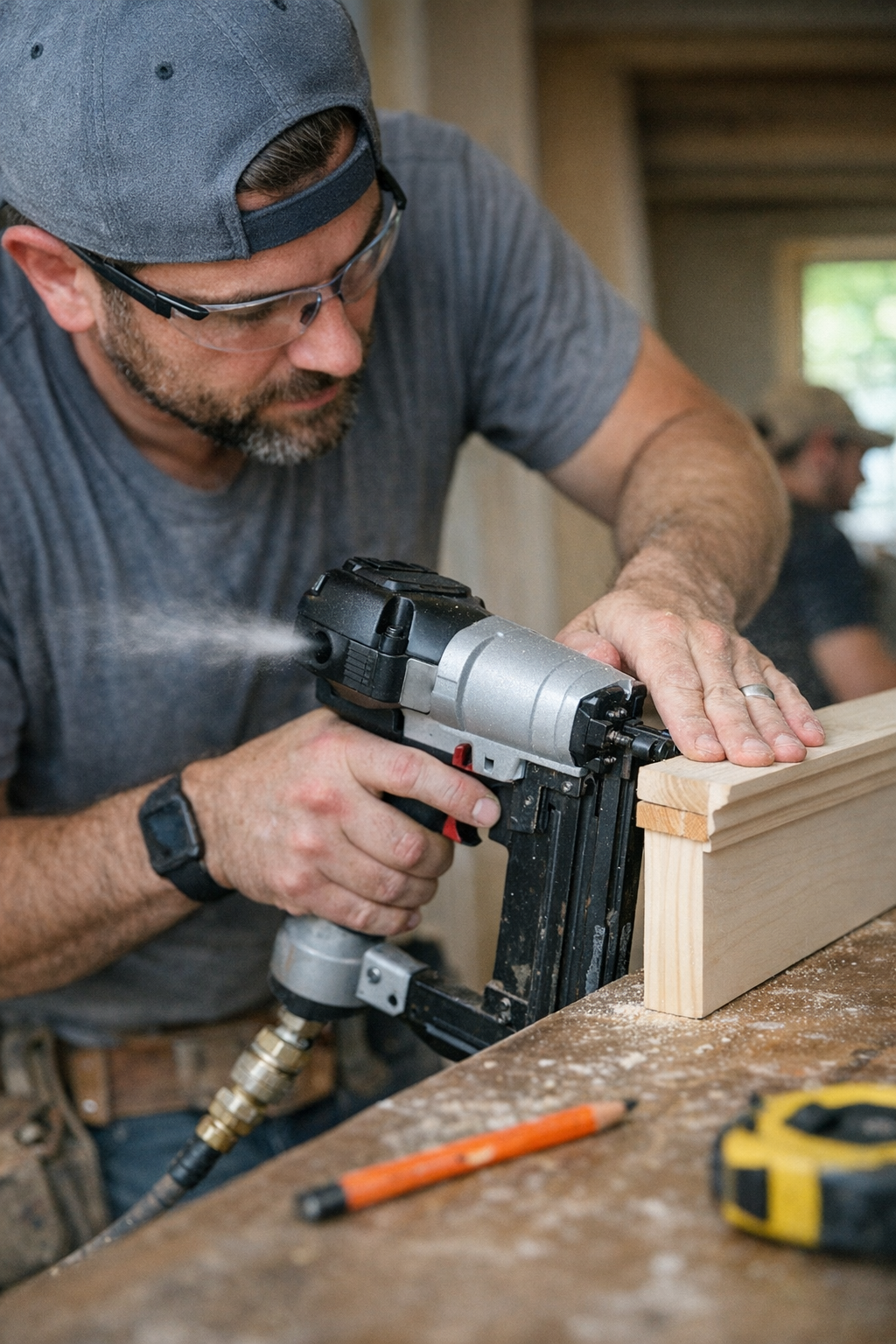
The first dozen nails never tell the truth. Most pneumatic nailers feel solid for a handful of test shots. Stand at the bench, take your time, everything lines up—no dust, no distractions, crisp trigger, flush nails. But the real test starts when you move from careful samples to a roomful of trim or a string of finish work. Suddenly, every shortcut in the nailer’s airflow design comes back to bite. Dust starts drifting over your marks, every clap of exhaust chips at your focus, and that smooth rhythm gets interrupted as you wipe down your board or squint for lost lines. Tool power and grip only get you so far. In the thick of a job, it’s airflow—the way exhaust moves, where it shoots debris—that separates a tool you trust from one you battle.
Airflow Missteps: The Slow Build of Friction
Anyone who’s paused mid-baseboard—wiping away crud, hunting for a buried line—knows airflow design isn’t just engineer trivia. A side exhaust looks harmless on the spec sheet, but real use tells a different story. After fifty quick shots, you’re left with trails of dust peppering your working edge, scratches marring what should have been a clean reveal, a layer of debris clouding the one spot you need clear. Each misplaced blow of air sets off a new chain reaction: more sanding, more touch-ups, more time spent coaxing heads flush instead of moving on to the next room.
This is the cost that doesn’t show in the specs—the repeated interruption, the minutes lost picking grit out of seams, the creeping frustration as a would-be-efficient nailer becomes one more thing to manage. Even a strong tool, if it spews exhaust in the wrong direction, turns fast finishing into backtracking and edge cleanup.
Design Over Specs: Where Nailers Actually Differ
On a shelf, every pneumatic nailer feels like a safe bet. Similar weight, magazine, trigger—nothing obviously wrong. But take them into a real job—where fast repetition and tight grain matter, where flush matters more than fast—and you spot the difference that work crews always notice first. It isn’t the logo or the feel, but how the tool manages what you don’t see: heat, pressure, swirling exhaust.
Consistency Slips When the Air Blows Wrong
Try running a side-exhaust nailer through prepped maple trim. The first few nails are fine. By the time you hit the fiftieth, fine dust is clouding every guide mark, bouncing into wet finish, and pushing you to tilt or twist the tool just to see what you’re doing. Each “click” leaves a mess you have to clear before you trust the alignment again. Sometimes proud nail heads creep in, even if your technique hasn’t changed. By late afternoon, you’re not just nailing—you’re cleaning up after the tool itself.
Swap in a rear-exhaust nailer and the equation changes. Exhaust air shoots behind you, away from the board, your hand, and the finish. The difference? Critical seams stay visible. Flush nails become routine, not a coin toss. You spend less time correcting and more getting clean, repeatable results across the entire run.
On-Site: Where Bad Airflow Really Costs You
Picture a long afternoon cut-up with trim and corner joints. By job number seven, you’re juggling precision, fatigue, and a swirl of loose dust. A side-vent nailer guarantees a pattern:
- Every shot sprays debris onto your marking lines
- Sections cloud over, pushing you to re-mark as you go
- You feel the extra heat as exhaust runs down your grip
- Proud nail heads force extra sanding just to keep up
Each flaw only takes a second to fix—but they add up. A moment’s wipe, a retouch here, a quick sand there. Before you know it, the momentum of your routine is broken. The line blurs, finish work slows, and what should be a smooth pass turns into a series of tiny cleanups. Not catastrophic, but never as clean as it could be—and never as fast.
Small Tweaks, Tangible Results
Retrofitting an exhaust or switching to a rear-vented model isn’t a theory. On a real job—58 nails into 40x10mm maple trim—just shifting the exhaust dropped surface splits to zero and meant every nail set flush on the first try. The grip ran cooler, eyestrain dropped, and cleanup at the end of the day felt almost like skipping a chore. Fewer sanding passes. No mid-job stops to mark over lines lost to dust. Instead of fixing errors, you’re stringing together clean join after clean join. Over a week, those minutes roll up into whole hours reclaimed.
No miracle—just a series of skipped frustrations and less wasted energy. Veteran crews don’t see this as a luxury; for stacked jobs or detail work, it’s what keeps the work tight even as tiredness closes in.
Watch for These Airflow Red Flags
Some signs that airflow is holding you back aren’t loud, but they’re painfully consistent:
- Tool vibration creeps up every hour you run
- Nail set becomes unpredictable, especially as the day runs long or the stock gets harder
- The housing warms up—noticeably—well before the shift ends
These “little” issues cost you more every time they repeat. What seems like a minor hassle becomes a grind of re-work, repeated fixes, early fatigue. Don’t treat airflow as a brochure buzzword. In the field, it’s the quiet factor that decides whether a nailer helps you finish strong or leaves you sanding out flaws until dinner.
Endurance on the Line: Why Airflow Rules in the Long Haul
Magazine size and trigger feel matter, but once the job stretches into hours, airflow becomes the silent differentiator. One nailer stays reliable, each pass just as clean as the first. The other asks more of you with every reload—more pauses, more sanding, more lost focus. On busy floors and jobsite corners, these are the differences that stick—especially when the margin for error vanishes and “close enough” won’t impress anyone at the walk-through.
Keep it practical: After any hint of surface vibration, uneven nail depth, or excessive body heat from the tool, stop. Clean the vents, test the exhaust direction. That five-minute tune-up is a smarter investment than forty minutes chasing second-rate results with sandpaper and filler.
Find pneumatic nailers and jobsite tools built for real work at Gumboll.