
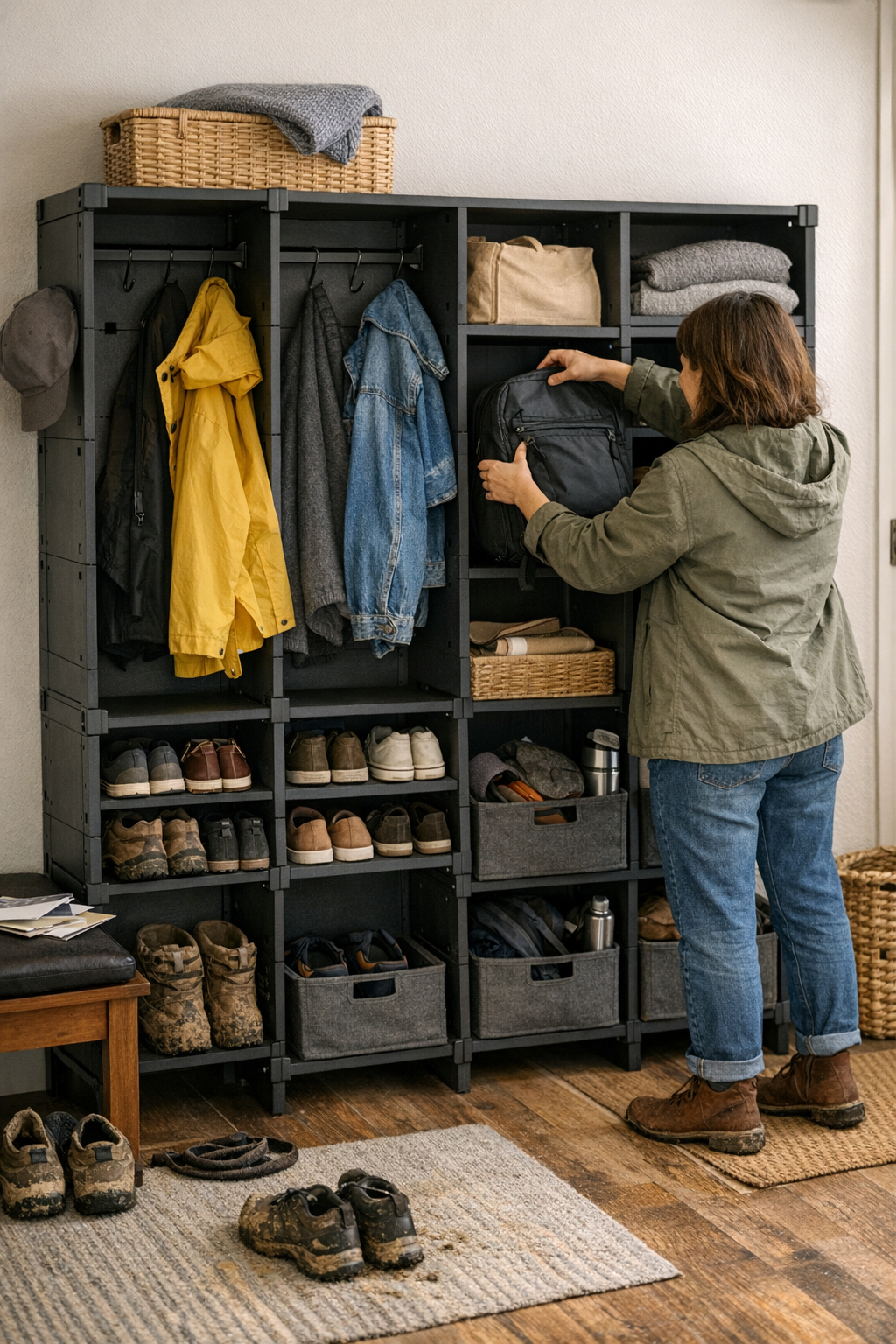
Entryway order isn’t lost in one moment—it leaks away, week by week, through the same repeated points of failure. That clean threshold you set up on Sunday is already fighting back by Wednesday: shoes slip past their “line,” bags slouch across the last open seat, and jackets land wherever mail was meant to be sorted. In busy homes, the difference between a kept-up entry zone and a daily obstacle course isn’t about how well things store when still—it’s about how quickly the area drowns in overflow when everyone is actually moving through at once.
Where “Simple” Storage Breaks When Life Speeds Up
The classic setup—a bench, a tray, a couple of hooks—looks crisp in a photo or after a deliberate reset. But in daily use, it’s not the tidy version you live with. As routines turn frantic, small breakdowns add up: the single shoe tray becomes a shoe horizon; one bag, hastily dropped, dominates the bench edge; and the “catch-all” basket becomes a melting pot of hats, keys, and outgoing bills. The difference between visual order and real control isn’t about a system’s potential, but its survival under repeated pressure. Most entryway ideas look “organized” for two days—then default back to blend-and-shove by midweek.
Interlocking Panels: Disrupting the Drift
Standard setups encourage drift: the hope is things will land close enough to their zones to work. Interlocking panel systems break that drift with physical boundaries—every time, for every item. Instead of a shared drop zone, each shoe, bag, or coat has to claim its bay or slot or not fit at all. No one’s “extra” shoves into common space unnoticed. These divisions can seem rigid at first, but once actual routines hit, the benefit isn’t theoretical—it’s instantly visible in the way overflow is caught early and obvious, not quietly swept off until the weekend.
Real-World Crunch: Where Weak Storage Fails
When everyone piles in—school bags thudding down, muddy boots side by side, wet jackets seeking the least-bad landing—the bench-and-basket combo folds almost immediately. The first wet coat ends up on top of the mail, shoes expand into traffic lanes, and anyone aiming to sit down finds themselves clearing someone else’s heap. You’re not resetting; you’re detangling. By the second round-trip of the day, the boundaries collapse. Every system “works” when it isn’t being tested. In a high-use threshold, the cracks appear at full speed.
By contrast, with interlocking panels, every item stops at its assigned line. Shoes hit the physical end of their slots—no shuffling outwards. Bags drop straight into their bays, not onto shared seats. When something spills over, it’s not hidden; it’s blatantly out of place and pushes an instant fix. Resetting becomes a habit measured in moments, not minutes of sorting and stacking.
Pressure Points: How Clutter Sneaks In—and How Panels Push Back
- Bag drop, clean zone lost: One off-aim backpack on an open bench creates a new magnet for gloves, papers, and headphones—turning a small slip into a full spread. Slot-based panels block this drift by refusing to let random drop-offs blend in.
- Shoe lines collapsing into piles: Every shoe mat starts as a single-file lineup. By Friday, it’s a multi-width scatter unless each pair has a walled or slotted boundary, forcing the row to restrain itself.
- Bench becomes “storage” again: The seat’s there to sit—until it’s needed in a rush, and every overflow item claims the available space. Panels hold chaos aside, keeping the bench truly usable—no reshuffling required just to take a seat.
- Blocked path, slow recovery: Undefined storage means one bulky jacket blocks a hook, shutting off access for everything else. With vertical separation, restoring order means moving one piece, not unjamming the entire rack.
Panels Don’t Prevent All Mess—But They Expose the Problem, Fast
Panel systems don’t make clutter impossible; they make it visible and blunt. Assigning a bay to each household member and allowing just a single shoe row—notably, 90cm can cover the basics for one person in a compact entry—means every overflow is a signal, not something that fades into background mess. When categories start to blend, you see it before the pile grows. The goal isn’t a magazine-shoot entry: it’s a setup where disorder stands out early, so resets return to frictionless faster—no hidden heaps, no multi-day buildup under bags or behind the door.
Structure here delivers on its promise only under pressure. Clear, enforced boundaries mean every re-entry and exit takes less time and negotiation. Even in the weeks when schedules get chaotic, the reset cost stays small—you’re not dreading the threshold or banking a full hour on the weekend just to restore usability.
Vertical Boundaries: Keeping Categories Separate—When It Counts
The vertical separation effect is practical: a wet jacket never lands on the mail; muddy boots never topple into a basket of scarves or hats. Panels insulate the mess, so even in a tight entry any misplaced item stays isolated. That’s the difference between a controlled system and an ever-tightening threshold, where one wrong drop gums up the whole flow for everyone.
The Real Value: A System That Resets Without Drama
Open baskets, shelves, and flat benches promise flexible storage, but every shared surface eventually turns into a generic pile. That means every pass-through gets clumsier, and every “tidy” becomes a full-blown reorganization. Panels lock down categories—overflow doesn’t sneak by, and movement stays unblocked. Without constant shuffling, just getting out the door becomes smooth—no forced resets, no lost minutes searching for what was hidden by the last rush.
The real shift for small, high-traffic entryways isn’t just a clean look—it’s breaking the cycle of quiet buildup and costly resets. Investing in more structure is about reclaiming speed and sanity, not achieving perfection, especially when life routinely blows past best intentions and every minute at the door actually counts.