
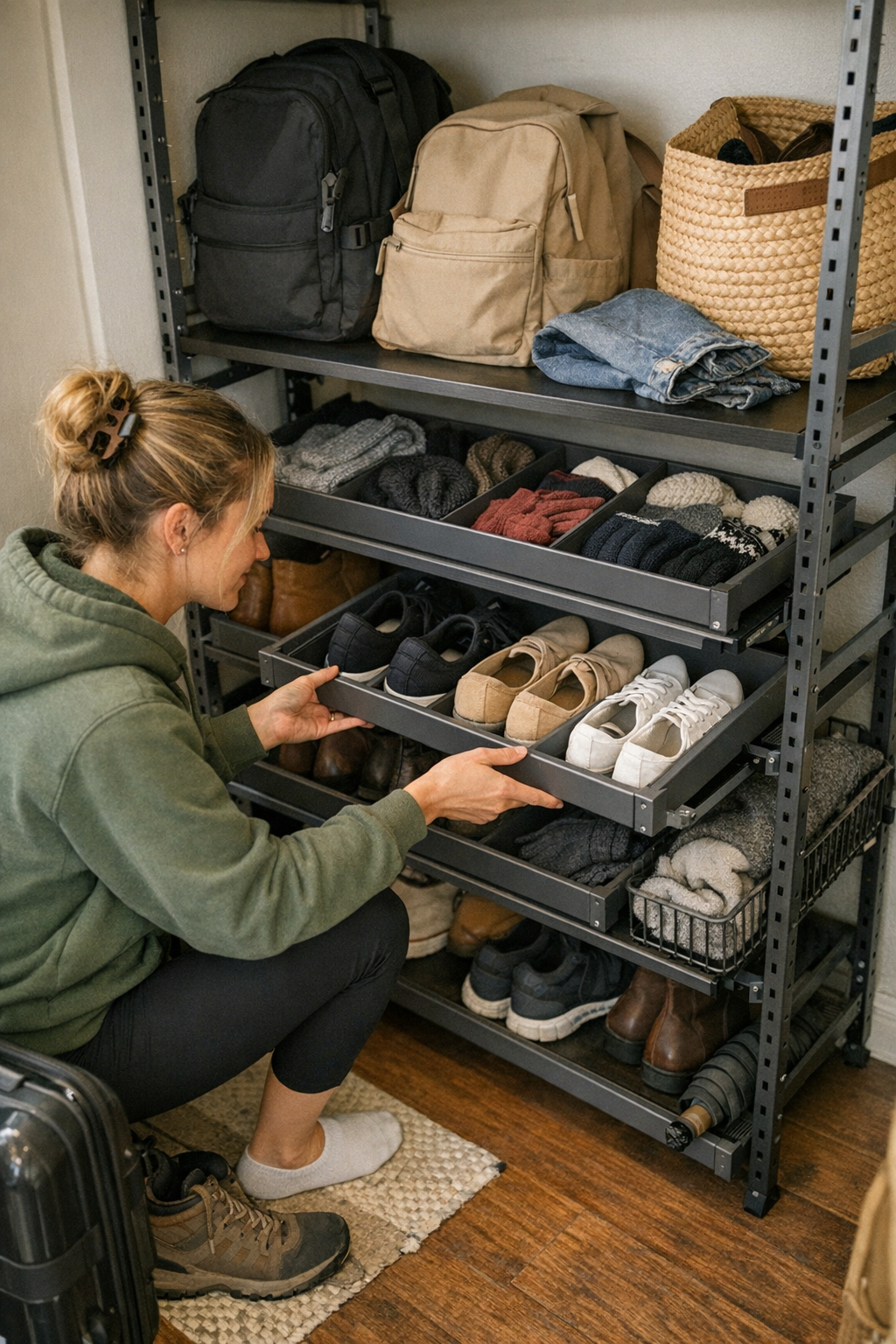
True storage success isn’t about how clean your closet looks on day one—it’s about whether the system still holds up once the everyday scramble actually begins. Most setups seem fine at first glance: baskets aligned, sweaters folded, shoes paired and parked. But real life is never still. Every weekday morning tests the system—blindly feeling for boots in a dark closet, digging past coats to find a single glove, shifting three bins just to fish out a gym bag. The difference between “organized” and genuinely functional storage is measured in these hurried, repeat-use moments that set the tone for the day.
Everyday Storage Friction: Where It Really Shows Up
The slow creep of chaos rarely shouts. It’s silent, steady, and familiar to anyone living with clutter that doesn’t start messy but slides there fast. By midweek, you’ve likely felt:
- Stacks swelling to the edge of shelves, folded sweaters slipping into lopsided towers after just two grabs.
- Baskets and bins losing their roles, turning from sorted categories to bottomless catch-alls—a winter hat tangled with outgoing mail, last week’s mittens buried under today’s scarf.
- Entryways choking up with shoes and tote bags, making the only clear floor space the spot you’re about to cover with whatever you just walked in holding.
- The daily shuffle and rearrange, where simply putting something away means sliding, restacking, and hoping it doesn’t all collapse by tomorrow.
What’s subtle on Sunday becomes friction by Thursday. Small annoyances add up—each wasted motion tempting you to drop something “just for now,” setting off a chain of clutter that feels harder to undo every day. Unless the setup is built for this constant motion, it slowly loses shape and purpose.
Surface Order vs. Real Function: When Good-Looking Systems Fail
The right baskets, matching bins, and tidy shelves can fake order—for a while. But neatness doesn’t survive daily use if the logic behind the categories isn’t clear. Without firm dividers or visible boundaries, baskets slide into chaos: yesterday’s paperwork sinks beneath today’s scarf, and every search turns into a rummage.
Open shelves are especially prone to slow drift. Placing things back never happens as neatly as the first time. Shoes inch forward. Sweater piles slouch left or right. Anything at the back turns invisible, impossible to reach without dislodging everything in front. The illusion of order erodes in minutes, and one hurried morning leaves the system looking ransacked until the next reset.
Up Close: The Week in the Hall Closet
Consider the overworked hall closet: wire shoe rack below, open shelving above. On Sunday, everything lines up. But by day three:
- The front row of shoes has crept forward, cutting off access to any pair in the back row.
- Snagging sneakers from the rear means balancing on one foot, removing boots, and causing the whole row to wobble.
- Gloves have no clear landing spot—they’re draped over shoes or stuffed behind coats, gradually forming their own unplanned heap.
- By Friday, you’re fishing for one mitten in a pile of hats, boots, and December’s forgotten lunch receipt—all layered and tangled together.
Each “simple” grab takes longer. Every time you return something, the original order collapses further. The cost isn’t just mess—it’s lost time, extra effort, and frustration that leaks into the next part of your day.
How Small Upgrades Create Lasting Categories
Most friction in daily storage use comes from a lack of clear, anchored categories. Now picture that same crowded closet, but with shallow, pull-out trays segmented by adjustable dividers. Shoes each get their own lane. Gloves and hats land in labeled, see-through bins above. Suddenly, every item has a staying spot—even after repeat grabs:
- Grab shoes without disturbing the whole row. No more digging or rescuing crushed pairs from the bottom of a heap.
- Return gloves to a defined compartment, not a vague bin where patterns blur and items disappear.
- Overflow is obvious—if a category fills, you see it instantly, rather than discovering the problem weeks later in a mountain of stray gear.
- The closet not only stays visually together through the week, it feels reliable: no second-guessing what goes where or how much friction you’ll face Monday morning.
This doesn’t require a full renovation. Sometimes, swapping a deep, mystery bin for a shallow, open-front tray—or installing one adjustable divider—shifts the whole routine. The way you move through the space changes. You stop double-handling items. The reset takes seconds, not minutes.
Category Clarity: The Key to No-Guesswork Storage
What works on Instagram isn’t always what lasts in a living home. The setups that endure are built around routines that repeat: pull, use, return—without thinking. If your system demands constant restacking or “resetting” means starting over each week, category clarity is missing.
Test your setup: can you single out a category—a bag, workout clothes, winter hats—without touching everything else? If not, define a home for each frequent-use item. A shallow tray, a clearly divided shelf, or a set of labeled hooks can turn habitual clutter zones into permanent order. Ask honestly: are your keys, gym socks, or headphones actually within easy reach, or are you always fishing them out from behind something else?
Tip: When In Doubt, Go Shallow
Deep bins and thick stacks are hiding spots, not organizers. If you ever find yourself sifting, opt for storage that’s shallow and visible. The less you have to dig, the less mess you’ll make. Often the most sustainable fix is pulling out a bulky bin the system didn’t need and replacing it with a low-profile tray that leaves every item in plain sight.
The True Test Is Reset Speed
Clutter rarely explodes in a day—it creeps in when resetting the space starts to feel like work. When a storage setup lets you put things back in a matter of seconds, clutter never gets a foothold. Messes stay small, routines stay smoother, and your attention moves on to better things than tidying the closet—again.
Watch out for these warning signs:
- Category zones fading together—no one’s sure where anything belongs
- Returning items that require three steps when one should do
- Stacking, shuffling, and “quick fixes” becoming routine instead of rare
If any sound familiar, the design is adding weight—not removing it.
Function Over First Impressions—Every Time
In homes that see real use, organization isn’t about staged photos or tidy surfaces that collapse under pressure. The right storage system holds steady through a full week of living: what you grab on Friday feels just as easy and obvious as it did on Sunday. Messes are brief, not embedded. The payoff isn’t just a cleaner space—it’s a smoother routine, less frustration, and a closet or entryway that fits the way you actually live.
For storage solutions built for real routines, visit ClosetWorks.