
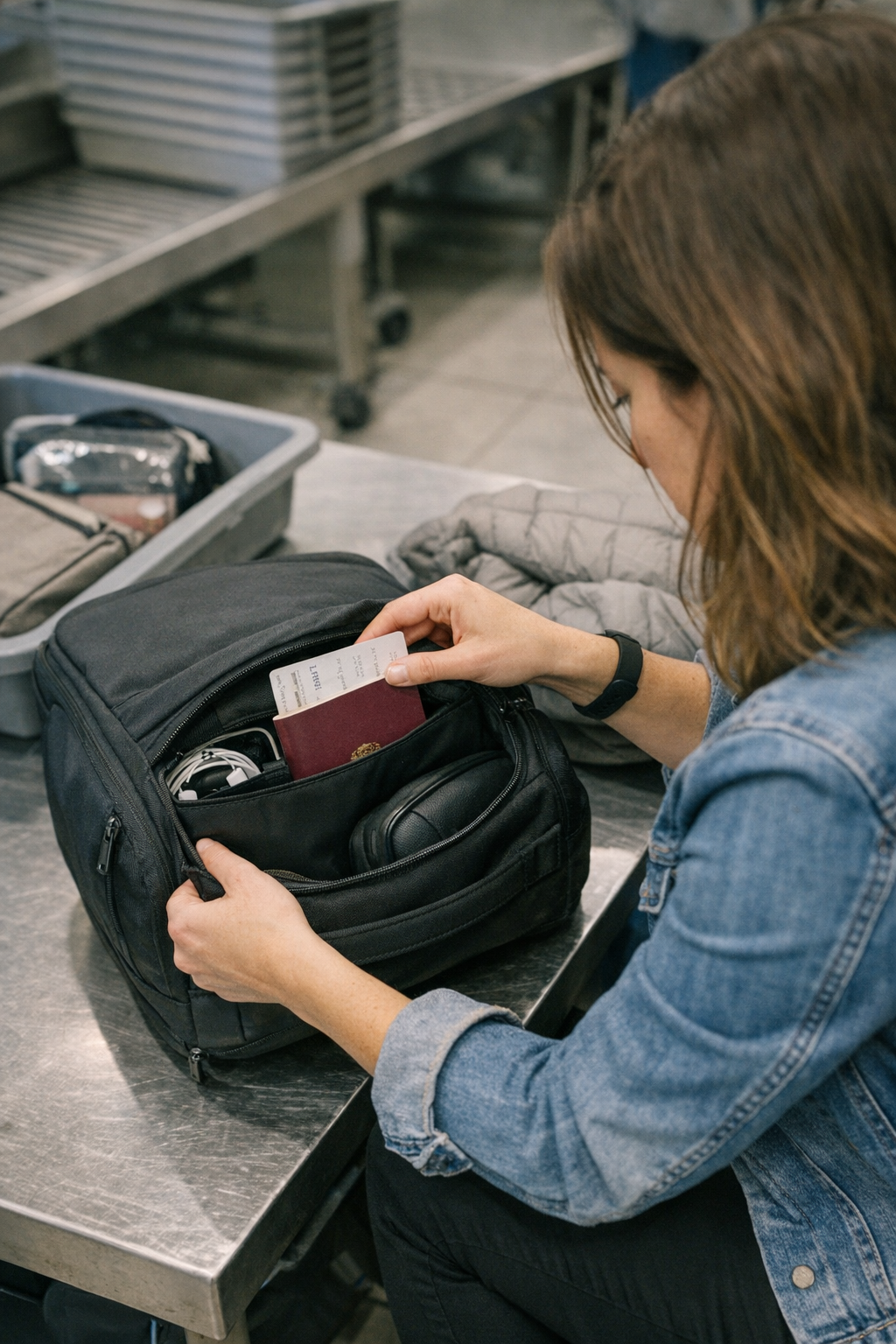
Your carry-on can look perfectly organized—and still slow you down every single time you move. If you’ve ever felt that spike of frustration when you reach for your passport at a crowded security tray or need your ticket at a boarding gate, you’ve seen it: all those orderly pouches and zipped compartments turn into barriers the second speed counts. What seemed smart on your hotel bed becomes a tangle of layers—passport under tech gear, charger tangled above travel docs, ID wedged behind toiletries. Suddenly you’re pausing, hands in multiple pockets, the line behind you building impatience. That moment exposes the difference between having control over what’s in your carry-on and actually being able to get to it when it counts. For frequent travelers, this friction isn’t rare. It’s repeated—every line, every tray, every return to the bag.
Why “Looks Organized” Isn’t Enough When Moving Fast
One mistake almost every traveler makes: believing more containers automatically mean better access. Sure, your bag sits like a showroom piece on a hotel surface—everything slotted, parallel, staged. But the real world isn’t neat or slow. You’ll feel the flaw the first time you have to reach for your passport while the queue surges and realize it’s trapped under two pouches and a cord sleeve. Each extra layer—promising “less mess”—actually raises the odds you’ll hunt for zippers, dig through pockets, and lose rhythm under pressure. What looks composed quickly becomes a bottleneck the moment movement speeds up, especially in environments built around flow, not aesthetics: security lanes, crowded boarding areas, narrow aisles. Forgetting that access comes before order means having to unpack confidence in public again and again.
The friction isn’t just first-day nerves. It compounds: Open, shuffle, pause to think—then repeat for every checkpoint, tray transfer, or boarding group. By mid-trip, the setup you praised for being “handled” is dragging you backward, forcing public repacking as other travelers press forward. The order hasn’t vanished; it’s just blocking what you need most when you need it fast.
Where Carry-On Friction Builds … and Keeps Returning
That Familiar Scene in Airport Security
6:05 AM. Security line jumps forward unexpectedly. You edge your bag onto the tray, aim for your passport—and remember it’s zipped beneath layers you thought would “streamline” your trip. Now it’s both hands juggling cubes, moving gear in a rush, knees pushing the bin. What felt like control becomes an awkward scramble: fingers stuck in the wrong pocket, devices on display, small items sliding loose under stress. Repacking now means resetting the same trap for later, as quick “just for now” moves turn into more steps at the next touchpoint.
Boarding Lines and Overhead-Bin Moments
Gate calls boarding. You grip phone, pass, headphones—then freeze as you realize your ID is zipped two levels below, behind a wall of “systemized” pouches. You shift items, bag sags open, a slip threatens to spill, anxiety spikes. The group behind you tightens as you dig. By your seat, the neat repack takes twice as long because you’ve just performed a one-handed pouch shuffle in the middle of a boarding stream. Travel order resets, but the interruption cost is real—and it comes back every time.
In-Transit Retrieval: When “Everything in Its Place” Blocks Flow
Mid-flight. You want your headphones. Instead, you’re unzipping a compartment layered with paperwork and stray receipts—documents now wrinkled, cables uncoiled, what was “orderly” devolving into a quick-access obstacle course. Small retrievals create new mess, making every later reach risk another mini unpack. The system that kept things visually perfect now means repeated micro-adaptations in motion—time lost, and focus scattered throughout the trip.
A Practical Shift: How Frequent Flyers Actually Pack for Access
Experienced travelers ditch symmetry and prize fast reach: essentials don’t get buried—ever. That means separating passport, tickets, key tech, and phone into top-access, one-motion compartments. Forget stacking—these use slip pockets or open flaps you can reach while your bag’s still on your back or shoulder. The neat logic of hotel-night packing vanishes at gate pace. Suddenly, it’s not about ultimate visual order, it’s about extraction speed on the fourth trip through a checkpoint.
Envision a tight transfer at a major hub: your passport, “secure” under nested organizers and a charger roll. On paper, safe. In practice, a multi-zipper fumble as you sense the line close behind you. Travel doesn’t pause while you repack. Well-meaning setups that look perfect on Instagram don’t survive real airport rhythm.
The “Quick Exit” Pocket: A Quiet Solve for Repeated Interruption
The unlock isn’t more organization—it’s a single, easy-access pocket for only your highest-use essentials. No zipper routes, no overlap. A wide, rim-facing slip compartment on the outer layer keeps documents, passes, and go-to tech visible and grabbable—without letting the pocket turn into a dumping ground for snacks or paperwork you don’t need to touch. Limit this section to what you actually reach for during transit. Each retrieval becomes a single, predictable move, not a three-step shuffle. Even when reboarding or lunging for a bin, you aren’t slowing for a pocket search. You move—your bag moves with you.
How Over-Organization Can Slow the Real Trip
Packing cubes, color-coding, standalone cases—they look like solutions, but on the move, they create new hurdles. Each added sleeve increases the chance of pouch confusion, forcing your hand to follow a choreography that fails once timetables shrink. Outer compartments—designed for speed—turn into deep “junk drawers” as layers stack, and each access becomes a search, not a withdrawal. This isn’t a hypothetical: most travelers see it halfway through their trip, repeating the same access puzzle in lines where impatience is the rule, not the exception.
The pain point is real at busy times: after takeoff, in low cabin light, you stand for headphones and discover a grid of shifted cubes and extra cases block what used to be a simple grab. Instead of pulling and sitting, you risk dropping gear or holding up others, forced again to patch up neatness under pressure.
Designing a Carry-On Setup for Real Movement
The rule of thumb: If you’ll need it before landing, don’t bury it. Group slow-use and “just-in-case” items down deep; defend the top entry and outer slip zone for repeated retrievals—documents, passes, compact chargers, a travel pen. Leave room for the setup to flex: slight mess is fine if it means you never hesitate at the worst moment. The point isn’t photo-friendly order, but snap decisions and recovery—a setup that stays light and accessible through every checkpoint and churned boarding, instead of locking you into routine repacking cycles.
The best carry-on isn’t the one that impresses in photos, but the one that spares you reentry friction after the first tray, the first boarding line, the first time you need to move faster than your bag’s “system” allows. Minimal steps, one-reach access, fewer crowd-induced fumbles: that’s the kind of flow most repeat travelers quietly learn to build, and the difference that makes every round trip less of a process and more of a path.
Ready to dial down carry-on friction for your next trip? Browse gear that fixes repeated travel interruption at CarryOnSupply.