
You know the exact moment your outdoor storage makes life harder—you step outside to drop a trowel or toss a soccer ball back, and what should take seconds turns into kicking aside shoes, yanking open overstuffed bins, or clearing yesterday’s clutter just to reach your target spot. Small yards and side corners reveal their failings fast. One-minute resets balloon into drawn-out detours, blocked walkways, and a silent dare: how much more mess can this corner absorb before someone calls it quits? What looks neat on Sunday becomes a frustration loop by Tuesday—especially when the gear doesn’t end up where it’s supposed to, and the area stops working as a path and becomes another pileup zone.
Why Most Outdoor Storage Fails in the Real World
The real friction isn’t about bin size or shelf style—it’s about whether the setup lets you and everyone else make a single, obvious move in and out, every time. If your routine becomes a relay race of moving one thing to get to another, the cracks show fast. Each missed return—gloves here, boots over there, a stray coil of hose—adds invisible labor that stacks up with every use. The larger the family or the more frequent the chores, the more you notice the slowdown.
What seems organized at first—a new rack, a few sturdy bins—evolves in a week. Benches double as clutter shelves. Bins fill and overflow, lids crack open just enough to tempt, but not enough to empty. A once-usable path now snakes around abandoned bikes or forgotten sports gear. That “quick yard reset” isn’t quick anymore. Instead, you’re untangling someone else’s stash just to do your own simple job. The setup isn’t neutral—it quietly dictates how often you’ll have to start over.
How “One-Trip” Storage Shifts the Pattern
You see the upgrade the first time you can put something back without moving three things out of your way. Suddenly, five-minute chores really are five minutes. When the most-used gear has a visible lane back home, not just “a spot somewhere,” pickups and drop-offs become natural. In houses with kids, roommates, or regular guests, only storage that holds up to chaotic, multi-person use stands a chance. Everyone’s habits get baked into the flow—or the setup collapses back into chaos anyway.
The Real-life Collapse of Bins and Racks
Loose bins and simple open racks almost always unravel. By midweek, that roomy deck box swallows everything—then overflows. A ball bag disappears under a pile of towels. Rakes and spades vanish behind camping chairs. Pretty soon, digging out what you need makes each trip longer—and each “return” dumps something else further out of line. The bins shift, the piles mix, and each retrieval makes the next return harder. Momentum builds—but in the wrong direction.
Wall Systems with Built-In Paths: Breaking the Cycle
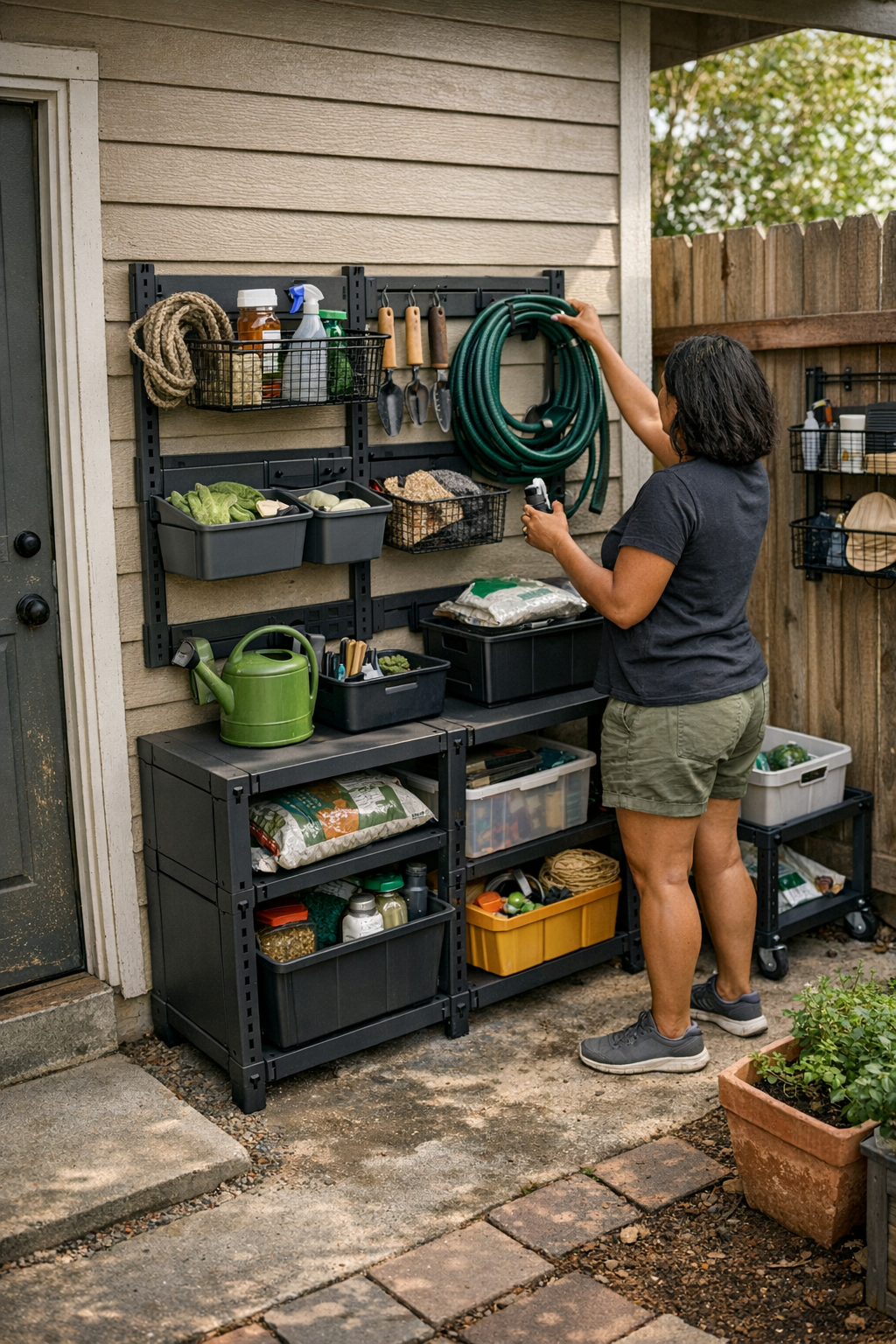
Now picture a wall track with labeled hooks, baskets, and defined landing spots. The setup shows, not just tells, where a watering can or a muddied set of gloves belongs. A missing item stands out; a pileup gets corralled quickly. No guesswork, no endless shuffling. The outdoor area stays navigable even after a busy weekend—small laps, not big resets. Items find their spot, or at least don’t block the entire flow when everyone slacks off. Instead of the same bit of gear being the trip hazard daily, it lands in its pattern and the system absorbs the mess, rather than broadcasting it.
Bottlenecks: What Clogs the Side Yard
Walk any real side yard or narrow driveway in summer and you’ll map the pain points quickly. Hoses get half-wound and sprawl into the walkway. Folding chairs pile up just inside the fence—right where everyone needs to move. No system for how to return things means every user picks their own landing spot and chaos scales up. The difference between a shelf and a hook, floor vs. wall, changes the work: one setup sheds mess, the other traps it.
The classic pattern: one person hangs bags, another leaves muddy boots by the gate, someone stashes tools in a crate. By Saturday, planning to hang hammocks or grill is a slow-motion obstacle course. Need a rake? It’s under chairs. Want the soccer ball? Both racks are now buried. Resets get drawn out—more shifting piles, more walking in circles, less actual use of the yard. Each “quick tidy” just rearranges the same problem spots.
When a Simple Wall Track Clears the Choke Points
Swap loose bins for a six-foot wall rack with hooks and deep baskets—suddenly, each everyday item (watering can, brush, gloves, grill tongs) gets a visible spot. After a cookout or a round of gardening, putting things away means one direct loop instead of three. Even when people leave piles—chairs near the track, stray shoes—the fix takes a minute, not an afternoon. The new system absorbs the drift. Walkways stay open, and everyone—even chronic slackers—tend to play along, because the alternative (mess pile) feels like more work than using the wall.
Spotting Outdoor Storage Friction Fast
- Loose floor bins block movement. They fill quickly and sprawl, interrupting natural paths. Even a “flexible” bin set traps you into reroutes when grabbing something buried below.
- Wall space is underused or oddly placed. Hooks too high, baskets crammed tight, or sections not aligned with entry points—so the overflow always lands back on the floor.
- Hidden dumping grounds swallow the overflow. A single corner, tower, or bench gets loaded with extra gear midweek. It looks manageable until you actually try to put something away—then it’s clear you’re up against the pile, not the system.
- Resetting always needs two or three steps. To store gloves, you push the garden bin aside, realign chairs, and pop a stuck lid—all before getting to the real task.
- Surface order, hidden friction. Even when racks look organized, if traffic routes get blocked or the path from yard to door clogs, the setup isn’t working—it just looks tidy from a distance.
What Actually Holds Up: Storage That Survives Habit
The best outdoor setups aren’t those that look perfect on install—they’re the ones that bend to real habits and still hold shape. Modular wall tracks with spaced-out return spots, hooks deep enough for awkward tools, and wide baskets with room to see what’s inside keep routines moving, even when two or three people are bouncing in and out at random. The right layout absorbs chaos instead of multiplying it. Messes stay contained. Routes stay open. The reset after a long week drops back to a true five-minute loop, not a half-hour overhaul.
The benefits snowball: every clear return path means minutes saved each day, and full hours reclaimed over a season. Less tripping over bins. Fewer blind corners overflowing by Wednesday. A yard that feels ready for anything—because the system meets you at your practical worst, not just your organizational best. When outdoor storage cuts physical retracing and allows direct returns, the whole space breathes easier—even if people don’t change their patterns.
Smarter Moves for Real Setups
- Put high-traffic gear in the easiest spots—even if it breaks the “theme.” It’s better to grab and return in one step than to preserve textbook order no one actually uses.
- Don’t block every wall just because you can. Leave visible open lanes near doors and walkways—this makes it faster to notice out-of-place items and stops gear from swirling into traffic zones.
Any outdoor setup gets messy—but how messy, and how hard it is to reset, comes down to whether your storage absorbs or amplifies daily movement. Every trip saved and every shortcut restored means less of your weekend gets burned on rerouting piles or hunting for “lost” gear. The difference between theory and real use is clear the next time you need to find—or put away—anything before dinner.
Find practical outdoor storage that fits real routine, not just square footage, at TidyYard.