
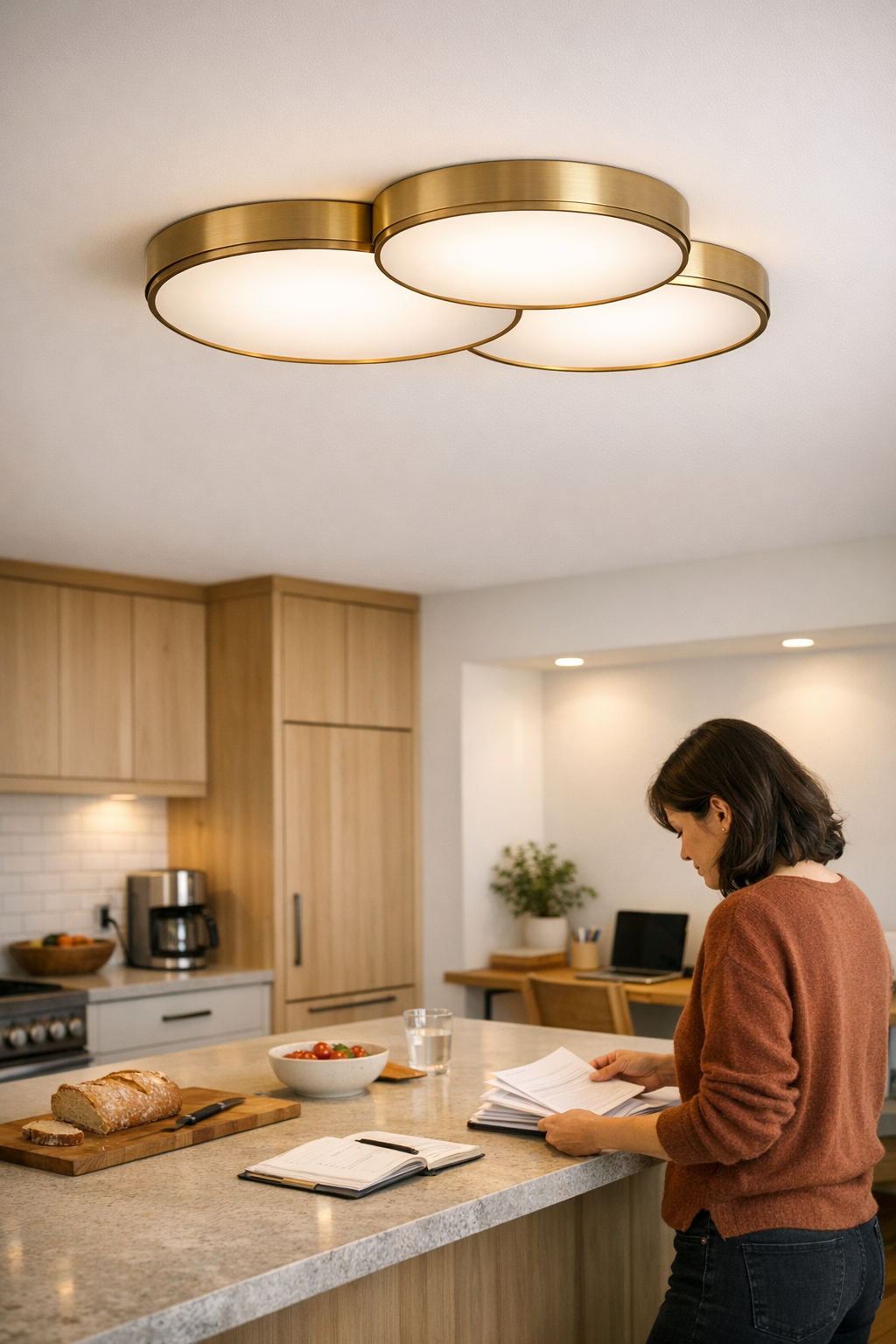
Every weekday evening, the same problem appears: Your kitchen counter looks clean and “done,” but daylight is gone, and now one patch burns with overhead glare while the next slips into a dull shadow. Slicing vegetables or wiping up crumbs, you keep dragging everything back to the only spot where the light actually helps—and each time you catch yourself, it’s obvious the ceiling lights aren’t matching how you use the space. Instead of evenly-lit surfaces, you get harsh bright zones broken by gray bands. The kitchen worked on paper; in practice, daily tasks keep colliding with lighting that divides the counter into neglected stretches and overexposed pools. The setup isn’t broken, but it keeps forcing small, silent workarounds.
The Real Annoyance of Ceiling Light “Pooling”
This friction doesn’t show up the first night the new fixture is installed. At first, a fresh ceiling light or grid looks tidy, even impressive. But after a week of late-night emails at the kitchen table and morning meal prep, the reality sets in. Patterns form: You keep shifting the mail into a bright rectangle. You avoid one corner where reading labels means squinting. The overhead fixture makes some surfaces look “fixed,” but in motion, those zones of light chop the space into areas that interrupt your routines.
This uneven coverage—where brightness clumps in one spot and tapers off too soon—is classic light pooling. Overhead fixtures that look clean at rest create visual seams and blunt shadow lines along your counters, desks, or hallways. Try reaching for the edge of a workspace or checking what rolled under a shelf: You find yourself compensating, angling, and moving, because the fixture’s light stops just short of where you actually work. It’s a slow, creeping performance problem, not a dramatic failure.
Why Even “Minimal” Setups Still Create Friction
Flush-mounts, recessed cans, and slim ceiling panels all sell “minimalism,” but when these fix light in one direction, the problem just shifts shape. Tight beam cones make for neat blueprints but leave real surfaces split into bright spots and shadow-rims. Even a grid layout, meant to banish clutter, can map invisible boundaries across a room—especially once you start working or cleaning in real locations, not just standing where the catalog photo aimed the light.
Each time you slide paper to a different side of the table or reach under a floating shelf, the line between enough light and not-quite reaches your hand. The surface tempts you to use it, then splits your work between a hot pool and a dim edge. There is rarely a total failure, but the friction is steady: surfaces half-lit, one side of a walkway always murky unless you relocate your routine to suit the fixture’s grid.
Repeated Discomfort Adds Up
Annoyances compound, not because light is missing, but because it’s in the wrong place at the wrong time:
- Cutting with one hand while shielding your vision from overhead glare
- Feeling along a shelf, never quite finding clean edge visibility
- Catching a cable run or bracket in your line of sight every evening
- Assigning a corner of the worktable as the only area “worth” using
This isn’t a layout quirk—it’s a repeated failure to support how a room actually gets used, especially in zones that blend work and daily life.
How the Right Fixture Turns “Resolved” Into Actually Usable
The improvement is instant in demanding spaces. Consider a kitchen doubling as a home office: Adjustable ceiling spots once “solved” the need for flexibility, in theory, but left a blacked-out counter edge every evening. After switching to a flat, broad LED panel flush against the ceiling—with cabling hidden in an unobtrusive bracket—the forced dance between bright and dim ended. Light finally reaches both the main prep area and the far corner, so you’re not forced to haul your work or cleaning supplies back and forth, tracking the light across the room.
No need for heavier bulbs or extra lamps—the win comes from smoothing the distribution. By replacing those two old overhead darts with an evenly-diffused, low-profile panel, the room stops dictating where you stand. That stubborn band of shadow (the one you learned to avoid with a soft shrug every week) simply stops existing. Where you once thought about stick-on task lights or running another extension cord for a lamp, suddenly you’re done. Edges are visible; counters stop hiding smudges. The light no longer divides the room into “usable” and “annoying.”
Support Hardware Should Fade, Not Distract
With many setups, the hardware itself becomes the friction point. Exposed brackets, cables, or makeshift management schemes push themselves into your view every time you look up. Good lighting support—clean brackets, hidden channels, or snap-in hardware—disappears from attention. The test isn’t whether you admire the bracket, but whether you stop seeing cable paths entirely as the surface keeps working for you. When support stays visually silent but removes setup drag, the change is genuine.
When to Upgrade: The Telltale Signs of Pooling and Patchiness
Even with an uncluttered ceiling or sleek fixture list, you see it if you look for it:
- Persistent reading trouble at the desk edge—no matter where you sit
- Hallway sides and shelf backs lingering in shadow, forcing awkward stretches or missed dust lines
- Spots of glare or “hot zones” so strong you flinch or consciously avoid them
- Cables or DIY supports drifting back into sightlines, undoing even your best tidy-up effort
The workarounds become habits: stacking tools in one favored light spot, leaving an area unused except as storage, nudging the lamp for each task. The fix isn’t “more light”—it’s even, background light that actually supports activity. When minor frictions—dim halves, glare blooms, stray hardware—vanish, you realize how much smoother the room can feel.
Uneven vs. Even: Real Use, Not Just Visual Calm
Linear LED panels and broad diffused fixtures change behavior, not just atmosphere. One thoughtfully-placed, low-profile panel sends light smoothly across an entire surface, eliminating the old patchwork of brightness. Multiple compact fixtures only work if their beams blend with no seams; too often, they carve up your working areas into bright cores and dead borders. The real test is how you move: If you’re no longer driven to follow the brightest patch or clean only what you can see in a beam, you’ve found the setup that works with—not against—your routines.
The goal isn’t a ceiling that looks spare on a video call. It’s a countertop that’s readable end to end, hardware that quietly recedes, and a surface you can use without thinking about “where the good light is” every single day. Once the friction fades, the room frees up for any task at any angle, at any hour.
Small Adjustments, Big Practical Gains
It often takes less overhaul than expected to clear out these annoyances:
- Swapping narrow-throw fixtures for a flat LED panel wipes away those jagged edge shadows instantly
- Replacing a tangle of visible clips with an integrated, hidden bracket eliminates sightline bugs and setup fidgeting
- Thinking in terms of even coverage, not just fixture count, ends the habit of nudging lamps or dragging work to follow the light
The key isn’t bumping up total brightness. It’s about ensuring that every square inch you actually touch—prep zones, tables, shelf edges—stays visible and ready, with zero cable distraction or visual clutter added in the name of order.
Daily Routine Should Dictate, Not the Fixture Grid
The real verdict comes after a month of real-life mess and movement. Are you still skirting one dim section? Still untangling cable runs that aren’t as hidden as you hoped? Or do you simply stop thinking about where the lighting ends and the work begins? A setup that looks seamless but divides your surfaces into shadowed puddles is just another round of rearranging around a ceiling plan. The right lighting-support approach—clear surfaces, low friction, no more shifting for better light—translates not into “newness,” but into a room that actually works as hard as you do, no matter how repeatedly you return to the same spot.
LightSupport – making lighting and support perform for everyday spaces