
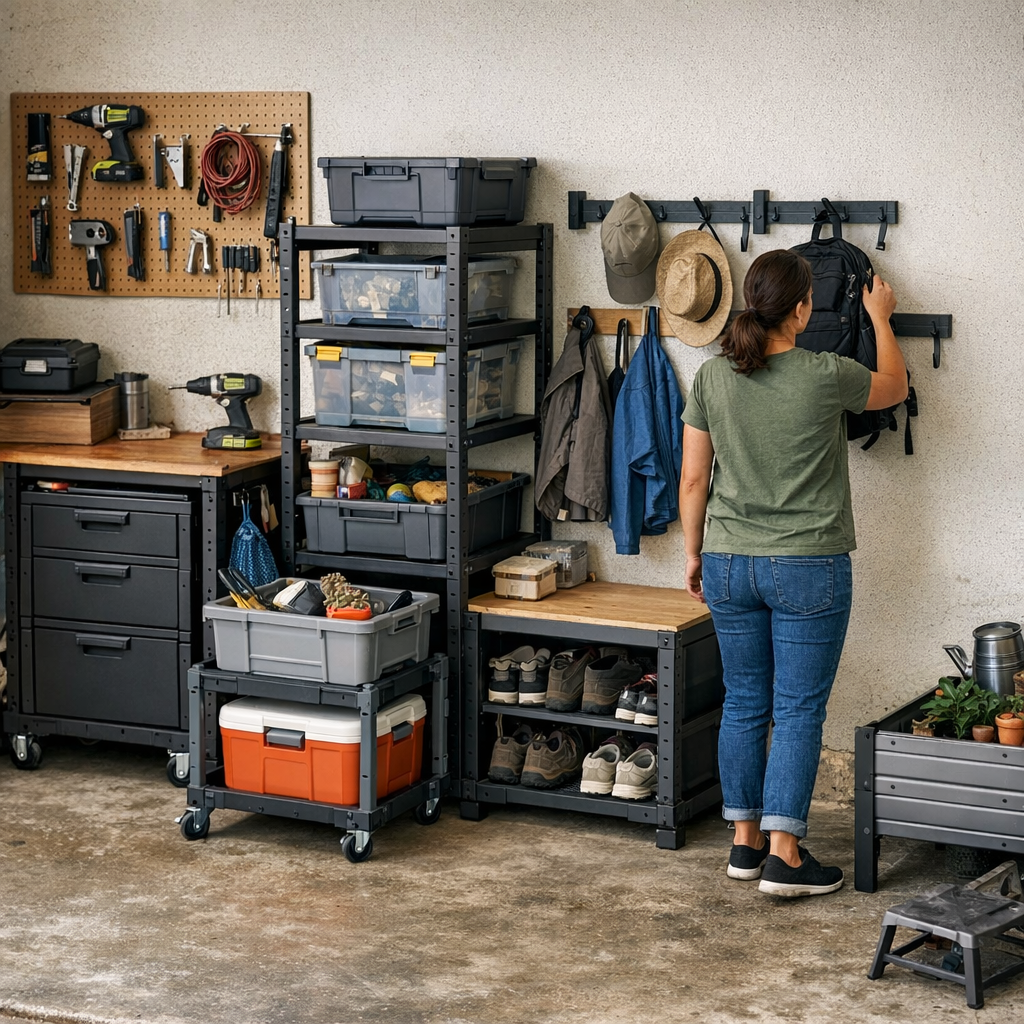
Entryway storage always flatters to deceive—until real life sets in. On day one, everything feels under control: hooks in neat formation, cubbies perfectly squared, shelves lining up like architectural plans. You stand there, picturing every shoe, bag, and coat in its place, convinced you’ve finally closed the gap between chaos and calm. Then routines hit. The careful symmetry crumbles—shoes block the walkway, jackets pile three to a hook, and baskets overflow with whatever didn’t fit elsewhere. Within a week, the entry looks less like a system and more like a lived-in scramble, proving yet again that first impressions fade fast once actual habits collide with even the best-laid setups.
When Setup Meets the Pace of Real Life
This is where most storage systems reveal their true colors: not on setup day, but during back-to-back mornings and unpredictable evenings. The difference between a space that quietly resets itself and one that slips into disarray comes down to what happens as people move through it—bags grabbed in a rush, muddy boots dumped in the nearest gap, groceries suspended on whatever surface is open for half a second.
Photo-ready order holds together for about three days—until you’re wrestling a backpack from under two coats or twisting sideways just to wedge boots onto a shelf that looked spacious enough only in the catalog. When bins are awkward, hooks too high, or shelves crammed too tight to reach, the cleanup routine becomes a workout. If your storage doesn’t fit the reality of your movements, you fall into workarounds: shuffling bins to clear a path, negotiating space with someone else, or simply stacking one thing awkwardly atop another and telling yourself you’ll fix it on Saturday. Most setups don’t fail all at once. They fail in all the little ways that force you to constantly make up for what the layout won’t let you do naturally.
Tracing the Slow Breakdown
What does it really look like when a setup stops working? Shoes start clustering in the wrong places—with piles creeping closer to doorways and traffic lanes. Hooks disappear under three jackets, so anything new gets draped over a bench, or lands on the nearest basket. Items without obvious homes—hats, sports gear, pet leashes—migrate to what should be clear corners, slowly becoming obstacles for anyone stepping inside. Every pass through the area is an improvisation: nudge the rolling cart again, sidestep the chest that never fits quite right, or reroute entirely because one cabinet blocks half the flow.
You know the system’s failing not by the volume of stuff, but by how often you find yourself moving things just to move yourself. Categories blend out of frustration, not necessity—a shelf meant for shoes now shares duty with mail and the odd umbrella, simply out of reach-based convenience. Instead of helping you get in and out, the setup becomes another source of negotiation—and the difference is measurable in every sigh, slowdown, and missed morning exit.
Everyday Friction Points You Can’t Ignore
Picture getting home at 6 PM with two grocery bags and soggy boots. The hook closest to the door? Already smothered by winter coats, demanding an awkward stretch if you want yours to fit. You try the cubby, but the angle’s too tight—why twist awkwardly when it takes half the time to just leave shoes by the wall? Within days, that shortcut becomes routine, and soon everyone’s stepping over a sprawl of shoes. That’s where gridlock starts: one small inconvenience creates a chain reaction of clutter.
For smaller entries, those problems only grow. A cabinet door that blocks passage every time it swings open, a corner that’s never quite empty but always full of “for now” gear—these little design misfires draw a direct line between storage on paper and the real-life shuffle and sidestep. Storage isn’t just a numbers game; the shape, reach, and footprint of every piece determines whether movement flows or constantly faces micro-obstacles. It doesn’t matter how many bins you squeeze in if you’re reshuffling contents or paths every single day.
Reshuffling: The Invisible Time Drain
You rarely notice just how much time and energy you waste until the entry forces your hand. That rolling cart isn’t just in the way once—it has to be shifted two, maybe three times, just so you can sit on the bench. The wall lined with identical hooks never adapts—so when Saturday soccer starts, there’s nowhere to put the extra bag except by wedging it onto the nearest available spot. Overflow becomes a way of life, not an exception. What started as “enough storage” pivots into a daily chore that chips away at the utility the setup should have provided.
Small Fixes with Outsize Impact
Tiny layout changes often pay off the most. Swap one long row of hooks for staggered pegs at two different heights and suddenly the congestion vanishes—no more wrestling a jacket off the lower hook just to reach a kid’s backpack. It’s a five-minute adjustment that buys back time, space, and convenience.
Move a shoe shelf six inches clear of the main path—now there’s no need to squeeze sideways or leave shoes heaped by the door. The open pathway signals where things should land, making clutter instantly visible and easier to resolve. These aren’t splashy remodels, just subtle realignments that quietly eliminate friction. Return flow—actually putting things back—feels natural, so the area resets without even having to think about it. Weekends stop being reserved for an entryway comeback.
Setup Tactics That Withstand the Mess
The best setups aren’t the ones that look the sharpest on delivery day—they’re the ones that can absorb mess and routine pressure, then still snap back. Day-to-day usability matters more than total storage capacity, with setups either smoothing your routines or making you fight for access every time.
- Break the straight line. Don’t force every hook and shelf into a tidy row—stagger heights and mix wall with floor-level storage. A bench below hooks, or bins overlapping hook zones, lets you organize vertically without creating bottlenecks.
- Keep wall and floor systems distinct but complementary. Separate jobs mean less pile-up—so carts and cabinets don’t choke the same corner, and mobile units aren’t nailed down at the expense of flow. Rolling storage should move out of the way (not just look like it can), and modular bins should let you reclaim or repurpose dead space as your needs shift.
- Treat repeat overflow as a flashing light. If one corner keeps capturing stray gear, solve for easier access there—or redefine what belongs to that spot. Don’t just add another layer; rethink the zone.
- Use awkward wall spans and corners as adaptable zones, not abandoned ones. Modular systems can slide, expand, or contract. Done right, they make even the least convenient nooks carry their weight—so no spot’s a permanent backlog.
Audit Your Reset Routine
Once a week, pause. Watch how things circle back to their “spots,” if they circle back at all. If a bin or hook is always skipped, or if you ever catch yourself cutting corners because a shelf is awkward to reach, it’s a cue: something about the layout isn’t matching your flow. Real organization isn’t about visual order; it’s about a system that quietly resets itself during real movement—not as a chore to be done after the fact.
Why Looks Aren’t Enough: Lasting Setup vs. Surface Order
An entryway only earns its keep if it stands up to repeated, daily use. It’s not enough for storage to be present; it needs to keep clear movement routes, distinct categories, and a naturally resetting flow. If every pass means sidestepping, double-stacking, or improvising with overflow piles, the setup just adds to your work. The win is a space that does its job while your routine stays uninterrupted—not picture-perfect, but always ready for the next round.
Discover modular storage systems built for real, repeated use at StackNest.