
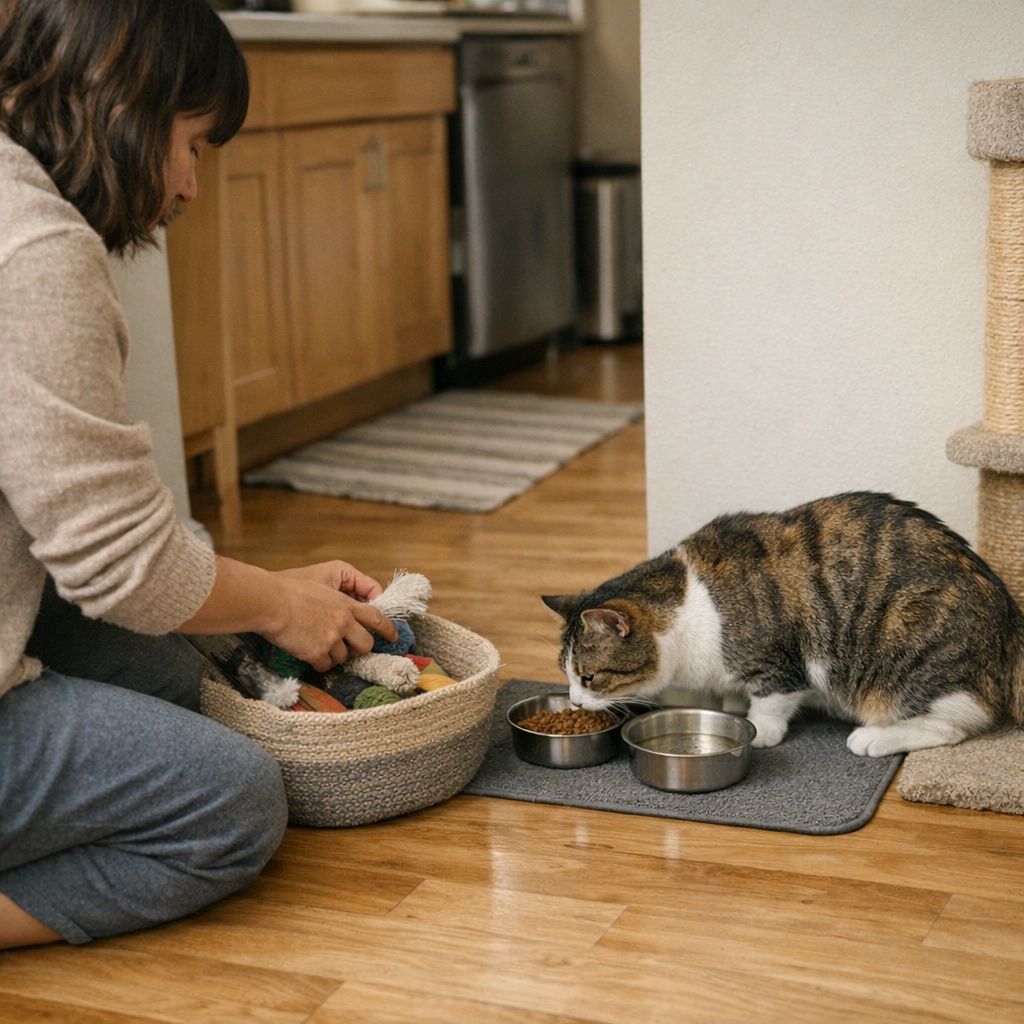
Tidying up after indoor cats isn’t a feel-good moment—it’s a treadmill of small resets that refuse to stay finished. The supposed “feeding zone” is where this cycle breaks down fast. Toys drift back to the bowl before you’ve put the scoop down. Half-chewed play things block the mat edge, stray kibble slides off mid-reach, and the “done” feeling after cleanup evaporates before you get to the next room. Even with a tidy surface, the work repeats: every meal means detangling toys from feeding gear, dodging blocks underfoot, or wiping down a space that never quite feels settled. The friction isn’t just mess—it’s the blur between play and feeding, and it’s exactly where a better StillWhisker setup starts to matter.
The Overlap Trap: When Play and Feeding Blur Together
If you’ve ever found a crinkle ball hiding behind the food bowl during an ordinary refill, you know the cycle: playtime turns into dinner without a reset, and the result is a feeding area that refuses to stay controlled. A wand toy is still within your cat’s strike zone as you pour kibble, and the “transition” is nothing but a quick handoff. This isn’t about having a hyper cat—routine itself sets the trap. Toys creep into feeding space, energy lingers high, and you end up managing the same spillover cleanup over and over.
The real-life symptoms are hard to ignore:
- Wand toys or balls pressed against the food mat before your cat even finishes eating—cue a hasty juggle just to pour fresh kibble.
- Kibble kicked past the mat’s edge, turning cleanup into a two-room job when food tracks under furniture or into shared walkways.
- An overall sense that the feeding corner is never truly “done”—the line between chores and clutter vanishes as toys keep sneaking back before the next meal even starts.
How the Feeding Area Becomes a Hidden Repeater
It doesn’t matter if your space is a studio, an open living room, or a crowded multi-cat apartment—when the reset between play and food is missing, mess skips back instantly. You may have a mat that looks organized at a glance, but after a few cycles, reality creeps in. Toys appear just outside the frame, food bits show up in neighboring zones, and that just-cleaned surface looks ambushed by clutter before the day’s over.
Watch for these signals:
- Your cat splitting attention between mid-meal bites and toys left in reach, dragging food and play objects back and forth.
- Routine resets that slow you down: instead of a quick surface wipe, you’re rounding up toys and food bits in tandem, usually two steps too late for real containment.
- Momentary order that lasts minutes, not hours—toy scatter and food drift cross over to water stations and shared human paths before you notice.
This isn’t surface mess—it’s fatigue from always shuffling something away. The rescue supplies are present, but never where you need them when the scatter line moves.
That Supposedly “Organized” Space? It’s Only Half the Battle
You mop up, you return toys, you stack bowls. But when the cycle always resumes—play rolling into mealtime, toys returning to the mat—your efforts plateau. The tell: those “clean” resets feel shorter each time until you’re perpetually in mid-cleanup. On busy days or with multiple cats, the repeated work exposes where “order” isn’t enough if you don’t break the routine’s weakest link.
Owners miss key differences:
- Visual order doesn’t equal a true reset. Toys moving back mean your cleanup cycle is on repeat, not concluded.
- Clean mats or bowls can disguise a maintenance loop—the scattered edge between feeding and play simply migrates to another corner or shows up again during the next reset.
- Organized setups fail to deliver if the cat’s transitions are too abrupt—without a gap, mess repeats itself in the background, even if it’s not immediately visible.
Real-World Moments: When Routines Don’t Quite Land
Everyday friction is not dramatic, but it’s relentless. Filling the bowl means maneuvering around a feather stuck under the mat. Refilling water turns into skimming floating toy shreds and wiping puddles where toys, drool, and stray kibbles merge. Even with a toy basket close by, the missing pause means objects keep looping back before you can grab them. Recognizable moments pile up fast:
- Reaching to refill the bowl and being blocked by scattered toys, forcing a last-second tidy-up while food spills wider.
- Fishing a loud, half-buried toy out from under a feeding mat mid-meal as your cat bats both at once across the floor.
- Water dishes cluttered with toy debris and puddles that spread as you step or wipe, meaning cleanup supplies are needed mid-routine, not after.
- A toy basket that can’t outpace the cycle—the window to collect and reset always comes a moment too late.
Week after week, this turns a minute-long cleanup into a drawn-out series of micro-interruptions, sliding into your own meal window or turning a “finished” space into a stopgap for the next spillover.
A Small Reset with a Big Payoff: Containment Before Feeding
The turning point isn’t extreme organizing—it’s one intentional closure before the cycle repeats. Pausing to collect all toys into a contained, reachable basket or soft bin, then waiting a moment before feeding, interrupts the auto-repeat. Instead of letting toys and bowls stay tangled, you add a clear edge between play and meal.
With this single added step:
- Toys are out of sight, so your cat’s energy begins to wind down, making last-minute chases or spills less likely when food is out.
- The few seconds between play and feeding lowers meal-time scatter—cats shift from stimulation to eating mode, rather than bouncing between both and dragging objects across the mat.
- Cleanup isn’t a frantic room-wide sweep: now, it’s a direct, predictable reset, not a constant hunt for outliers before every meal.
The difference doesn’t feel perfect, but it’s practical. The “scatter boundary” stays put: toys don’t swarm the food zone, and feeding mess is easier to find—and fix—before it escapes to other living spaces.
What Does This Look Like in a Shared Space?
Shared kitchens, living corners, studio layouts—they all magnify the cycle if there’s no reset. A toy within a step of the bowl triggers the same chase, no matter how you arrange things. By putting every toy away—far enough to force a gap—you signal a functional line that holds through normal household movement. Even a small, soft basket puts just enough distance to keep the feeding area stable, no matter how compact the room or stacked the routine.
Making the Reset Routine Stick (Without Turning the Room Into a Stage)
You don’t need a showy ritual or a designer space. The fix is about easy, frictionless transitions: sweep up toys, drop them into an open bin away from the food station, and give it a short pause before setting down the meal. The ideal container is simple—soft-sided, not a distraction during feeding, placed for your quick access but not a magnet for a bored cat. This isn’t a 10-minute project. Even a 30- to 90-second gap resets the energy and keeps the boundary intact, whether you’re in a rush or have time for a slower wind-down.
The difference in upkeep stacks over time. On hectic days, a rushed, minimal toy grab is still enough to blunt the mess. On slower evenings, a more deliberate collection and pause tighten the control. Either way, you spend less time tangled in the transition and more time staying ahead of repeated work—the whole point is to keep the cycle manageable, not magazine-worthy.
Everyday Proof: What Actually Changes After Resetting the Routine
Repeated use draws a line: after a few cycles, the contrast is visible.
- Toys show up near the food or water less often. The “danger zone” around feeding stays cleared, even with multiple resets per day.
- Kibble and crumbs mostly stay on the mat—no more tracking food into living room rugs, under appliances, or shared walkways with every rushed meal.
- Cleanup shortens. Maybe not dramatically, but the time saved each day adds up, especially if feeding routines stack up across cats or meals.
- Cats finish eating and are more likely to rest or groom instead of hauling a toy back for round two—or restarting the mess you just contained.
The feeding-play cycle can’t be eliminated, but the pressure points become easier to handle—less reshuffling, fewer mid-meal obstacles, a predictable routine instead of a permanent scramble.
See setup ideas for