
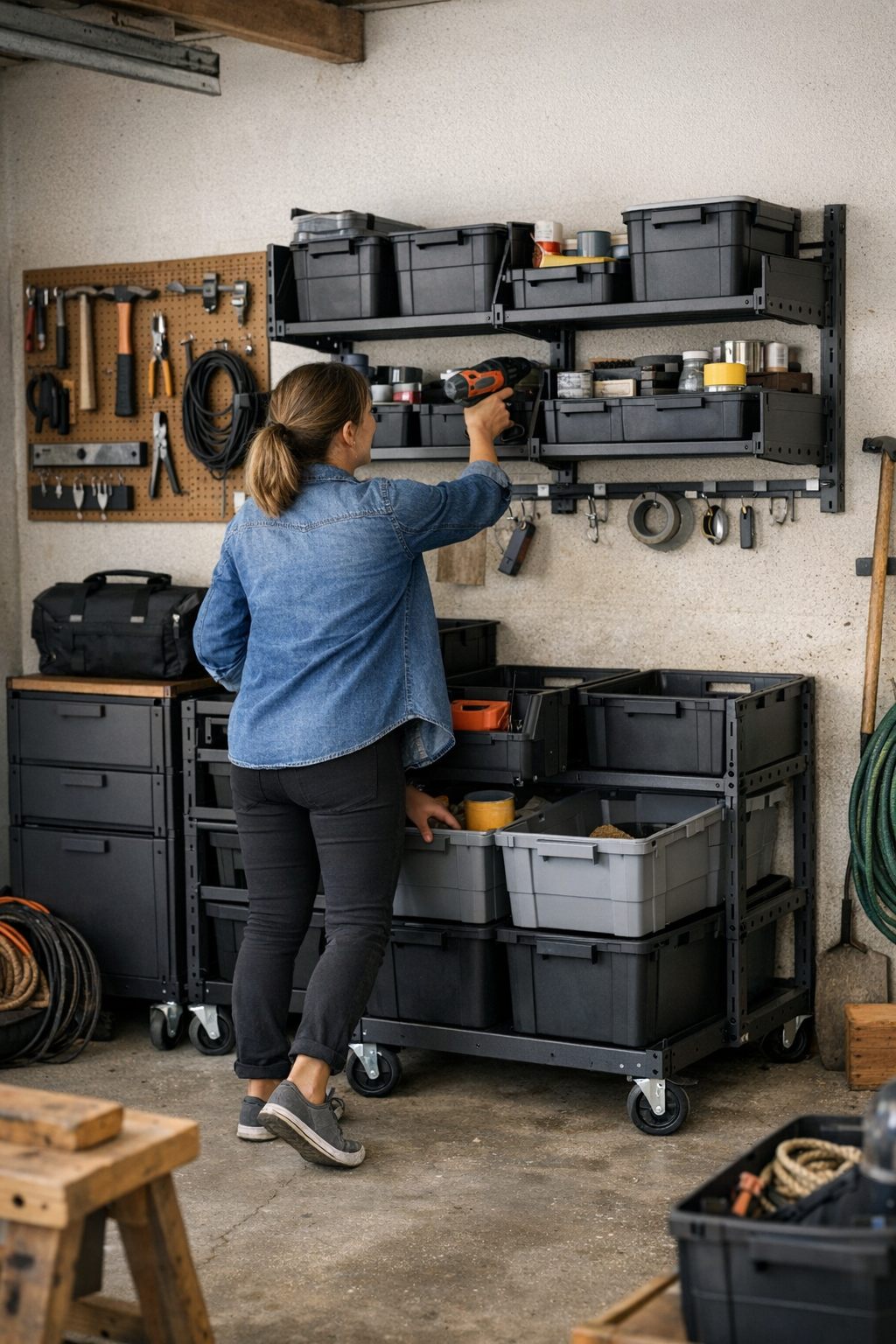
Behind the “perfect” storage facade, the real test begins as soon as the work starts. Garages, basements, cluttered studios—at a glance, everything looks crisp: bins lined up, shelves just-so, carts tucked tight against a still-clean wall. But by Wednesday afternoon, the real rhythm takes over. A tray of screws lands somewhere random, a rolling chest blocks the only clear path, and that corner shelf—supposed to keep things within reach—now harbors a shifting pile you dodge every time you walk by. If you’ve ever built a “modular” system meant to restore order, only to be haunted by daily readjustments and slow, creeping clutter, you already know: what matters isn’t day-one alignment, but how your setup stands up to real, repeat use—loading, grabbing, shuffling, returning—without turning the simplest task into a hassle.
The Quiet Sabotage: Where Weak Storage Chips Away at Workflow
The subtle breakdown often starts fast—imperceptible at first, then all at once. Maybe that wall-mounted rail felt rock-steady when empty. But after a week of tools coming off and on, it sags just enough to send a jolt of doubt through your next reach. A rolling cart, smooth on its maiden glide, now bumps and lists over every floor seam, drifting just far enough that you have to pivot it back, again and again, just to clear the cabinet doors. Those micro-wobbles and tiny tilts? They slow you down, force tiny compensations, and start turning the ordered space into a puzzle you keep having to solve.
Ignore these little shifts, and routines warp. Heavy items get orphaned in safer, less useful places. One bin winds up jammed against the wrong wall, stealing movement from the main aisle. Overflow piles up in a zone you’d sworn would stay clear. What promised to be a fluid path instead becomes a shuffle—resetting the system just to finish what you started, every single time.
When “Good Enough” Isn’t: Small Flaws, Big Interruptions
Instructions and marketing never warn you about the day-three surprises: that shelf bowing under an awkwardly loaded toolbox, the floor unit’s one leg floating slightly above the concrete, or casters so undersized they screech and catch after the first actual haul. Instead of supporting your workflow, the system starts dictating awkward workarounds—loading lighter objects where the frame holds, parking rolling storage sideways just so it doesn’t wander, never trusting the upper shelves with anything substantial.
The effect is everywhere—if you look for it. You nudge a storage cart toward the door, hit a shallow dip, and it veers off so you end up parking it further from reach. Wall units flex when you grab a power tool, so next time you leave it where it’s easier to access, and the “dead zone” expands. Setups that should liberate space quietly fence it off instead. Each extra moment spent moving or bracing a unit, each shortcut you take to avoid a lurch or tip, is another little tax on your flow. Soon, less and less of your organized footprint actually works the way you intended.
How Looseness Slowly Undermines the System
Picture the aftermath of a real week: you tidy it all Sunday, but by Wednesday, you’re sidestepping an out-of-place cabinet and digging for a sander on a shelf that now shifts under the weight. The rolling chest you need most ends up wedged across two floor seams, blocking your fastest route and forcing a detour. One catch pan, meant as a quick overflow, gets stashed in the only open patch left—the original plan for wall and floor use already compromised by little slip-ups and awkward resets.
What started as a rock-solid setup has become a source of friction. Every fresh project means an impromptu clean-up before you can even get started. The more you use it, the more the pieces migrate out of alignment, drawing you into a cycle of fix and reshuffle. Instead of clarity and speed, your reward is a slow crawl back to square one.
Simple Anchors, Real Gains: Restoring Control
This isn’t inevitable—nor does it require a full overhaul. The difference comes with a handful of focused fixes. Screw wall shelves into solid studs or masonry and watch the bounce disappear. Swap tiny casters for sturdy, wide wheels and feel the cart track true instead of fishtailing on cracked concrete. Even bracing a wobbly leg or shimming uneven feet transforms the way you navigate the zone: fewer interruptions, less tip-toeing, more willingness to actually use every shelf and bin as intended.
Small reinforcements restore confidence. Heavy tools go back on high shelves without second-guessing. Rolling bins can finally be parked straight, even in the tightest footprint. Each adjustment chips away at wasted motion, letting every area do the job it’s meant for—no more letting awkward movement win out over usable space.
Does Your System Still Move the Way You Need?
Forget the perfect bubble-level reading on assembly day. Here’s the test: Put your normal workload onto the system. Rapidly slide bins off and on. Pull out a rolling chest and try to dock it one-handed between jobs. If you’re bracing units with your hip, constantly nudging pieces back into alignment, or making mental notes to “go easy on that shelf,” your storage is already slowing you down. Each workaround will grow—until you find yourself walking a longer route just to avoid the wobbly section.
If you’re stacking bins at odd angles “so they won’t slide,” or building up catch-alls in zones meant for clear movement, it’s time to retune the setup—before workarounds become part of the daily script.
Storage That Fits the Actual Room—Not the Ideal One
Every real workspace is imperfect: old slabs slope, walls hide soft patches, thresholds catch tiny wheels, and years of small accidents leave dents and dips nobody sees on a floor plan. Wall storage might promise a clear floor but only if the surface and anchors take a beating day after day. Floor units might span the load, but a rock or slope turns them into blockers instead of helpers. Ignore these realities, and the setup itself becomes another obstacle—eating time, not saving it.
The clever catalog layouts never last past week one. What matters isn’t the stated capacity or look, but how every shelf, bin, and bracket stands up to repeated, slightly messy, daily use—and still gives you the same open, reliable access day after day. You can tell if it’s working: resets take minutes, not whole afternoons, and every bin and tool returns to its home at speed, not after a careful game of shuffleboard with whatever drifted during the week.
Making Order That Stays: From Looks to Lasting Function
Some mess builds invisibly—a cabinet that never sits flush, an aisle that loses a foot’s width because a rolling chest keeps wandering, a utility bin that stays in overflow because it’s easier than re-clearing a wobbly shelf. The best setups don’t just tidy up for the photo—they stay aligned with your daily moves. Friction fades: anchored shelves, stable carts, and sturdy bases mean less wasted motion, less mental overhead, and fewer half-hour resets just to clear the area for one new project.
This is what separates a space that “looks organized” from one that actually works. In a system that holds fast, you stop noticing the storage—because everything you need stays just where you intended. Zones remain clear, cabinets open without wrestling for space, overflow doesn’t claim your walkways, and at the end of even the busiest week, you can reset the room in minutes—not hours—because the foundation is right.
Visit StackNest for practical, real-world storage solutions.