
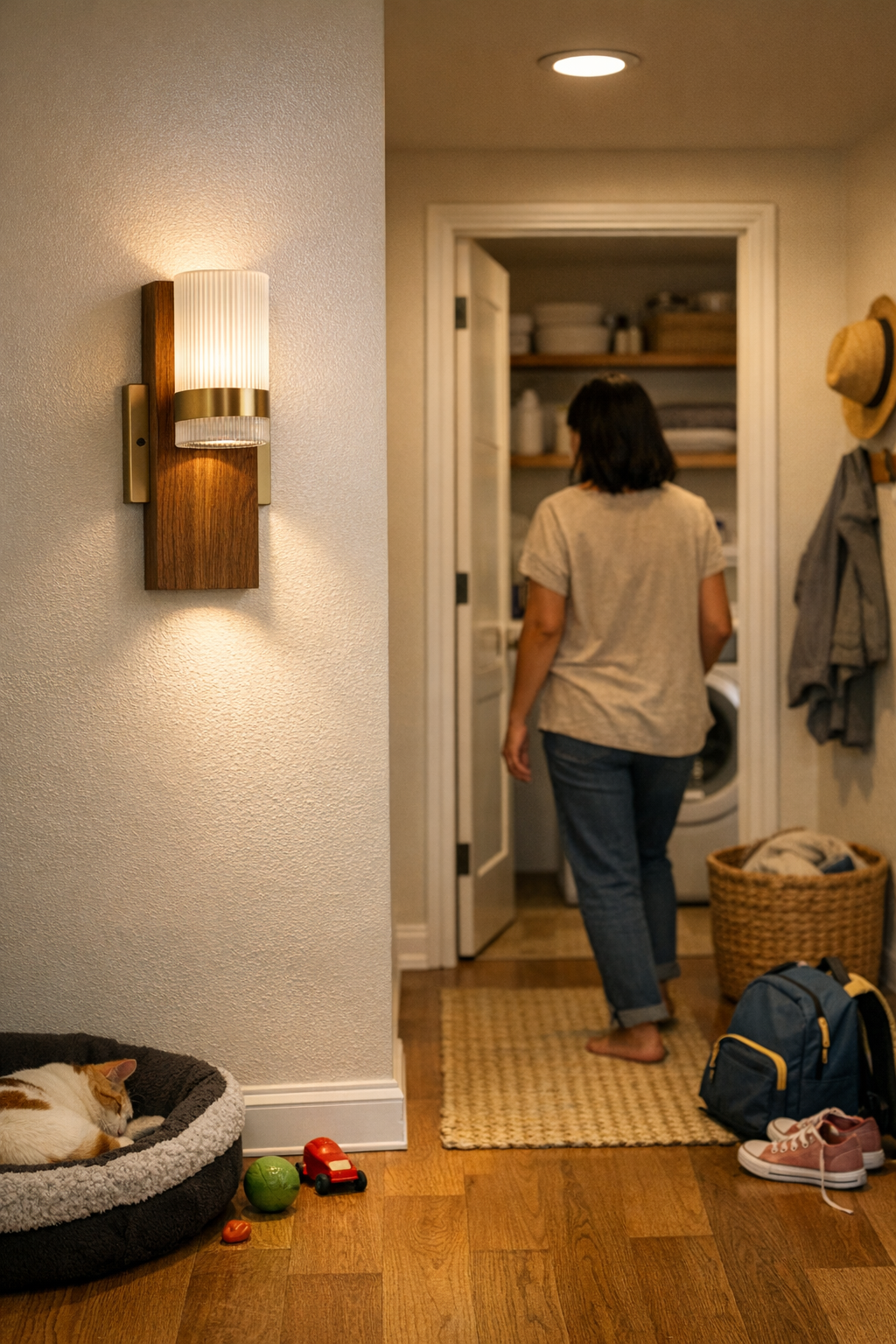
If your lighting only treats the room as one big “nearby” area, reality pushes its limits fast—especially in a house with restless kids, pets circling for territory, and routines built on movement, not empty space. That ceiling fixture that looked bright and open on day one will start to betray real problems by week two. Toy piles gather back into walking paths. Pets claim the warm spot that cuts through the route you need. What seemed like even light turns patchy, with glare near the ceiling and unpredictable shadows at your feet. Suddenly, the room looks bright but works badly: the difference isn’t how much you see, but what keeps landing in the way—tripping you up, slowing you down, and making the space feel less usable the busier it gets. This isn’t a design quirk; it’s a direct consequence of the lighting setup itself.
Why Room-Wide Lighting Fails During Real Routines
Turn on the main ceiling fixture and it feels like you’ve handled the basics. But as routines stack up, the flaws get sharp. Homes don’t work as blank cubes; real life creates conflict zones—main paths, parking edges for bags or toys, pause points for noisy kids or a dozing pet. Central ambient lighting erases these distinctions, blurring lines you need clear. In heavily used hallways or near the utility zone, gradients take over. Parents notice it first: you dodge one obstacle, then another appears, never quite seeing where the “safe to move” area ends because the light never marks it. Tired? You miss it entirely—and risk a stubbed toe or worse.
Think of a hallway on a Thursday night. Light spills everywhere, but the stuff you need to avoid—bags, scattered shoes, a pet deciding to settle—moves right up to where you walk. There’s no obvious signal: just a slow fade from “clear” to “not quite,” forcing constant split-second choices. You don’t fall—you just learn to hesitate, to curve your step, to scan shadows for what the fixture failed to separate.
How Shadow Lines Interrupt Simple Movement
Soft, undefined lighting leaves disorder free to migrate. One moment a child bursts through and drops a backpack near the kitchen. The family pet stretches out—half-on, half-off the edge of the walking lane. Overhead fixtures do little to distinguish zones: sometimes the floor’s edge vanishes in deepening shadow, sometimes glare leaps up from polished tile. What should be a straightforward movement becomes tactical—slowing at turns, bracing to spot hazards just before you hit them.
This is the slow drag of bad lighting: everyone adapts, but in ways that turn routines jagged and frustrating. You learn to sidestep by habit. Movement becomes a mental task, not a simple walk—never quite trusting what’s beyond the next shadow, never sure where the usable space really ends.
Real Scenes: Where Weak Lighting Edges Cause Trouble
Pausing at the stair turn
The landing is more than a step—it’s a decision point, a pause with consequences. A single overhead light turns the stair’s edge into a shifting gray area. A dropped toy or stray laundry basket lingers unnoticed. Until someone’s foot catches; now the edge matters. Nearly every household endures a near-miss before catching the problem: indistinct shadow means nobody knows exactly where safe ends and risk begins.
Crossing the hallway with clutter close by
Children carry, drop, and forget. Pets prefer settled corners. Hallway fixtures that just flood everything don’t warn or shape behavior—they blur it. Every trip down the hall tangles with confusion: Is this gap wide enough? Was that a bag or just a shadow? You catch yourself twisting, changing speed, not trusting what’s ahead.
Losing the counter edge in shadow
Faces lean into mirrors, or hands scramble for the last cleaning wipe on the utility counter. Surface lighting that looks “uniform” from across the room can’t stop shadows from one side swallowing half the workspace once you approach. The edge of the basin blurs. What’s safe to grab, what isn’t? You adapt by moving, leaning, craning—because the light won’t do its job.
The Consequence: Routines That Never Feel Smooth
These aren’t catastrophic failures—but they’re relentless. When movement lanes and storage edges blend, families start tiptoeing through their own routines, correcting as they go: nudging shoes, barking “stay!” at the dog, giving children an extra warning to keep backpacks clear. This is creeping friction: not enough to bring things to a halt, but enough to create constant, low-level stress, and a chronic sense that home layouts resist rather than support movement.
What Actually Defines a Reliable Lighting Boundary?
Boundaries aren’t established just by throwing more lumens at a ceiling. They’re created when lighting makes the “in” and “out” zones visually speak for themselves—a clear, observable edge separating movement and pause, safety and pile-up. Average overhead fixtures fill everything, but they don’t mark territory. If the light doesn’t draw a real line, clutter and behavior slowly creep back into your path, because nothing says “this area’s for walking, that area’s for waiting.”
The Practical Change: Zoned, Offset, or Downward-Focused Fixtures
The difference between ongoing frustration and quiet traffic flow is physical: use lighting to mark, not just light. Offset wall sconces, for example, installed just outside a stair run, cast a repeatable band that reads “safe passage.” Shifting a semi-flush mount fixture toward the main side of the hallway defines a dominant path, with softer spill relegated to the waiting zone. Task lighting over utility counters or bathroom sinks puts brightness right where you need to see and act—leaving the rest softer, less tempting for clutter or temporary holding.
What really happens after these changes? Slowly, habits shift. Pets nap in the softer shadows. Kids learn, almost invisibly, to drop shoes beyond the well-lit lane. The main path stays clear—without anyone policing it—because the space itself supports what you want to happen, not just what a fixture can theoretically cover on paper.
Everyday Improvements You Actually Notice
The signs of better lighting aren’t dramatic makeovers—they’re the smaller frustrations that finally subside:
- Navigating stairs without pausing to wonder what’s at the edge or dodging an unnoticed toy.
- Pets choosing the dimmer, safer part of the room, left automatically out of circulation zones.
- Countertops with visible, shadow-free edges—making cleaning, prep, or grooming straightforward, not guesswork.
- Hallways that feel designed for motion: clear, direct, free from the slow drift of clutter back into your feet.
If lighting only suggests where boundaries might be, confusion sneaks back in—every crossing, every sudden pause, every overlooked object. But when the lighting draws true edges, everyone reads them and home routines gain a smoothness you stop noticing for the best reason: nothing is blocking your way.
Quick Tip for Improving Zone Edges
To spot weak edges, stand at a usual pause-point—stair landing, hallway corner, or near a counter—with main fixtures on. See where space feels ambiguous, where movement seems tentative. Then turn on a directional sconce, vanity light, or even use a flashlight: does a clearer edge or brighter path reshape how you treat the area? That’s the start of fixing not just how a space looks, but how it works.
Lighting That Holds Up to Real Life
The gap between a “bright” room and a functional one opens wide after enough lived-in days. The right indoor lighting isn’t about filling volume with light—it’s about giving daily movement a clear, reliable map. Homes that hold up to repeated family use, shifting clutter, and unpredictable routines don’t just look good; their lighting quietly prevents problems before you even notice them.
Explore practical indoor lighting that makes your spaces easier to use—day after day—at LightHelper.