
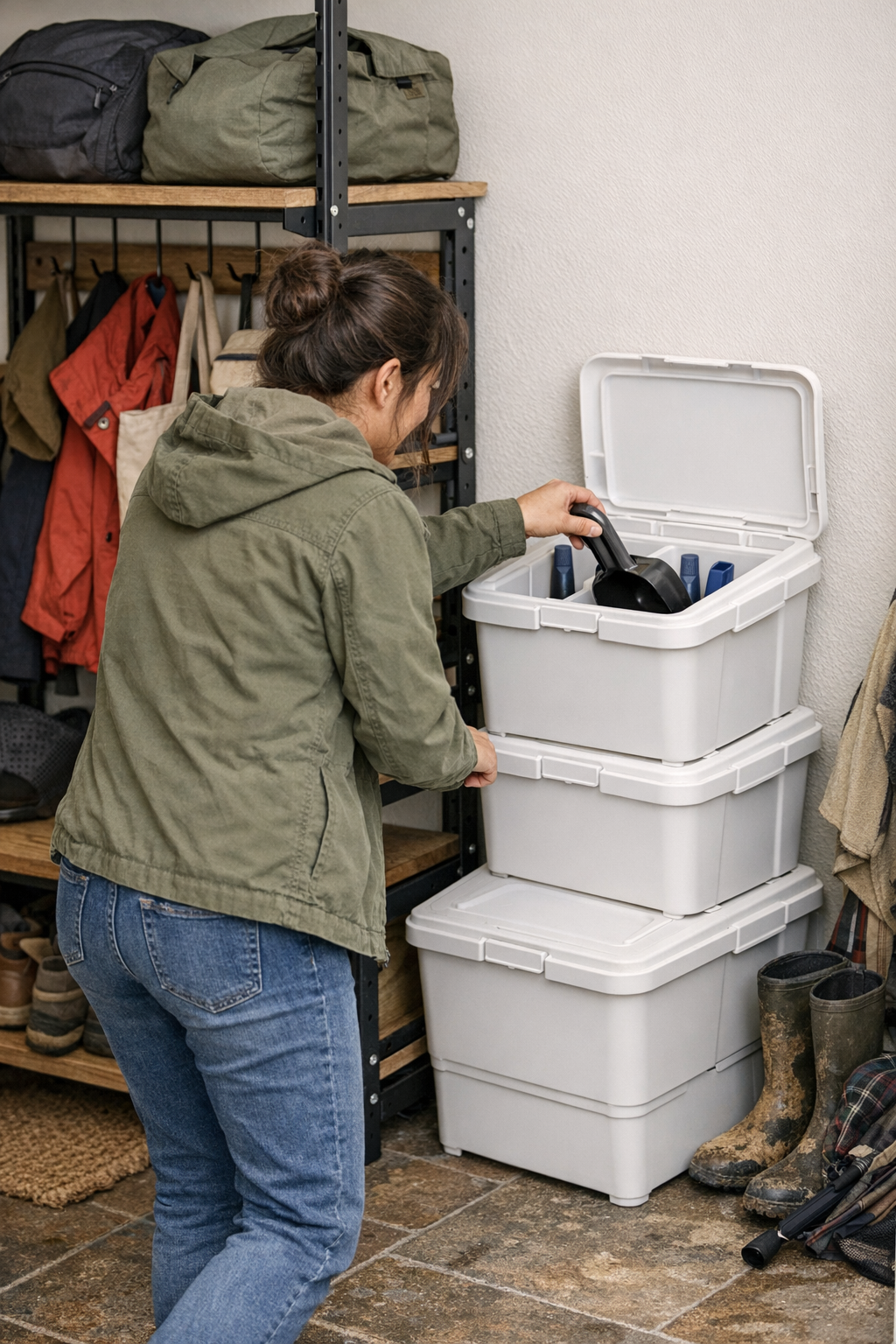
Leave a scoop anywhere loose in your entryway, and your daily flow immediately shifts from predictable to messy. Set it “just for now” on a bench, balance it on a shelf, or prop it by the door—and suddenly, the quick grab-and-go you rely on dissolves. Items pile up at the only open patch, shoes edge wider, and the next person through the door hits an obstacle instead of a path. The space looks calm when undisturbed, but the first scramble for that unreturned scoop reveals the real weak point. In less than a day, what should be routine—grab, use, return—is replaced by scattered resets and blocked exits.
The Trouble with “Almost Away”
Every entryway collects “almost away” decisions: a scoop perched because hands were full, a bin with no defined category, or a shelf that quietly absorbs overflow. It all blends in—until routines overlap. One kid drops gear on the bench, someone else shoves a bag against the wall, and now the zone that looked under control in the morning won’t reset in time for the rush back out. Order on pause becomes drift; shoes spill into the path, bags overlap in the corner, and a single left-out tool invites the next. Lived-in entryways rarely get one reset per day—real pressure comes from repeated unscheduled returns, staggered exits, or that sharp transition from a rainy weekday to the evening dash. By then, visible clutter spreads with every small sidestep, and every “for now” turns semi-permanent by sunset.
Entryways Under Pressure: When Clutter Surfaces Fast
Routine only survives when every step is effortless—school mornings, wet dog returns, stacked arrivals after dark. The more hands and shoes moving through, the faster the system reveals its limits. After three days of rain, shoes multiply at the edge, and floor space shrinks with every unscheduled drop. The quick grab turns clumsy: someone grabs for dry shoes or the missing scoop, but benches are blocked, racks overflow, and bags drift into every open seat. Each missed reset sets the stage for another: leave a scoop out, and it’s one more object to trip, sweep aside, or search for. Midweek, the shoe line spreads wide, stray gear vanishes under coats, and the official “storage” zones become nothing but background to kitchen floors and hallway chairs. Clutter doesn’t arrive as a pile—it arrives as momentum, ripple by ripple, until the path tightens and exit routines jam.
Dedicated Bins: One Movement, No Drift
Containment changes everything. Give every scoop, brush, or tool its own dedicated bin—right size, right position, no exceptions—and retrieval becomes frictionless. Instead of scanning the room, pushing aside bags, or unsticking stuck shoes, you reach in, use, and replace in a single motion. There’s no block at the bench, no accidental bag-drag across the path, no hunting while the door is half-open.
- The bench stays clear for sitting, not as a catch-all overflow zone.
- Shoes and gear stop drifting into walking space or crowding underfoot.
- Everyone—first out, last in—expects the same: the tool is there, always, never improvising its place.
Bins with a vertical fit and lids account for muddy days and quick transitions, preventing spills and shielding gear from weather. Slim vertical bins trim side-to-side sprawl—no more tripping hazards or expanded mess zones. With designated homes, each reset is a second-long habit, not a weekend project. Containment keeps movement direct and interrupts clutter creep before it becomes something you have to clean up for real.
Hidden Costs of Loose Storage
If bins are absent, too generic, or mis-sized, clutter may look sorted in a photo but collapses the moment routines stack. Loose scoops never stay put—they become magnets for everything without a home. A bin lid fills with overflow: yesterday’s scoop, today’s gloves, tomorrow’s gardening tool. Shelves fill up with objects that have no return path, so display space mutates into stash space, and nobody knows what’s supposed to live where.
Friction compounds in small ways—someone coming in with groceries stashes a bag at the threshold because a scoop blocks the right spot. A child, shoes muddy, drops them in the sole bit of open space, forcing a full shuffle just to get out again. What looks “neat” blocks actual flow: if every trip in or out means moving something first, the setup breaks down. Entryways don’t need snapshot order; they need a real, unfussy system that absorbs use without creating a daily reset burden.
The Weeklong Test: Where Real Resets Succeed or Fail
Optimal setups pass the test of repetition. Fix upright, right-sized bins to the wall, label each with its scoop, and after a few days of busy use, you’ll see what holds. The routine shifts: open the bin, grab the scoop, close, done—every time, even when distracted, rushed, or juggling bags. No searching, no sidestep, no resetting a sprawling bench. Tight bins plant the habit—surfaces stay open, and “just for now” evaporates.
After a full week with rushed mornings, late returns, and shoes drying in cycles, the system holds: retrieval is fast, reset is instant, no trail of abandoned gear or block at the door. Even with back-to-back exits, nobody’s digging under piles. When something slips—a scoop left out or a bag dropped in the wrong spot—reset is so obvious and easy that the spillover never builds. One missed day is recoverable, but a system with clear containment resists chaos far longer before pressure shows.
Real-World Tips for Sustaining Clear Entry Flow
Every scoop gets a named spot—always inside, never balanced, never “just close by.” If a bin’s too tight or too shallow, swap it immediately. A bin that’s awkward is a bin that won’t be used, period.
Clarify the rule for every user, every day. Systems dissolve when only one person follows through—remind at the door, inside the bin, or wherever error is likeliest. The less explanation needed, the less debate later.
Check after high-traffic bursts. Any time the family piles in at once, or a muddy day hits, give it a brisk scan: is anything hovering, perching, or hiding out of place? Fix within seconds. That habit prevents drift from turning into a full reset cycle by the weekend.
It’s About Resilience, Not Just Visual Order
The best entryways aren’t made for show—they’re built to absorb pressure, reset fast, and keep traffic moving no matter how unpredictable the week gets. The line between “just looks organized” and “really works” isn’t subtle after repeated use: in the wrong system, routines bottleneck, clutter spreads, and every movement needs a workaround; in the right one, everything returns to ready, day after day, with no second thought.
Display fails when the pace picks up. Containment—deliberate and repeated—forces the system to stay open, recover fast, and adapt to real life, not just a photo op. Don’t settle for tidy that only lasts until tomorrow. Build for daily, durable function and let organization be the side effect, not the vain goal.