
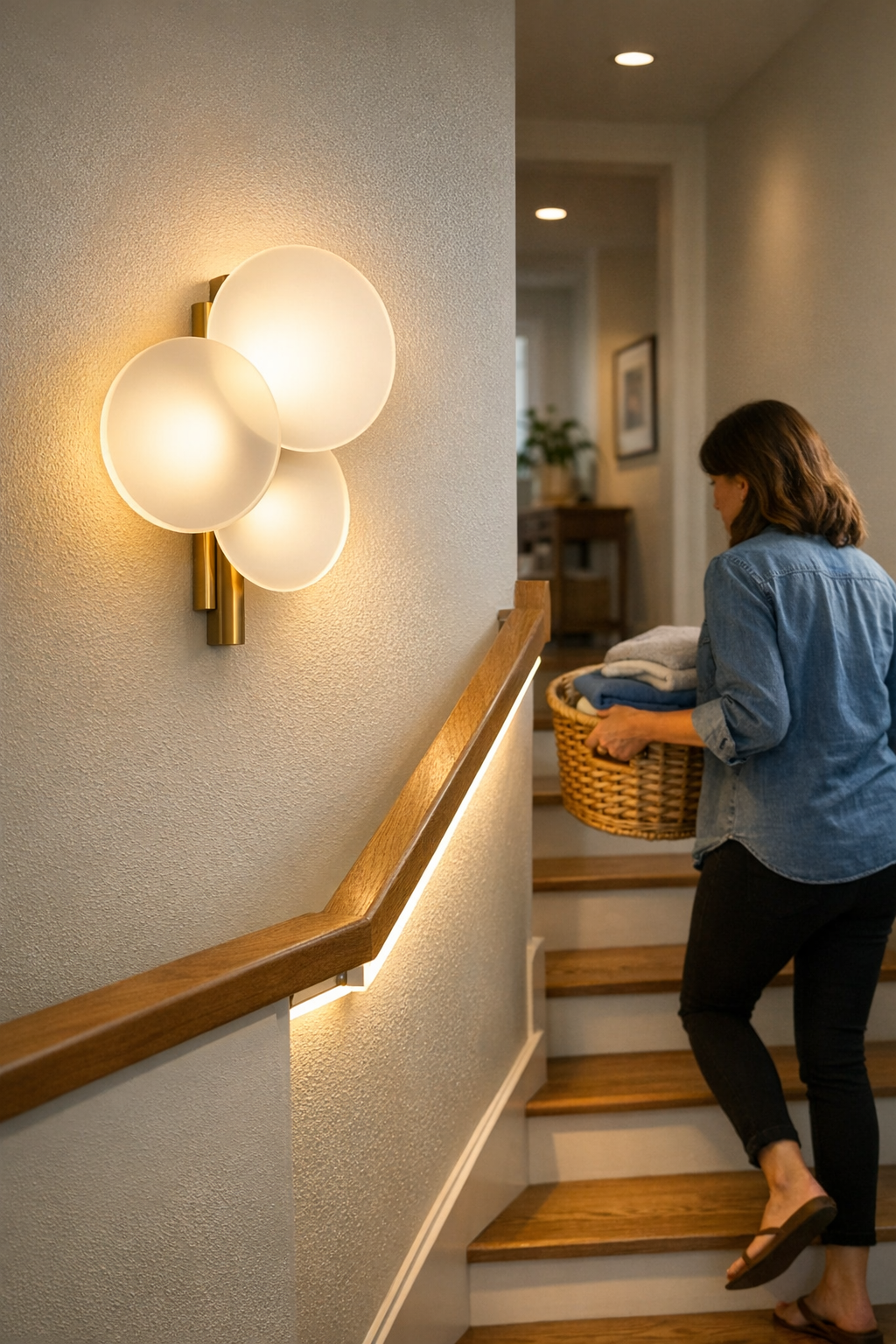
Most stairway lighting failures have little to do with how a setup looks in daylight—or on paper. The real friction hits at the edges: a harsh glare that forces you to squint mid-step, a riser swallowed in shadow just when your hands are full, or cables that slip from tidy lines into your peripheral vision after a week of hurried routines. Stair safety can break down not from a lack of total brightness, but from sudden, jarring changes between overlit patches and hidden steps. If you’ve ever stopped short at an unexpectedly blinding step or tested the bottom edge with your foot, you’ve noticed how one lighting mistake turns every trip into a negotiation.
Why Contrast Jumps Sabotage Stairway Comfort
Stairway lighting is thrown into question the moment the light shifts without warning. One riser glares bright, the next fades into murk; a ceiling fixture beams overhead, but loses the last steps near the landing. Harsh, angled light can turn every descent into a messy test where your eyes scramble to process new edges. Instead of a quick, forgettable walk, you’re pausing, tiptoeing, and recalibrating step after step. A fixture that seems “good enough” on installation often becomes a weak link by the tenth trip—serving as a reminder that minor misfires add up daily.
The issue scales up quickly: hesitate at a glaring patch, prod for a lost tread with a loaded arm, or flatten yourself to avoid a cable nudged loose by a backpack. Each small pause doesn’t simply interrupt the flow—it sticks in memory. What’s missing isn’t sheer power, but repeatable clarity—making every tread easy to find and each riser visible, whether your hands are free or you’re balancing a basket in low light.
The Gap Between Looks and Daily Ease
Many setups tidy up the appearance of a stairway only for repeated use to highlight the flaws. Common problems:
- Ceiling fixtures—brighten the stair zone generally, but often flare overhead and fail to reach the first or last steps where footing matters most.
- Wall-mounted lights—promise clean lines but can throw raking shadows, making foot placement uncertain, especially on textured steps or when shoes change the surface profile.
- Handrail LED strips—read as gentle and indirect at first, but install one a half-inch off and foot shadows split the run, creating unpredictable dark bands.
- Concealed cable paths—look crisp until a basket, vacuum, or coat sleeve nudges them crooked, sending a bright line sloping into view whenever you turn the corner.
Small in theory, but as family routines layer on—kids darting, adults managing loads, the dog brushing a bracket—any slip or weak angle gets exposed faster than in a staged install photo. At corners and mid-flights, especially, even an “invisible” support can become the snag your hand grazes or the dark spot your foot second-guesses.
Real Moments Where Lighting Choices Get Tested
Picture the actual problem points: Evening, both hands full, you descend and the stairwell seems softly lit—until one edge disappears. Your step hitches as the next tread blurs into shadow. Instead of moving smoothly, you find yourself mentally repeating, “Don’t miss the next one.” It’s rarely about total output; it’s about unreliable step definition that forces a slower, distracted routine. At night, a bracket in the hand path, or a shifted cord, can be enough to break concentration and force a stop-and-check, even when the setup looked sharp at install.
The difference reveals itself over days: an overhead fixture bounces glare into your eyes, or you start catching a cable edge when rounding the landing. Routines—finding a handhold, balancing a laundry basket, or guiding a half-asleep child—show where the setup unravels, one daily interruption at a time. Visual tidiness is quickly outpaced by the friction of repeated, real-life use.
How Consistent Lighting Quietly Changes the Routine
Swapping scattered wall spots for a continuous, low-glare LED strip below the handrail rewires the experience. Placement matters—when the strip tracks just under the rail and avoids the sweep of the hand, the problem zones vanish. Over the first dozen trips, irritation fades: the last three treads, which vanished into shadow after dark, are now calmly defined even with both hands full.
This isn’t a showy transformation—it’s a gradual erasure of small irritations: toe-searching for the bottom, swinging a basket for more light, or tensing for a missed edge. The reward isn’t drama, but the slow normalization of walking the stairs without a pause or second glance.
Placement and Cable Management: Where Details Matter
Brighter overheads may look impressive but introduce new contrast jumps where you’re least ready for them. Bracket placement that feels “invisible” when empty-handed can turn intrusive when you’re guiding a stroller or running late. Cables that aren’t locked out of every-day traffic migrate—sometimes into your sightline, sometimes underfoot.
Field observations make a difference:
- Blend cable covers to match nearby trim or wall, anchoring lines along existing seams or tucking them behind support brackets—making them nearly invisible and less likely to be snagged out of place.
- Map cable routes out of the main walk path; even one exposed span at a corner attracts friction from backpacks or laundry baskets and slowly unravels a once-neat install.
- Simulate real traffic—test both up and down, after dark and with full hands. What looks fine at install reveals friction only after a week of lived routines.
Choosing Hardware for Real Life, Not Just the Blueprint
There’s real value in a stairway where lighting and supports perform under pressure—where the right balance of clarity, unobtrusive cable routing, and bracket placement stands up to the messy rhythm of daily life. The solution that made the setup look done on day one can let hidden cables drift into view, or leave familiar steps in guesswork shadows, once the real routine kicks in. A bracket that “hides” at eye level may interrupt your grip on the 50th climb, not the first.
The goal isn’t a perfect showroom finish—it’s fewer silent disruptions, fewer distracted hesitations with every trip, and a setup you stop noticing because it simply works. That kind of reliability outlasts first impressions.
For more practical stairway lighting, mounting, and cable management solutions that hold up to real use, visit LightSupport.