
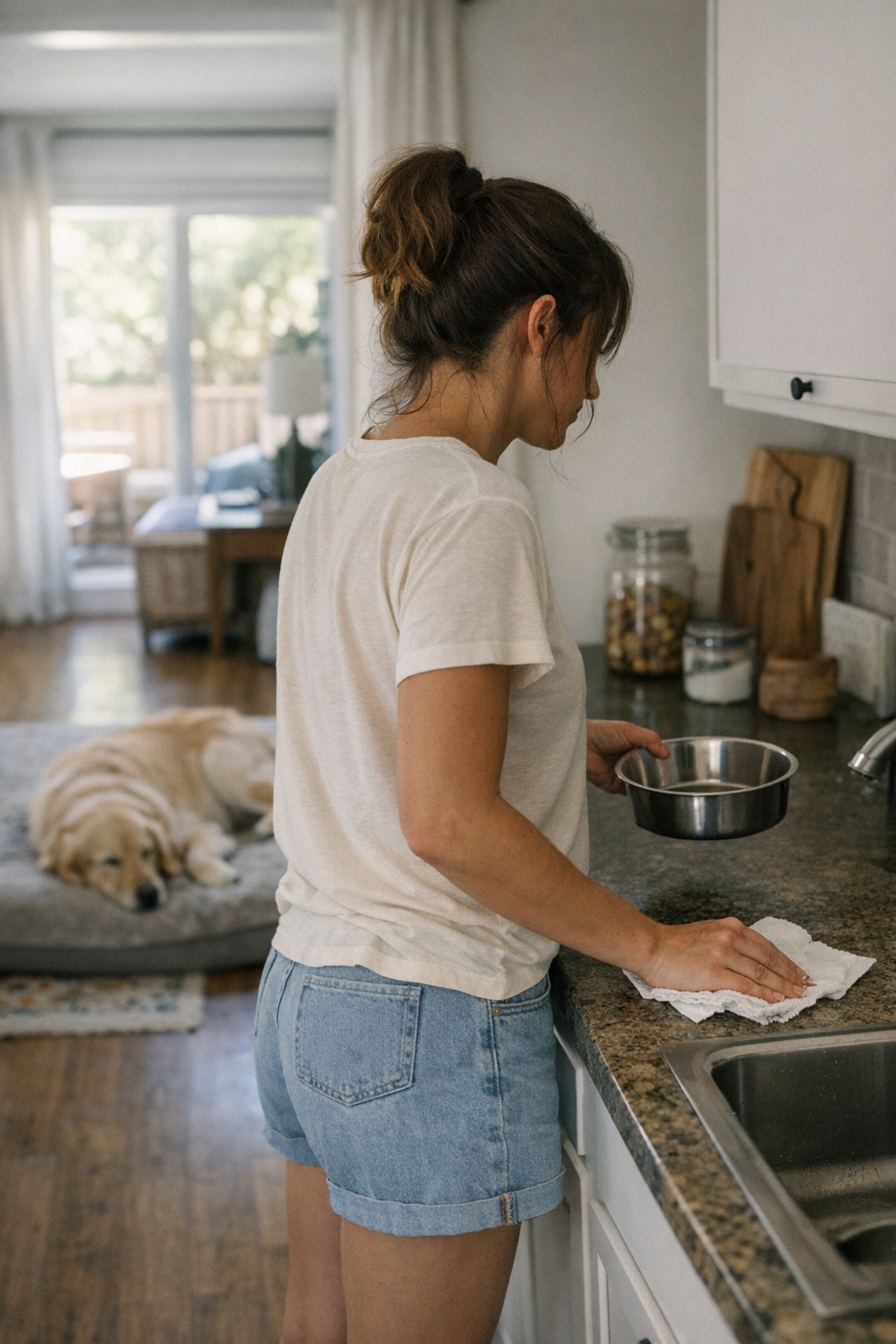
Post-meal routines with dogs break down fast over small, overlooked weak points. Maybe it starts with a bowl left out for “just a second,” a towel that’s always a few steps too far, or a cleanup that drags because the wipes are buried behind a crate or a spilled toy. What looks like a routine quickly becomes a mess of pacing, glances, or delays—both you and your dog hovering near the kitchen, never quite sure when mealtime is over and rest can begin. This is an everyday friction: the area looks organized, but every cycle adds minutes and micro-stalls, interrupting both your dog’s wind-down and your own next task. DogPile-world routines aren’t shaped by how neatly things look—they’re shaped by how the flow actually performs across repeated use.
When “Done” Isn’t Done: The Drag of Unclear Transitions
It happens fast: your dog finishes eating, the bowl sits where it always does, and you plan to reset “in a minute.” Something distracts you, the bowl lingers, and suddenly your dog is planted halfway to his rest spot, waiting but unsure—one paw in eating mode, tail edging toward bed. The house feels settled, but neither of you get the reset signal. Meals never get a clean finish; rest never really starts. The friction here is subtle but constant: a half-cleanup, a bowl that’s somehow always in the way, and a dog stuck in limbo, waiting on you to act.
This stall-in-place isn’t chaos, but it pulls real momentum out of daily life. There’s no dramatic mess—just a routine that never closes. The delay is small but contagious, slowing down not just the dog’s post-meal wind-down, but your whole schedule. When the “done” moment blurs, your dog circles, the towel hunt drags, and both of you burn extra energy on the same old half-reset.
The Cost of “Almost Finished” That Never Resets
Let a few micro-pauses become normal and the day quietly bends out of shape. The bowl left near a bed, the wipes out of arm’s reach, toys scattered underfoot—every friction delays cleanup and pulls your attention off the next thing. By dinner, it’s easy to feel like you’ve spent all afternoon stuck in micro-loops—shuffling bowls, calling your dog back, and running extra laps between kitchen and rest corner. None of it feels big, but every “almost done” eats away at smoothness, energy, and pace.
The “Half-Wait” Pattern
Most dogs signal the problem just by standing at the kitchen edge or glancing at their empty bowl. They hang back because nothing says “change mode”—the bowl’s still there, crumbs remain, the area feels unfinished. When cleanup hangs, your dog isn’t sure if he’s still supposed to be focused on food, on you, or on heading off to rest. Both of you end up stuck, neither moving fully to what’s next.
Where Routine Friction Really Hides
The tools are nearby, sure, but rarely truly ready. Paper towels behind a crate, wipes buried under grooming pieces, a toy bin you have to sidestep to reach the trash can. None are big obstacles, but stack them up and every post-meal moment stretches. The room looks under control: bowl lined up, toys binned, towels folded for looks. But as soon as mealtime ends, you’re looping, reaching around corners, and pausing to clear another block. The tidy setup reveals its weakness only in the moments you need speed and clarity—the gap between organizing for pretty and organizing for function.
The Room That Looks Ready, But Trips You Up
Even visually neat spaces break down under repeat use. Maybe the dog’s bowl crowds her bed; maybe you’re always reaching behind a crate just to get a wipe. The more you go through the cycle, the more awkward each tiny shuffle feels. By the fifth reset, you’re sidestepping past toys, fumbling behind rest corners, and never getting a smooth pass to reset. Even with clear floors and folded towels, something’s always in the way—or just out of reach when you need it most.
Immediate Cleanup: Turning Reset Into Signal
The difference between laggy and smooth isn’t a new system—it’s committing to cleanup as a visible, immediate anchor. As soon as your dog finishes, the bowl lifts, crumbs disappear, and everything resets before distraction takes over. The dog gets a clear cue—no more circling, no confusion, no leftovers holding back the move to rest. You no longer lose minutes trailing back for wipes or finding the floor blocked by a toy misplaced earlier. Cleanup becomes the “switch modes” signal.
This single shift returns control to both you and your dog: every meal signals its end; every reset happens without dragging out the in-between. There’s less back-and-forth, fewer delayed settles, and almost no “is it done yet?” energy cluttering up the house. The transition isn’t about speed, but about friction-free flow—the meal ends, the dog moves off, and the day resumes momentum.
Practical Flow: Ordinary Midday Meal
Pour kibble, set bowl, step back. Dog eats, you wait, then act. Bowl up, quick towel wipe, crumbs gone. The dog follows your movement, peels off the feeding spot, and glides to bed without waiting for another signal. No repeated calls, no hovering at the doorway, no lingering by an empty bowl. The difference? Every part of the scene closes in one reset, letting both of you swap “feeding mode” for “rest mode” instantly. You get on with your day, your dog gets deep rest, and neither stays stuck in the half-finished zone that exhausts everyone by dinner.
Repeated Use Finds the Setup’s Weakest Spots
- Bowl too close to bed: cleanup bumping into nap time, every time.
- Wipes always one step out of reach: slow response the moment you need quick cleanup.
- Toys drift by the feeding area: sorting before you can even start tidying.
- Dog waiting at the door for a signal: neither part of the routine really closes out.
The most effective setup isn’t just neat—it’s the one that lets you get through the sequence quickly, every single cycle, without tripping on last meal’s friction points.
Tiny Setup Gaps, Outsize Routine Drag
Every routine will have its stray moments, but when the setup makes you repeat the same shuffle multiple times each day, the drag adds up. “Just a minute” pauses, towels out of range, and repeated signaling all add weight to the daily flow. If cleanup becomes your automatic anchor, predictability locks in: both you and your dog know the signals, the lines between stages are clear, and the slow creep of repeated friction stops dominating your day. The finish line for one part of the routine becomes the launch for the next—no leftover energy stuck in the middle ground.
Reset in Practice: Real-Life Checkpoints
Try walking your own post-meal routine with fresh eyes. Where do you pause? Does a bowl linger where it shouldn’t? Are essential wipes, towels, or bins off by two steps? Does your dog freeze in the hallway, waiting for clearer direction? The difference between a routine you can live with and one that genuinely works comes down to how deliberately you close the loop after every meal. A reset that’s immediate gives the whole house clarity—less drag, less spilled-over energy, and more consistent comfort for both sides of the leash.
Beneath the Tidy: Structure That Actually Works
Surface order means little when the actual cycles keep exposing weak points. Try any feeding area across five cycles and watch for where it starts to break: bowls that stick around too long, towels too remote, toys slipping back into food space. The pretty, organized look fades fast if the structure can’t take repeated pressure. The real upgrade is making each clean-up truly easy to reach and reset—again and again—because that’s how routines feel lighter, not just look better.
The bottom line: looking tidy is only a head start; real payoff comes from a setup that lets you move smoothly from food to rest without dragging out the reset. When your cleanup is ready and instant, your dog gets clearer signals, you cut out the hidden friction, and your day stops stalling at the very step that’s supposed to restore momentum.