
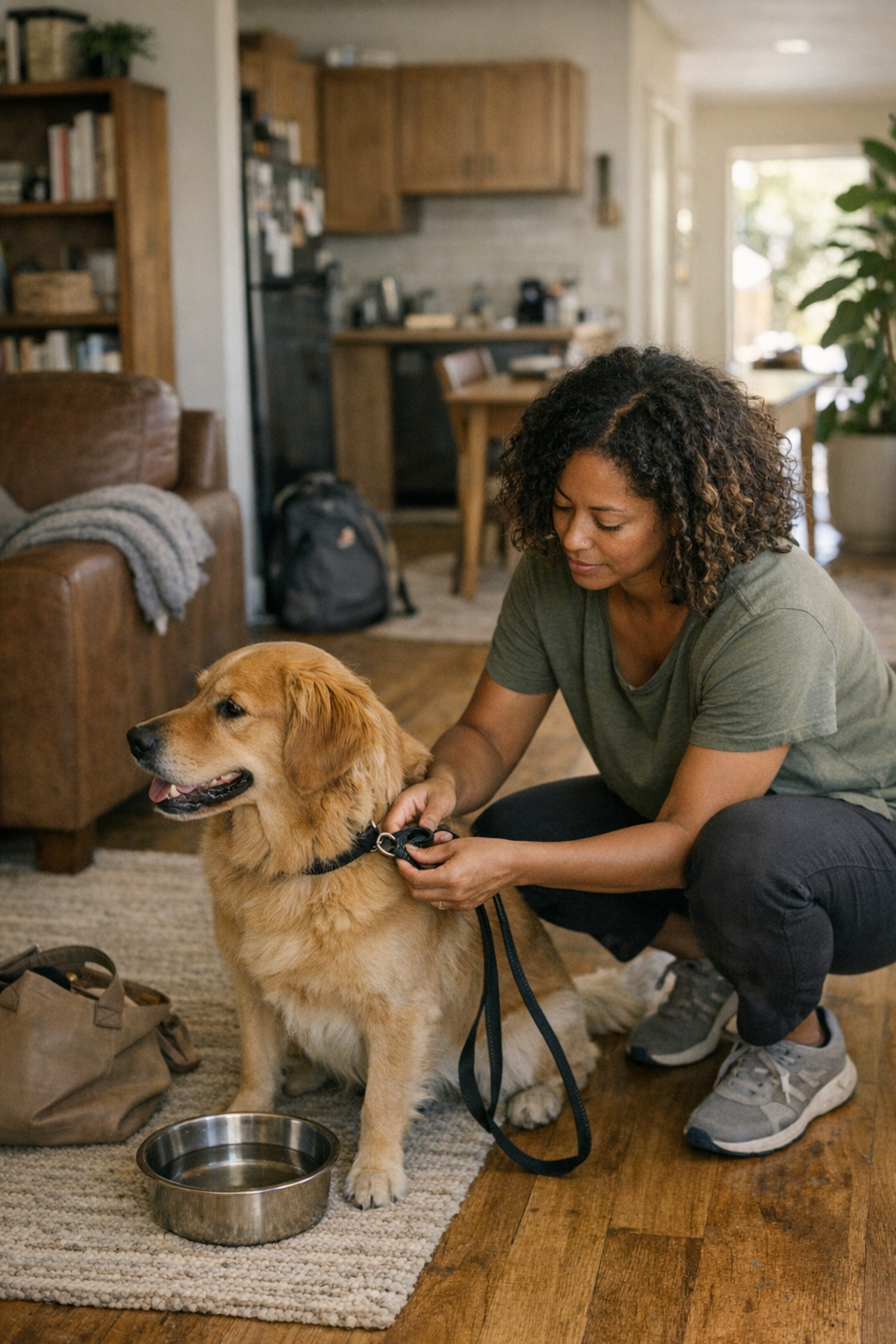
The real after-walk pause isn’t about manners—it’s about the logjam. Whether you’re returning from a walk with bags on one arm, leash in the other, and keys wedged between your fingers, that calm sit or stand by the door stops feeling like structure and starts acting like a blockade. The first few days, unclipping right at the threshold seems efficient. But week after week, what was a brief, tidy checkpoint quietly becomes the spot where your routine breaks down: shoes still on, hands juggling, critical dog gear just out of reach, and a dog left glancing for a next step that never lands. The entryway stays clear, but the flow of home life snags here—again and again. This is the kind of overlooked daily friction DogPile is built to diagnose—where practical setup, not just discipline, makes the real difference.
When Calm Turns into a Bottleneck
On paper, that door-side pause looks organized. Your dog’s waiting; you’re unclipping; the process seems controlled. But reality pushes in: one hand on the leash, the other arm loaded with bags and keys, and now you’re fumbling because the water bowl or wipes are nowhere within reach. That moment of order cracks fast the second you realize you have to stretch or backtrack for the next step. Instead of a move into home mode, you get a standoff: you, the dog, the door, frozen in place as your workflow stalls.
No leash yanks or barking—just a jammed entry zone where you need the space to act. Typical signals pile up:
- You’re half in, half out, stuck balancing on the mat, unable to step free until all hands are empty.
- Your dog waits for something more, hovering uncertain while you dig for a towel or drop a bag to find keys.
- Trying to grab one item blocks access to another, so nothing gets put away smoothly.
After a dozen cycles, this silent hold eats up your mornings and clutters your evenings. Every post-walk reset feels bogged down, and the transition to “home” never quite clicks—you remain mentally outside, even while standing halfway in.
The Lingering Effect of Entryway Pauses
It’s easy to mistake this routine as good practice; the dog is calm, after all. But repetition reveals what first felt orderly soon forces both of you to wait pointlessly for some secondary “go” cue. The hidden cost? Routine momentum grinds out, second by second, cue by cue.
- Shoes stay on, trapping dirt at the door and stacking clutter in the space you’re about to need.
- The water bowl sits empty while your dog paces, waiting for relief that never arrives at the right step.
- Bags and gear pile up at the choke point, blocking easy access to both dog space and human space.
- Transitions swell into a string of half-completed tasks, never really letting you move on.
Looking tidy doesn’t guarantee living ease. You notice the drag only after the rhythm is broken by too many friction points, and what felt managed proves itself unworkable under real, repeated use.
Real-World Friction: Where Small Holds Up Big
This isn’t chaos—but it’s a mounting stack of micro-holds. Maybe you kneel to unclip and realize you still have damp grocery bags on your wrist. Maybe you step inside and reach reflexively for a towel, only to find it’s still drying in the hallway. Keys hang off your finger; the wipes are at the far end of the bench; your phone buzzes from your jacket in a heap by the leash. Meanwhile, your dog stands in limbo, taught to wait but never actually released into comfort or food. The artificial “pause” becomes a friction point you both start to hesitate around, especially at the end of a long week of broken transitions.
The Subtle Crunch as Schedules Tighten
The trouble compounds on days when you’re squeezed for time: you rush in, mentally juggling your next call or meal prep, but get stuck anyway—shoes still on, bowl empty, bags clustered, dog stuck by the door. The “official” pause point eats up precious minutes without ever earning its keep. By Wednesday or Thursday, the sense that your system is sabotaging you—not helping you—becomes unmistakable.
What Actually Helps: Moving the Unclip Deeper
The most practical reset? Shift the leash-off spot away from the threshold and into the next real action zone. Unclip not by the doormat, but beside where the day actually continues—dog bed, feeding corner, or water station. It doesn’t require a major overhaul; just restructure the “release” to align with your actual next step.
- Set down the water bowl where you plan to stop, fill it, then unclip—so the dog flows straight to what matters.
- Kick shoes off as you walk in, before hands are needed elsewhere, and before gear blocks movement.
- Drop bags in a spot that keeps them out of the path—not at the narrow door—while the leash is still in range to control the dog for another few steps.
- Stash cleanup items where you pass naturally, so you’re set up for quick use, not a delayed scramble back to the door.
This single adjustment erases the “threshold freeze.” Home becomes a sequence, not a stutter. The silent waiting game at the door disappears, replaced by a smoother, less interrupted handoff into daily life.
How Threshold Pauses Become Cracks in Your Routine
Boundaries work—up to a point. Dogs cue off repetition. When you teach “leash off at the door,” you train a checkpoint that holds everyone there, regardless of what’s practical. The longer you use it, the more it becomes an anchor point that needs another cue to resolve. It’s not calming; it’s a pause that outlives its usefulness and traps you in a cycle neither of you actually enjoy.
- You repeat a dozen versions of “okay, go ahead” just to get both feet inside.
- Meanwhile, gear oscillates between human and dog zones, never finding a home until after extra effort or laps in and out of the entry zone.
- The rest of the layout can look organized, yet this stuck point quietly sabotages you day after day.
Even a clear floor doesn’t equal a solved routine. When the one sticky spot at the door keeps holding things up, the consequence stretches into every other part of the home’s flow, growing more obvious the longer it’s left unaddressed.
The Difference Between Looking Organized and Living Organized
Setups that seem orderly on first glance can reveal their limits in use. Shoe bins, leash hooks, or gear baskets by the door help—but if they force you to double back, shuffle hands, or block easy dog access, the neat look quickly proves hollow. Organization should oil the routine, not stall it midstream.
- That convenient leash hook may actually encourage resets at the wrong spot, forcing you to retrace steps before you can settle in.
- The “waiting spot” for your dog can create more standoffs if it’s not paired with what happens next—water, food, or comfort.
- Splitting pause points means you check (and re-check) both dog and human essentials against each other, slowing the day every single time.
The proof is in the feel of the routine’s reset. Shift the action to the dog’s destination, and both sides—dog and owner—get relief from repeated, low-level stall-outs. The home starts working with you, not against you.
Small Change, Noticeable Improvement
This isn’t about buying your way out of friction. One targeted tweak—moving the unclipping or cleanup moment to where the next task naturally starts—breaks the stutter without creating new hassle or clutter. For most routines, that’s as simple as leading the dog to their bowl, bed, or rest corner before you drop the leash, or rearranging one towel or bag zone to catch you on the way in, not after the pause. Over the next week, you’ll spot fewer repeated calls, walk back less often for missed wipes, and dodge the low-level irritation of a “door moment” that never quite ends—even if the space itself looks unchanged.
Putting the Fix to Work: A Day-in, Day-out Perspective
The proof comes through the ordinary mess: a muddy walk, arms full of groceries, shoes dripping on the mat. When the gear is staged a single zone further in, your home routine unjams and neither you nor your dog waste time in the entryway—reset flows into the rest of the day without dry runs, repeated cues, or the nagging sense you’re fighting the space you just organized. The door doesn’t need to be a checkpoint if the rest of the setup is finally working with your real, repeated use.