
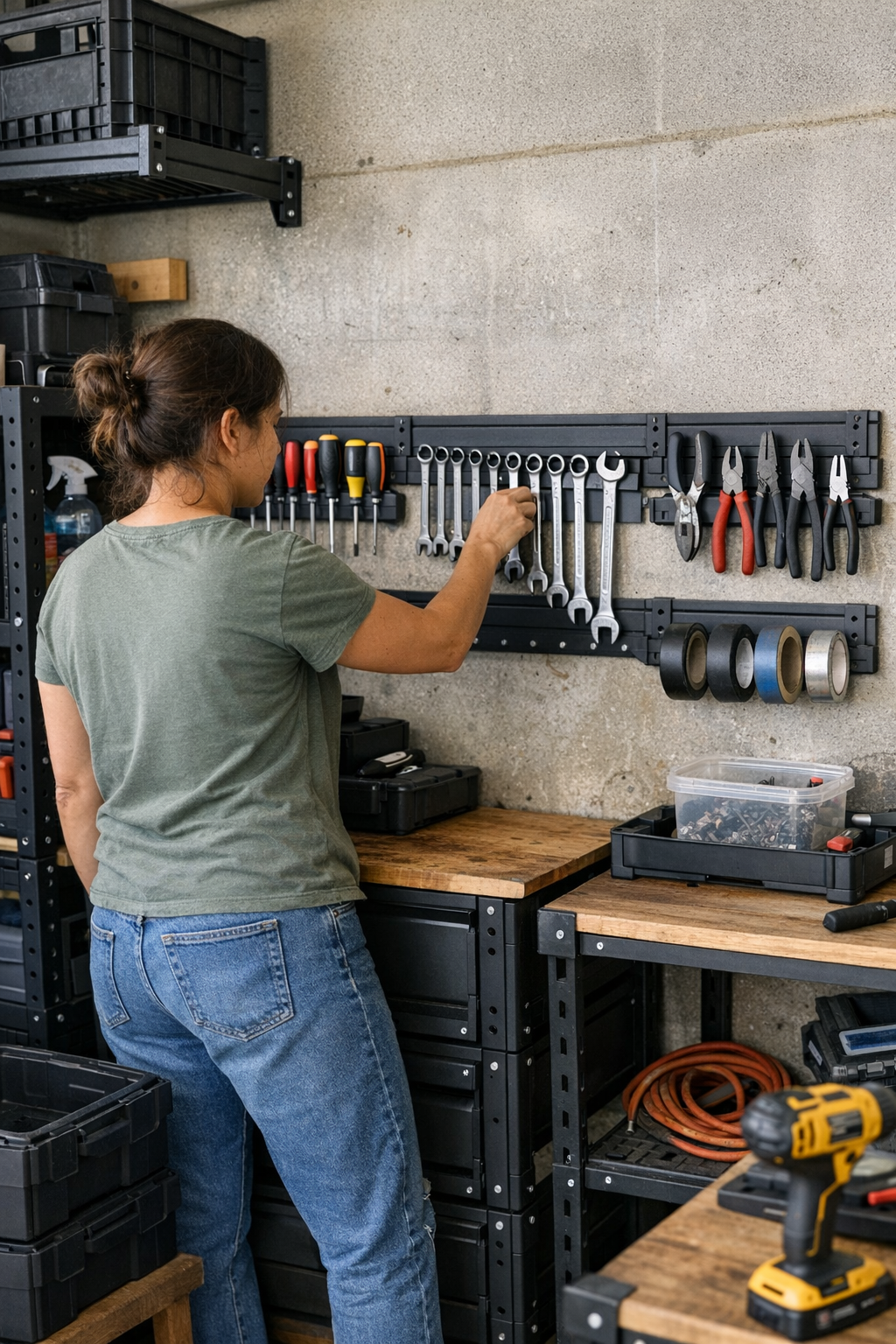
The wall rail system is almost a trap—a setup that lures you in with that first-day perfection. The rails go up, the hooks line the wall, and suddenly every screwdriver, pliers, tape roll, and wrench has a spot. For a brief window, the workspace transforms. You snap a photo: wall looks tight, every handle lined up, not a tool in a pile. Whether it’s the garage side wall, a converted shed, or the back edge of a basement workshop, the promise is clear—no more wasted time digging through bins or stepping around stray parts on the floor.
But the reality starts showing within a few days. Your fixes and projects turn into a daily rhythm: a garage cart gets shifted to open up the path, you reach around a cabinet edge again, the work zone briefly clear before the tools start shuffling back into motion. That first wave of satisfaction? It’s always just a bit too fragile.
Where “Good Enough” Organization Quickly Breaks Down
Fast forward a week. Regular use exposes all the friction the clean wall photo missed. Grabbing a tool means knocking into another. Reaching for the tape measure requires moving the big wrench out of the way; two screwdrivers tangle for the same slot. Even just returning tools after a late-night tweak feels clumsy. You hesitate, balancing items, scanning for a free hook, finally wedging a tool wherever it’ll fit. Each micro-improvisation, barely noticed in the moment, adds up to a crawl when trying to keep pace.
To the casual eye, the setup passes. “Everything’s on the wall,” someone might say. But for the person who actually uses the space, a pattern emerges: one main rail jams up, the others stay half-vacant. Your reach zone clogs with orphan bits—drill bits shoved sideways, a clamp doubling up next to the tape. A slot that technically “holds” gets blocked, and gradually, clutter concentrates wherever your hands keep landing. The other rails might as well blend into the paintwork. By Wednesday, the area’s still “organized”—but it’s subtly sabotaging your momentum.
Mixing Categories: Recipe for Routine Clutter
It feels efficient to slot tools wherever they fit. You fill up by shape and size, not by use. For a while, that’s enough. Until, that is, you’re in a rush—three tools to return, none slot back cleanly. The screwdriver’s only free spot means wrestling past a big wrench; tool grips overlap, slots begin to bow, maybe something tumbles behind the bench. A couple tools land “just for now” on whatever surface is closest. Ignore it once, ignore it twice, and now you’re living with a slow drift back toward chaos—the system demanding your attention just to function.
The Clutter Magnet: Why the Mess Finds One Spot
The tightest rail—the one in your main workflow—becomes a magnet. A stray fastener or marker gets dumped in the gap “until later.” A tape reel ends half-hung, the backup tape ghosting behind. Meanwhile, three feet down the wall, perfectly fine rails are wasted. This is the zone that starts to resist resets. Suddenly, clearing up takes willpower and a full stop, not just flowing as part of the routine. That “organizing” moment feels heavier every time.
Category Rails: Simple Shift, Tangible Difference
This is where splitting rails by tool category doesn’t just tidy up—it unlocks friction you’ve learned to live with. Screwdrivers finally get their own rail, tapes stay clustered together, wrenches drop into their lane. Now, cleanup stops being a mini-puzzle: each return is direct, quick, brainless. No more doubling up or stacking tools by size rather than type. Overflow is obvious. You’re not hunting for a slot—you’re moving on.
Even in cramped spaces—a bench tucked against a wall, a narrow garage aisle—this small discipline matters. Instead of reshuffling mid-task, the layout runs on autopilot. Grab, use, return. Two users aren’t stepping on each other’s system; everyone can scan the wall and see what’s missing. Return speed picks up. The zone stops bottlenecking. And the mental drag lifts.
Pushing Past the “Neat Wall” Myth
Picture the old way: a Saturday, tools stacked for a repair. Four rails, all jumbled. By noon, you’re struggling—misplaced screwdriver blocking cleanup, screws sliding behind a pile of wrenches. Dead corners catch orphan parts. The job’s pace slows to hunt-and-fit, with tools landing on carts or benches just to stay out of the way. That’s what “organized enough” really feels like—a setup that stores things, but keeps interrupting the work flow.
After relabeling and splitting the rails, the same rush job flows. Each tool snags its exact spot, no reshuffling needed. When something is missing, there’s a clean gap—not a guessing game or a scavenger hunt. No more stumbling into loose bits two days later. Resetting the area just happens as part of working. It isn’t flashier; it’s just less friction, time after time.
Beneath the Surface: When Looks Aren’t Enough
Most wall rails claim “a place for every tool”—but in practice, it too often means “it fits somewhere, for now.” That’s not what gets you through real projects. The difference between a wall that looks tidy and one that truly flows is huge. A packed, photo-ready setup impresses, but if you’re pausing every step to move a tool, that organization is just busywork in a new disguise.
The cracks show up fast: an early-morning rush, two projects colliding, or a quick fix before dinner. The system can’t keep up. Tools cluster in high-use zones, corners fill, and soon movement feels pinched. Resetting isn’t just returning things, it’s wrestling the space back from daily entropy. The outer order hides a deeper resistance that drains routine work.
Setup Tweaks That Pay You Back Every Day
This isn’t about a prettier wall. Assigning rails by category gives you smoother movement, faster returns, and less energy lost cleaning up after yourself. Leave an extra slot or two open on every rail—that bit of slack lets you flex during busy spells or absorb odd overflow without the whole system collapsing. And mount rails so the furthest slot is comfortably reachable for everyone using the space. A tool that’s hard to return will wander; don’t give friction a foothold.
Even with tools in and out, benches shuffling for bigger projects, or a cart wheeled in to clear the walkway, a zone built by function—not just form—holds. You won’t find wrenches marooned in random corners days later. When something is out, it’s obvious and it’s fixable. The whole system leans toward clarity rather than confusion, and that carries through every job—big or small.
There’ll always be late nights when you dump a handful of fittings on the nearest shelf. Even the sharpest layout can’t guard against every rush or distraction. But when your rails are set up with real, daily flow in mind—clear categories, extra slots, easy reach—you get more than a fleeting “organized” look. You get a setup that actually helps you work, recover, and keep moving. In any busy, lived-in workspace, that’s worth far more than a photo on the wall.