
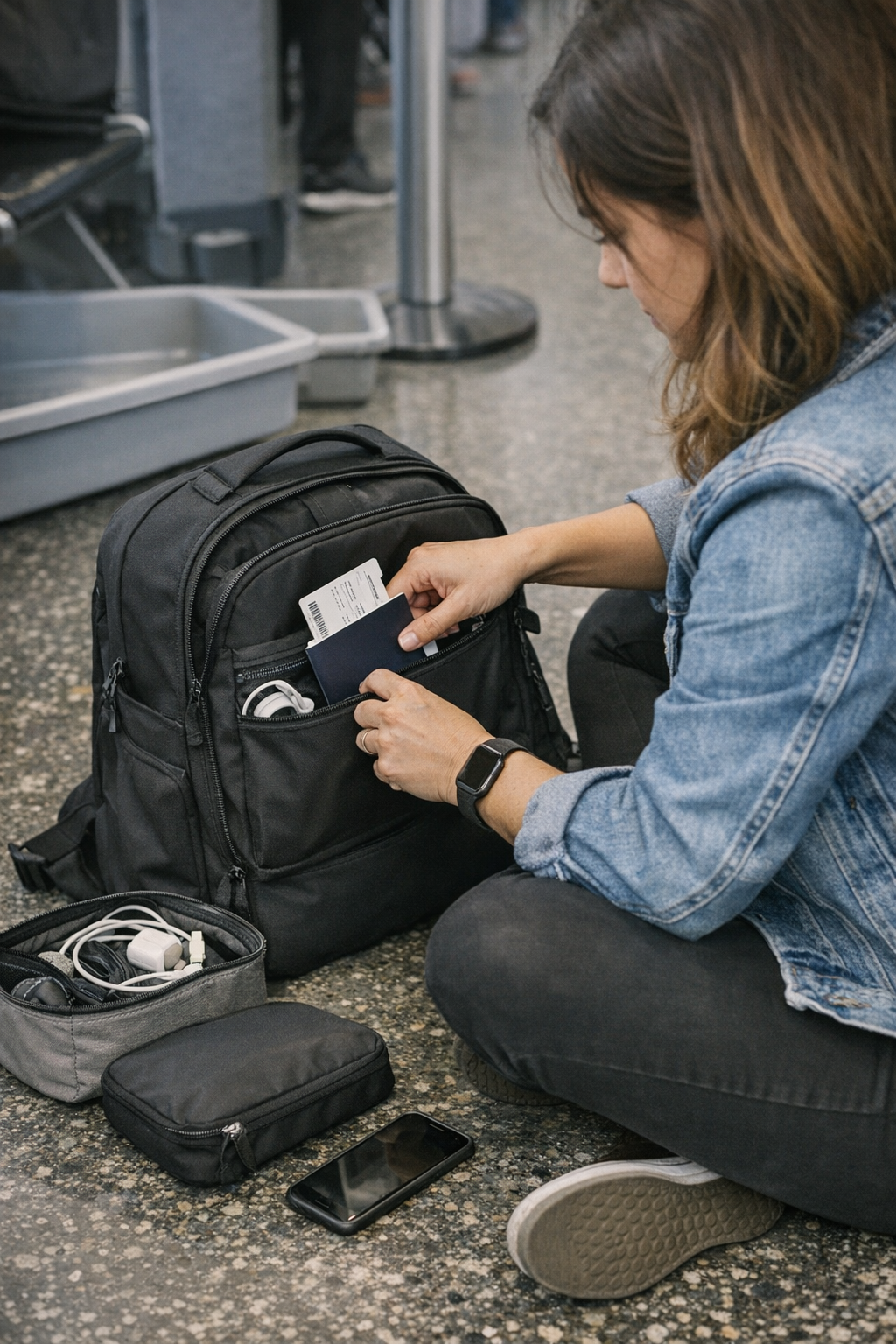
A carry-on bag can look perfectly organized—zipped, stacked, everything in a labeled pouch—yet still slow you down the moment you enter airport mode. The real difference between a tidy setup and a truly effective one isn’t visible at home or photographed on a hotel floor. It shows up at check-in, security, and boarding, when you’re fumbling for a passport lost two layers deep or shuffling pouches just to reach a charger, and when repacking becomes a silent scramble. Physical order does not equal practical access: what works in static pictures often crumbles under repeated, rushed use.
What Looks Organized Can Still Slow You Down
Most travelers start with a sense of control: every item in a pouch, each pocket assigned, a cable kept in its case. On paper, it’s efficient; in action, the cracks show instantly. As soon as you need to produce your boarding pass or free your laptop for screening, the logic of “place for everything” buckles under the pressure of movement. Security trays come, bins stack up, and suddenly you’re juggling secondary bags—unzipping, digging, re-zipping—while the line behind you builds tension. Items meant to be “safe” slow you down, and what began as organized order leaves you mentally tracking three repacking moves just to restore your layout.
The Layering Dilemma: Visual Order vs. Real Access
A layered layout—pouches nested within pockets, tech zipped behind toiletries—promises predictability. But even the best system cracks under everyday travel friction:
- Repeated retrievals: Needing headphones or a charger typically means unstacking higher-priority items, especially when cramped in aisle seats or digging under a seat mid-flight.
- Overlapping compartments: A passport tucked behind two pouches feels secure at home, but during unplanned terminal checks, you pause, scanning pockets and stalling movement. Your “memory system” fails where real flow is needed.
- Stacked tech pouches: Cables and adapters tend to migrate deeper into bags. Each time you reach in—boarding call, gate lounge, after landing—you face more tangled friction and wind up stuffing items wherever there’s open space, erasing the intended order.
Even with a minimal, visually clean setup, friction re-emerges: cables hidden under pouches, flat items blending in front pockets, quick-access slots blocked by a single misplaced case. Every decision—outer pocket, deep pouch, stacked layer—trades off one friction for another, and you only learn which matters after the first few real interruptions.
The Cost of Internal Friction, Trip After Trip
The drag doesn’t end at the airport. Patterns you build while traveling seep straight into your workday or commute. If your carry-on is structured for perfect stowage rather than easy movement, every small retrieval—wallet, charger, ID—produces a momentary stall. The same setup that kept your bag neat on the plane leaves you double-checking pockets at home or halting a morning rush to repack something lost in the stack. What’s intended for the airport quietly slows down your daily rhythm, making “just-in-case” order a daily inconvenience.
Real-World Scenarios: When Your Setup Gets in Your Way
The Security Tray Pause
As the line pushes ahead and trays clatter, you unzip your “organized” bag only to find your passport under a pouch and your laptop in yet another compartment. Each extra second—digging, shifting bags, unzipping layers—means pressure from behind and lost focus. The setup once meant for confidence becomes a liability at speed: security flow turns awkward as your layout breaks under actual timeline pressure.
Boarding Line Tension
Gate agents request another pass check. You haul your bag upright, reach past two organizers, and finally produce your document after a short visible scramble. Every missed quick-access moment turns you into a hold-up for the line, making retrieval a show instead of a smooth move.
Seat Entry and On-the-Go Retrieval
Sliding a bag under the seat: headphones are needed, but the outer pocket is blocked, so you reach deeper through an inner sleeve, past the book and tablet. Knees pressed, an aisle crowded—you recover headphones at the expense of spilling contents, prompting another round of repacking. The illusion of order collapses after just one real in-transit reach.
Arrival Reset: The Repacking Burden
Arriving at a hotel or home, you face the aftermath: half the bag emptied to reconnect the scattered pieces. “Organized at departure” now means unpacking to restore a simple order. The more complex your in-bag structure, the more noticeable the post-trip reset becomes—and the less eager you are to repeat it on the next round.
Rethinking Carry-On Organization: A Shift to Predictable Access
After trip after trip, it becomes clear: more compartments and deeper stacking don’t solve real movement needs. What works is predictable, immediate access for your most-used items—outer-front slot for documents, a middle zip for cables, single pouch up top for headphones. You structure for the next interruption, minimizing the number of steps between you and your essentials.
This isn’t a promise of perfection. Even the best setup can slip after a tight layover. But when the items you reach for most often have a frictionless path—one move, one pouch, one spot—the sequence of daily travel turns smoother, not just visually tidier. You stop mentally mapping pouch layers and start moving in sync with the real airport routine.
The effect isn’t instant magic—some items still migrate, and certain bags resist clean customization—but each direct-access solution trims away disruption. When your carry-on feels lighter at the moment of retrieval, not just at the scale, you’re on the right track.
Making Your Next Trip Less Interruptive
Traveling well isn’t about maxing out storage or styling the neatest flat lay. It’s about making sure your most-retrieved items don’t demand a pause, a shuffle, or a guess every time you move. Every extra layer between you and your essentials isn’t just a tiny hassle—it’s a multiplying frustration across the whole trip.
Track where your movement stalls: repetitive delays at security, awkward reaches in crowded aisles, missing documents at boarding, reordering at arrival. Each issue signals a structural fix, not just a cosmetic one. Adjust your carry-on’s structure so that high-frequency items require a single, quick motion—not an unpack-and-reshuffle. Even a couple of tweaks—relocating your passport to a dedicated outer slot, or limiting tech to a single pouch—will dial back recurring disruptions and let both travel and daily routines run smoother.
Explore carry-on solutions designed for real travel movement at CarryOnSupply.