
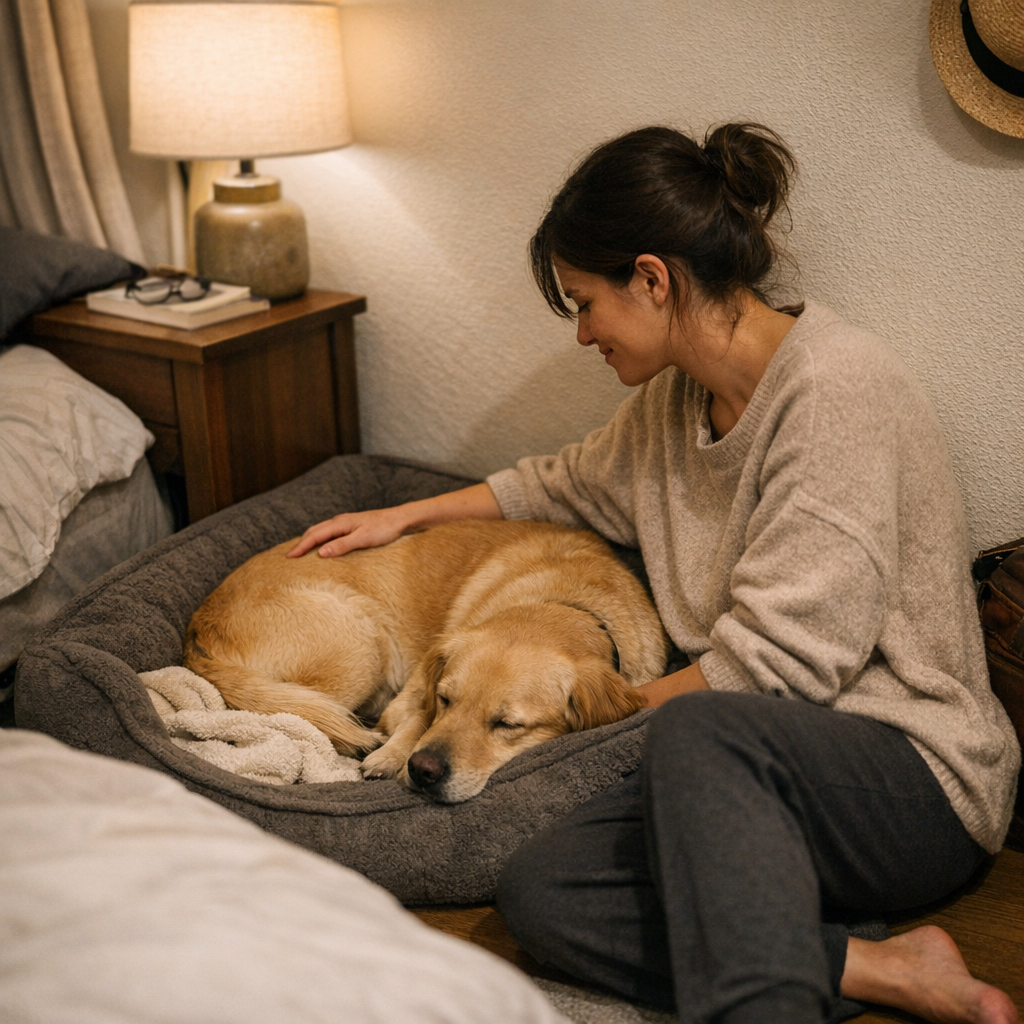
When bedtime for your dog turns into a series of restless pacing, circling, or post-lights-out hallway checks, it’s rarely just a harmless quirk—it’s usually a problem with the way you’ve set up the dog’s sleep zone. You kill the lights, climb into bed, and brace for the end of the day—only to hear those small but unmistakable signals: paws on the floor, hesitation at the threshold, a return trip to a “finished” setup that’s supposed to work but keeps leaking time and comfort. For many dog owners, these micro-interruptions are so familiar they go unnoticed: the dog leaves her bed minutes after you settle, hovers for another pass, or refuses to stay down when you most need the night to actually end. The routine that looks calm in theory falls apart in practice, leaving both you and your dog caught in a loop of repeated adjustments, slow resets, and sleep that never fully lands.
Why “Almost Settled” Feels Like a Repeat Offense
It’s not just the harmless circling—what starts as a minor quirk turns into a nightly drag. You switch off the TV, dim hall lights, and signal bedtime, but instead of stillness, it’s a fresh surge of steps: the dog pauses, listens hard at the door, hesitates at every distant creak. One more circle. Sometimes it’s a full reset—dog up and standing, ears trained on the hallway—just as you try to wind down. Most owners assume it’s just energy or habit, but when the same friction appears night after night, it starts cutting into the point of the routine itself. Unfinished rest piles up: mornings stall, evenings feel longer, and you start to recognize these interruptions not as “just dog stuff,” but as a sign that your setup is leaking comfort and time at the one hour it’s needed most.
Owners get used to these stop-and-restart cycles. Some shuffling is normal, but when your dog abandons the bed soon after you settle in, or keeps resetting for a “better spot” that never quite works, there’s nearly always a practical block in the arrangement—not just unexplained dog behavior.
What Bedtime Friction Really Costs
Most setups fail first in small ways: a well-made bed set near a walkway, the spot just catching spillover from hallway light, or the resting area positioned where footsteps and after-hours sounds pass through. The space looks together but feels unsettled, and everyone pays for it the next day: slow starts, extra pauses, a heavier drag on the entire morning routine. The “almost settled” effect doesn’t just end at night—it lingers. Repeated exposure to these micro-disruptions slowly weaves discomfort into your daily reset, blurring the difference between dog space and household flow until both are held back by invisible snags.
When your dog stands, hovers, or leaves the bed repeatedly, that energy isn’t just spent on movement—it’s time shaved from real rest and from your own reset, multiplying the cost as days stack up. A setup that works in theory but fails in the moment turns a quiet night into another round of late routines, unrealized calm, and barely recovered mornings.
Gaps in Setup: Why Bed, Location, and Use Aren’t Just Visual Choices
Reaching for an easy answer—such as blaming exercise or dog age—misses the actual pattern: most friction starts and ends with the physical setup. Too many beds are placed for a tidy look, not for how sound and footsteps actually move through the home after dark. A resting zone laid out in the “logical” spot—next to a door, near a hallway, or where returning from a walk feels quick—becomes a target for every after-hours disturbance. Even the best, most comfortable bed underperforms if it’s a single soft bump from kitchen doors, evening TV, nighttime water bowls, or the return sweep after a post-walk towel-up that leaves things slanted or off-reach.
Neat-Looking Isn’t the Same as Easy-Settling
The classic mistake is setup for appearance: bed pushed against the baseboard, dog gear stacked for a clear floor, all in “out-of-the-way” spots. The result is physical drag—every post-walk wipe is just out of reach, late-night noise crosses the resting area, and movement through the space interrupts settling instead of supporting it. Your dog doesn’t throw obvious tantrums, but the signs are there: more circles, restless shifting, fixing and re-fixing blankets, sneaking to laundry baskets or cold corners, always searching for that one missing piece in the so-called “relaxation zone.” Over time, the disconnect between looking organized and actually helping the nightly reset grows too obvious to ignore.
Turning Friction Into Flow: Where Setup Fixes Really Work
The difference isn’t magic—it’s measured in inches, wall proximity, and how well the resting area is shielded. Beds anchored with one edge against a wall, tucked away from main traffic, deflect surprise noise and signal real safety. Instead of running environmental interference—catching every late kitchen trip or phone-illuminated step—your dog gets a clearer perimeter and fewer reasons to monitor the household all night. The number of resets drops. Where you used to watch a slow-motion parade of turns and pauses, you now see one clean circle, then stillness. “Almost settled” becomes “actually down.”
Proof in Adjustment: What Changes When You Move the Bed?
After too many nights of failed sleep, trying a simple move—cornering the bed, setting its back flush against a wall, shifting dog gear closer to reach—immediately cuts out most circling and edge-hanging. The physical signals change. Where your dog was once alert to every stray step in the dark, she now curls up and holds position, even as hallway noise continues. The setup doesn’t eliminate every variable, but by removing the key friction points, evenings hold together: the night finally ends when you want it to, and “just one more lap” stops being a nightly obstacle for both of you.
How to Tell If Your Setup Is Still Failing the Daily Test
Watch for concrete signals that your flow stalls, even after cleanup and arranging:
- Multiple circles or long pauses before lying down—beyond a quick orientation
- Instant response to hallway movement, noise, or shifting light
- Dog leaving and re-entering the bed within a few minutes of settling
- Repeated pawing or blanket reshuffling as if something is always off
- Frequent attempts to switch resting places—ditch the bed for other corners or hidden zones
Treat these as practical signals, not odd behaviors. They mark real missed connections between your routine’s design and the everyday reality of how your dog—and you—move through sleep resets. The trouble isn’t the dog; it’s the blind spots in a visual setup that doesn’t match the pressures of real life.
The Bedtime Reset That Actually Works—What Changes Make a Real Difference?
The most useful adjustments aren’t complete overhauls but targeted, practical tests:
- Reposition the bed away from cross-traffic flows. Hallways or door zones act as traffic conductors, carrying every late trip or echo right onto the bed.
- Anchor the bed against a wall or solid surface. This creates safety cues—your dog needs fewer checks, fewer circles, and can relax into a defined space.
- Pick a buffer zone if possible. Even if you can’t get the perfect quiet corner, reducing direct lines of sound and light pays off fast, smoothing out both your routine and your dog’s rest.
Reset is about matching setup to the pattern of actual use, not just first-day impressions. Most dogs settle faster—sometimes within a couple of nights—when the area stops letting small frictions interrupt the process. Some outside noise or occasional visitors will always throw in the odd tense night, but the repeated drag of restless rhythm fades once the core friction points are handled by where and how the setup lives in your daily routine.
Why One Fix Outlasts a Hundred Tweaks
When a bed shift finally aligns with your home’s real flow, the effect shows up quietly but repeatedly. Better setup makes evenings shorter, mornings less fractured, and lets both you and your dog off the hook for endless tinkering. It’s not about buying the best-looking bed or filling the area with more gear; it’s about seeing what actually prevents smooth resets night after night. With friction gone, your dog drops into rest with less performance, you reclaim time, and the cycle of “almost settled” fades into the background noise—no longer the last thing standing between you and a functional routine.
If the Routine Still Fails, Check What Else Is Sneaking In
If you’ve moved the bed, anchored it, and blocked the main traffic points—but nightly friction remains—look for less obvious disruptors: shifting lighting that doesn’t stay off, household traffic that never fully quits, or routines that create unpredictable waves of noise after the supposed “reset.” Even the best setup can’t compensate for an unpredictable end-of-day sequence where pads, le