
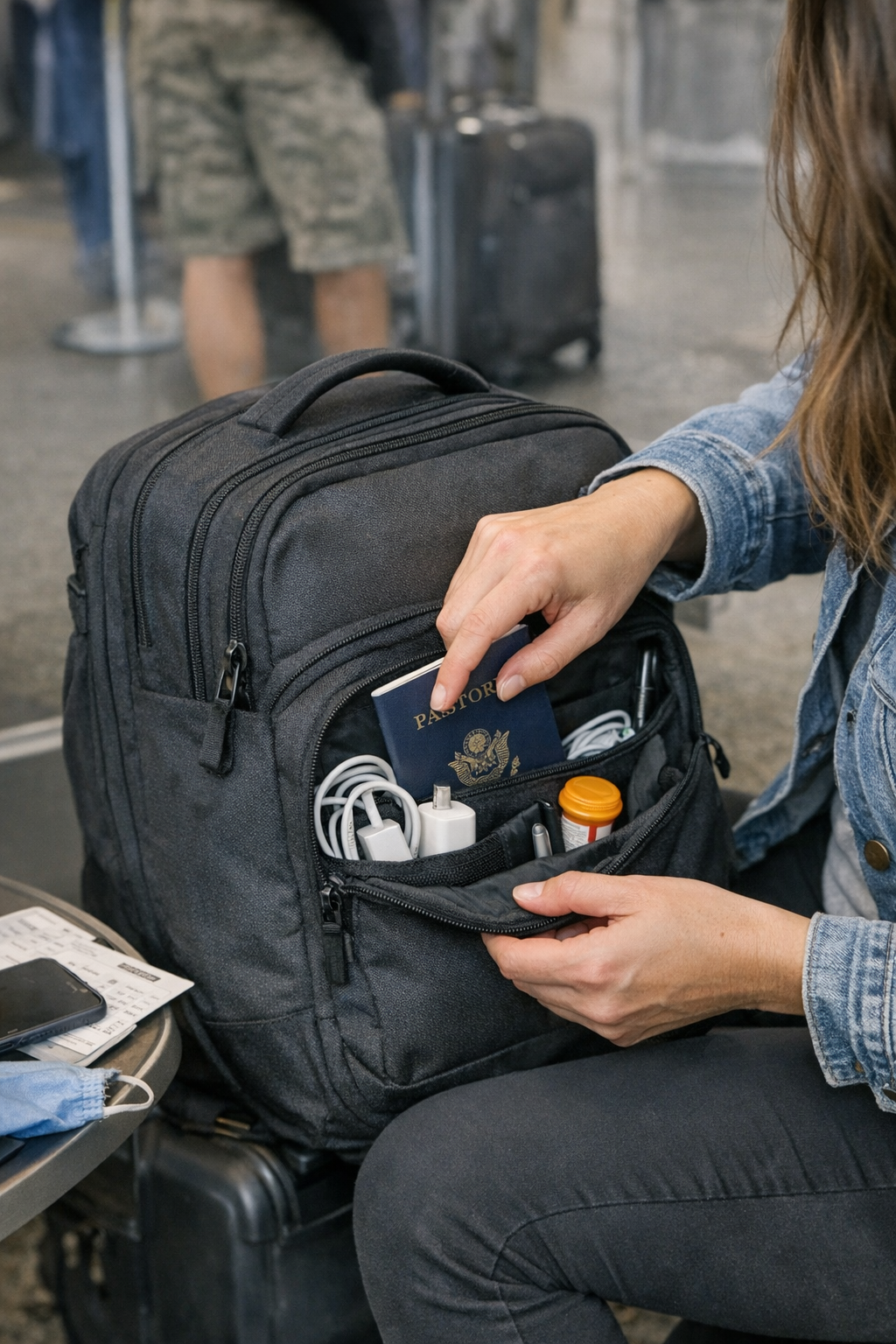
The illusion of an “organized bag” collapses the moment real travel begins. On a hotel desk, your carry-on looks surgically ordered—pouches aligned, zippers shut, passport squared in a sleeve. But at the airport, that visual order can turn into its own obstacle: wedged in an aisle seat, you find yourself digging through layered pouches, pausing the line or blocking the aisle, just to reach a charger or document you thought was “in its place.” What kept everything tidy all morning now slows you down at the first sign of pressure—because travel isn’t about static order, it’s about repeated, unpredictable retrieval.
Why “Looking Organized” Fails in Real Transit
Departure setups always look perfect: tech pouch zipped, toiletries nested, travel docs perfectly filed. Then the airport flow shreds that logic. Security bins start stacking, boarding lines squeeze, and suddenly you’re unzipping deeper and deeper, looking for the same few essentials in the middle of a crowd. Each neatly packed layer adds another delay—one more zipper, one more reshuffled pouch, just to put a hand on what you reach for most.
The desk test is deceptive: what seems controlled under calm lighting turns clumsy once you’re trying to grab a passport blocked by chargers, or a pen slipped between organizers. Movements multiply, urgency builds. Friction isn’t obvious in the mirror—only in the repeated interruption of your flow when access turns awkward.
Repeated Interruptions Matter More Than Mess
Order’s not the problem—friction is. Every extra unzip, each search through double-stacked pouches, adds drag to the travel sequence. Organizers promise order, but in real use, they easily gum up the rhythm: grabbing an e-reader means lifting paperwork, reaching a charger means unpacking a sleeve. With every repack, the time cost compounds. The enemy isn’t visible mess, but slow, repeated pauses that add up at every checkpoint and seat entry.
The Real Cost of Nested Packing
You don’t notice the trap at first: earphones sorted, travel docs slotted, charger buried neatly, everything layered for visual calm. But real-world travel means retracing those layers over and over—through security, during turbulence, after each boarding call—when what you need is never just one movement away.
Where “organized” setups fail over real trips:
- Paused at bag scan, holding up the line, because your passport is under paperwork and a tablet.
- Needing sanitizer and being forced to unzip three pockets, each revealing the wrong pouch first.
- The pen you used at check-in already lost between tech and doc organizers—again.
- Your “essential” pouch keeps sinking to the bottom after every security tray repack, even when it started on top.
These aren’t dramatic failures but they chip away at your travel pace. Each blocked retrieval, each untimely clutch of the wrong pouch, means more public fumbling and more fatigue—especially when routines have to repeat during a tight connection or a crowded return flight.
The Shift: Packing for Movement, Not Display
The upgrade isn’t complicated: move your real-use items—passport, charger, meds, pen—into a single outer pocket or top-access pouch. No double-zipping, no pouch shuffle for repeat basics. If you touch it twice between hotel and seat, it shouldn’t be buried for looks. This shift turns each borderline-miss—fumbled documents, lost sanitizer, pen hunts—into one-move retrievals. Instead of unsealing pouches in public, you build a flow that matches airport speed and boarding tension.
Real-World Example: The Outer-Pocket Reset
Test after test, every packed trip that put the main-use essentials—passport, tickets, phone, charger—into a dedicated outer pocket delivered instant wins at checkpoints. What changed wasn’t just the pouch location; it was friction that disappeared: one zipper, one action, one item in hand. No main-bag reopening, no lane-blocking repacks, no guilt-inducing repouching while the security tray stack grows. The rhythm of movement—unzip, grab, reseal, keep moving—turned gate lines and seat entries from frustrating pauses into smooth, continuous sequences. These aren’t “efficiency tips”—they’re force multipliers for ordinary travel pressure.
Recognizing the Weak Points
Perfect order fails where travel gets messy and time-pressured:
- Your passport’s wedged under tech gear while dozens wait behind you at a passport check.
- Turbulence hits and your needed meds are stuck under a double layer of organizers you haven’t touched since packing.
- Security trays pile up—your visually neat pouch setup now a puzzle of trays, bags, and zipped-down layers, each one stealing time during crunch moments.
These recurring trouble points aren’t dramatic emergencies—they just repeat, accumulate, and quietly sabotage your pace in every crowded terminal, busy aisle, and repacking rush. The “order” that looked good before becomes a slow leak of time and patience.
Tuning Your Setup for Real Travel Life
The real test isn’t how “organized” your bag looks after repacking. It’s how many times you can reach, retrieve, and keep moving before the system starts pushing back. Anything you use repeatedly before boarding needs instant access—outer pocket, top zip, wherever avoids the pouch shuffle. Tidy doesn’t always mean usable; function means knowing the minimum moves between you and what you reach for while the line is compressing and bins are filling. It’s not about ditching order—it’s about order that lets you move, not pause.
Autopilot repacking for looks makes the next round just as frustrating. Instead, the strongest setups favor flow: what you need, right up front, always where you expect it. The result? You spend less time interrupted, less time nervously shuffling trays and zippers, and more time actually moving through every checkpoint—and every aisle—without dragging your trip’s rhythm.
Does Your Carry-On Still Work Later in the Trip?
Smart design isn’t about a hotel-room photo. It shows when your carry-on lets you move, grab, and go—checkpoint after checkpoint—without breaking stride. Each slow retrieval is a signal: function lost to optics. If you keep losing seconds to hidden essentials or repack drag, your setup is due for a reset.
Every trip is a reality check. Early tune-ups produce a smoother, less interrupted journey home: faster retrievals, easier seat access, and less friction between you and moving forward. The difference isn’t cosmetic—it’s structural, and you feel it every time the airport pace forces another test of what’s really packed well.
See carry-on tools designed for real travel flow at CarryOnSupply.