
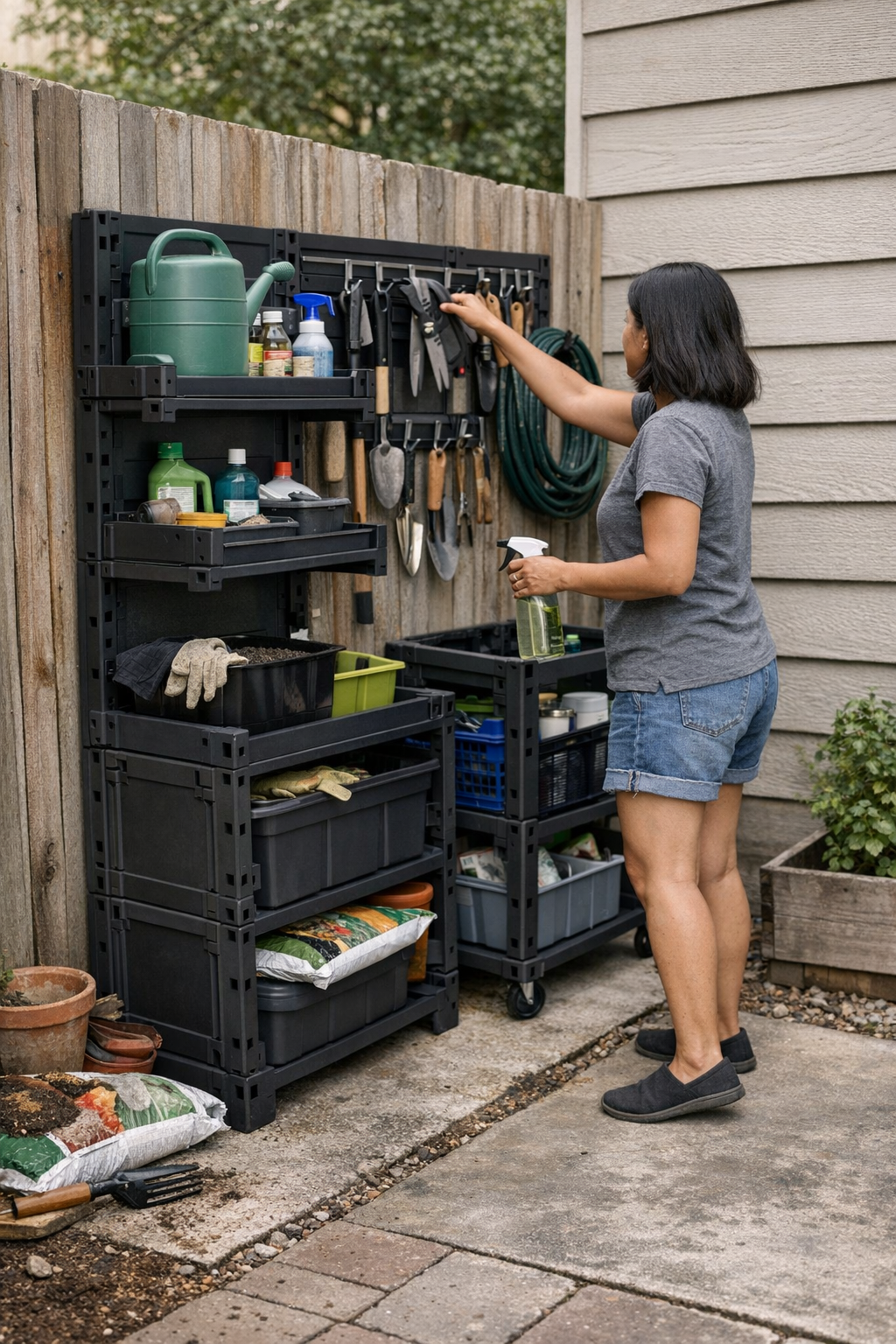
Step into any backyard or side-yard strip at the end of a busy week and you’ll spot it instantly: spades slumped on the path, gloves curled beside the fence, and a walkway you now have to squeeze through sideways. These are the trademarks of “organized” outdoor storage that only holds the illusion of order. The true test isn’t how crisp things look on install day—it’s whether grabbing and returning a tool is so easy you do it every single time, even when you’re tired and in a rush. Too often, the setup promises clarity but quietly stacks up new roadblocks, one shortcut and delay at a time.
Where Setup Friction Starts: The Ten Second Rule in Practice
Delay kills momentum outside, and if it takes more than ten seconds to grab or put away a tool, your system is already working against you. Here’s the friction: the moment storage feels like a chore, return flow drops. You reach for the trowel but the handle jams under two other tools, so it gets abandoned wherever you last used it. Next, a bin lid is sticky so gloves land on top—then the watering can clutters the path because no one wants to untangle the hose just to reach the rack. Each skipped clean return quietly stacks up another obstacle, and just moving through your own yard starts to feel like crossing a minor minefield.
Now multiply the problem: add a second person, or a shifting weekend project. Suddenly, what started as a nominally “organized” space drifts into full reset territory every few days. The floor fills with spillover items. “Just for now” becomes “stuck for the week.” That five-minute task? It now starts with shuffling through clutter from the last four hurried drop-offs.
The Real Divide: Wall Systems vs. Floor Storage
On a checklist, a storage bin and a wall rack sound equally useful—but in daily use, the split is sharp and immediate. Wall racks take things out of your way, giving every handled tool a visible parking spot. When installed near the action—garage edge, fence line, patio wall—they let you grab or return in a single, fluid movement. Bins and ground boxes, on the other hand, attract overflow. What starts as “temporary storage” quietly morphs into a jumble: gloves slip down the sides, small tools disappear below a layer of tangled hose, and the lid becomes just another thing to navigate around rather than through.
At first, the lines blur—everything starts tidy. But after a couple cycles of real use, wall systems show their limit quickly and honestly: when every hook fills, the wall says stop. Ground units don’t. They simply absorb more, until the footprint swells and daily returns devolve into stuffing things wherever there’s a gap. The surface still looks “organized,” but the actual movement and access tell another story—a constant, creeping need to reshuffle, hunt, or detour.
Scene Snapshot: The Clutter Loop in a Mixed Setup
Picture this: a side yard barely wide enough for a wheelbarrow, with a heavy ground box by the gate, hooks lined along the garage, and a rack tucked behind the fence. Early on, everything has a place. But after a stretch of wet weather, muddy boots collect by the box; a rake balances awkwardly on top because opening the lid requires clearing off last week’s pile. Gloves hang from a crowded line of hooks, doubled up and slipping. The path narrows. Every “quick drop” scores another point for chaos, and now just reaching the faucet means negotiating an obstacle course of your own making. You return one item and block access to another—resetting becomes its own project.
When wall and bin compete for the same patch of space, they reveal tiny battles: to hang a shovel, you have to move a coil of hose; to close the box, you have to force the lid shut over stray tools. The layout looks good in a photo, but you’re spending more time shifting items just to get moving. That’s the mark of organization that can’t keep pace with routine.
Getting Off the Ground: Where Wall Systems Change the Routine
The value of a wall system isn’t immediate—it’s proven after a month, when most bins have already gone sideways. Hooks, modular racks, and rails enforce separation. Each place is fixed, so tools don’t migrate or vanish. Once a wall fills, you see the space itself run out—there’s nowhere for overflow to hide. Bins let you stack, wall systems force a decision: keep only what you use, and spot a missing or misplaced item quickly. It’s not flawless, but it’s honest.
A small change—like leaving buffer room between hooks or matching each tool to its own labeled spot—prevents “cramming.” You feel the friction instantly if the system gets overstuffed, versus discovering a black hole at the bottom of a box three weeks later when you can’t find your best snips. Miss one hanging return and it’s obvious; miss a bin return and the problem quietly expands until you’re in reset mode again.
Real-World Trick: Keep Inventory in Sight, Not in Storage
What you see, you use—and what you see missing, you fix. Wall setups makes it obvious: pruners don’t return, the empty slot stands out. This cuts down on silent overflow and makes end-of-day resets a 30-second loop, not an hour-long dig. Even guests or less-organized family members know where things go—no complicated memory or signup sheet required. The setup works with you, not against you, especially on days when patience is in short supply.
Why Floor Storage Trips Up: Overflow, Blocked Routes, and Awkward Corners
Even well-meant floor bins eventually become bottlenecks. A couple rushed returns and you’re staring at a holding tank: gloves lost under a knee pad, small tools hiding under a tarp, hose piles swallowing up anything small enough to bury. If your routine ever slips—because you’re tired, because it’s raining, because life—these bins shift from storage solution to friction generator. Most people won’t dig at the bottom to do a proper reset. Overflow just finds the nearest path and sprawls outward, blocking gates, crowding corners, and slowing every future step.
The secondary effect is movement loss: a spade jams the gate; the swing of a box cuts the walkway in half; each retrieval turns into an argument with a pile. Micro-delays pile up, every five-minute job drags, and the promise of “easy access” dissolves beneath layers of gear that barely fits. If the setup forces you into routine reshuffling—moving three things to use the fourth—it doesn’t matter how neat it once looked. It failed the return test.
Spotting Dead Corners: When “Extra Space” Collects Extra Mess
Every outdoor area has a dead corner—the spot meant to solve problems, but actually hiding overflow. Maybe it’s behind the utility rack, wedged between the house and the fence, or a low bin at patio edge. These zones trap what doesn’t fit the main plan. Over time, they demand full resets: you drag everything out just to reach the one thing you use most, and then the cycle starts again. If you’re shifting stacks just to get to a regular tool, or resetting a path before you can start actual work, your setup is locked in a permanent losing battle against real use patterns.
This isn’t usually solved with more storage—it’s solved by giving each piece a visible, friction-free home that matches how you actually move in the space. Wall-based setups force that recognition; bins let you avoid it—until the pile wins.
Building a Setup That Actually Lasts: Flexible, Forgiving, Real
Perfection isn’t the goal. Staying ahead of friction is. The best setups aren’t museum-grade displays—they’re the ones you reset in a minute, not an afternoon. The ten second rule exposes weak points fast: if your process stalls or your patience wears out, you skip good habits and chaos takes over. Wall rails and modular racks let you adjust as your routine does—tightening in summer, spreading out in the off-season, or shifting as new tools and habits appear. Static bins can’t adapt; living wall setups can.
The real win? Not an immaculate look, but a space that works through the mess. If last weekend’s project muddies everything, a modular wall lets you restore order in seconds. If gear piles still creep up, at least you can see where reset is failing—not just guess what’s buried where. Even if there are scuffs on the handle or bits of gravel by the wall, the result is clear: more movement, less managing, and a setup that finally keeps pace with how you use your yard, week in and week out.
For outdoor organization that works with your reality—not against it—see real-world storage solutions at TidyYard.