
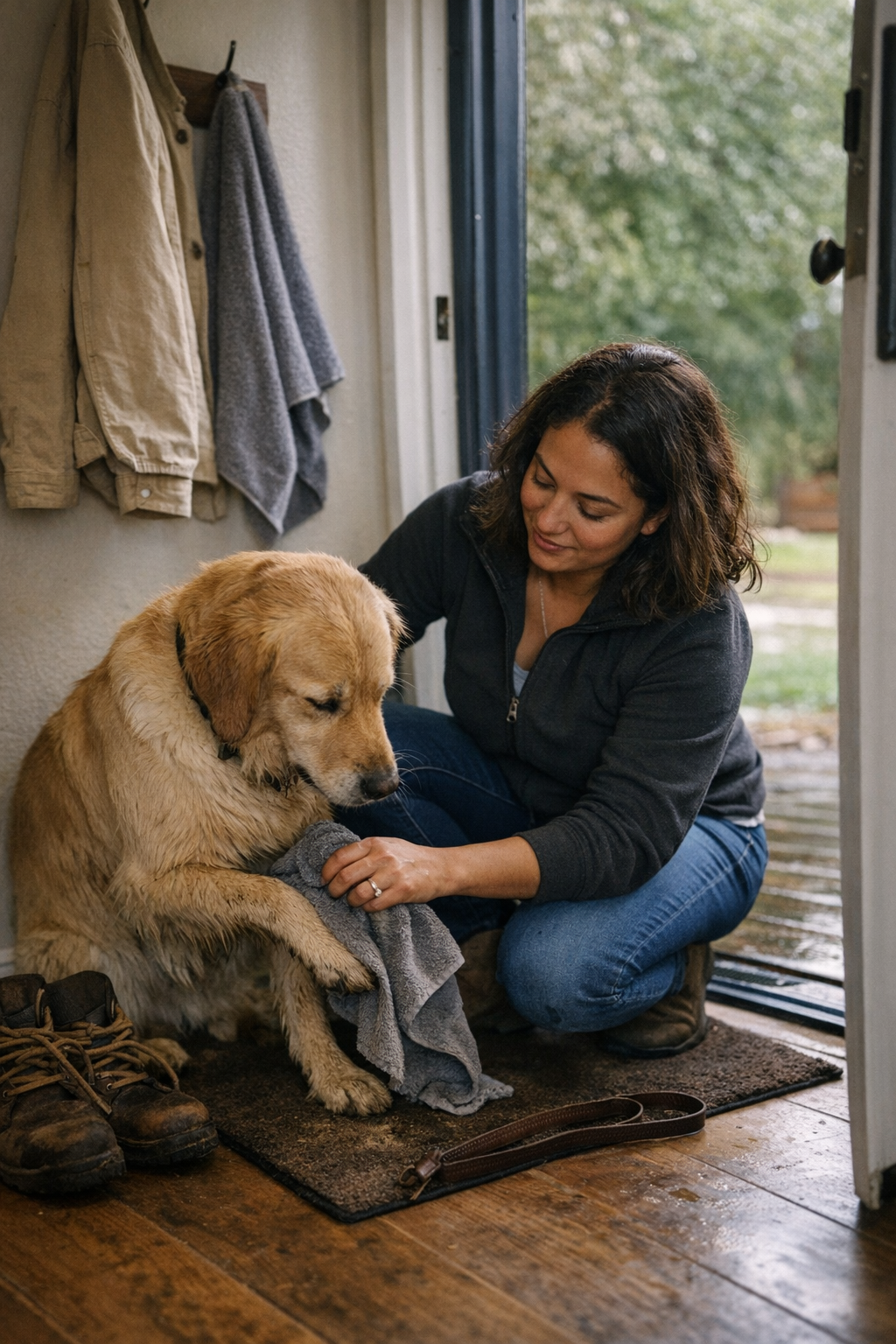
Right after every walk, there’s a split-second test: leash in one hand, shoes half-off, you reach for the towel—and it’s missing. Your dog’s quick paws land on tile, already streaked with yesterday’s tracks. Pause too late and you’ll find a whole day’s grit underfoot, turning a so-called clean routine into a slow-motion mess, all because the one thing needed is out of reach. This isn’t about one muddy day—it’s a recurring friction point that makes the whole routine feel fragile, no matter how tidy you keep the entryway. One misplaced, damp, or vanished towel and the supposed reset spills into cold, interrupted minutes and another round of cleaning later.
One Weak Point: The Towel That’s Never Where You Need It
The problem keeps repeating itself. You expect the towel by the door, but it’s been used for something else, tossed somewhere “for now,” or taken out of rotation. So you scramble, improvising with a dish towel, paper towels, or just hoping the welcome mat absorbs enough. For a day or two, these workarounds pass as harmless, but annoyance stacks up just as reliably as your twice-daily walks.
The pattern hardly changes: dog barrels in, leash tugs, paws find tile—and you’re not ready. Pausing to hunt for a towel means accepting new muddy prints. Every “I’ll get it next time” shifts into more spots to clean, more mess under shoes, and more resentment for a step that should have been automatic.
How Routine Friction Builds (And Why It Matters)
Cleanup lag is quiet but relentless. Towel gone, wipes tucked away, cleaner on a shelf no one remembers—each break in the chain adds up to slower resets and creeping disorder. Coming home turns from “we’re back” to “where’s my stuff?” long before you notice the cost.
The daily slipstream looks like this:
- Dog at the door. Towel missing. You hesitate, calculate the risk.
- Try to keep your dog still—usually a losing battle as paws slip or wander.
- Leave the open threshold, chase down a towel, and return to new prints and a disrupted dog.
- Cleanup becomes triage—imperfect, rushed, sometimes leaving one paw dirtier than before.
- The next time, you spot new dirt in the corners—not a big event, just slow, invisible drag.
Every patchwork fix teaches your routine to crumble right at the point it needs discipline.
Visual Order vs. Usable Order
It’s easy to fall for the illusion of “organized.” Benches aligned, bins labeled, hooks unused—but if the towel is blocked, missing, or mixed in with unrelated clutter, the routine stumbles. When the cleanup step is buried or unreliable, form sabotages function—and your floors keep paying for it.
What Actually Changes With a Towel at the Door
The real fix: anchor a dedicated towel at full arm’s reach where you cross from outside in. Instantly, the silent hassle at the entry starts shrinking—even more so when it’s pouring rain or after a late-night walk. That first pause gets shorter and less frantic. Mud stops at the right spot, paws are cleaned in sequence, and the chance for a mess to escape drops with every cycle.
This isn’t a miracle: there’s still grime, there’s still weather, but the doorframe stops being a choke point. The difference is not the absence of dirt but the absence of chase, dodge, and doubled work in the cleanup loop.
The Routine in Real Time
Here’s how the setup changes the post-walk return:
- Dog pauses—leash steady, mat beneath, you don’t need to move.
- The towel is visible, hanging right where you expect—not stuffed in a closet, not lost to laundry.
- You wipe—methodically, without the scramble, while your dog starts to wait for the signal.
- The last paw never touches the inside floor until it’s done; fewer prints, less stress.
The repeated “where is it?” moment disappears. Clean floors stay that way, not because every step is perfect, but because the weak point doesn’t keep reappearing. Routine takes over where improvisation used to slow everyone down.
Everyday Obstacles That Don’t Go Away On Their Own
Most breakdowns happen fast: after rain, with muddy paws, or when other people are walking through. Maybe the first paw is half-cleaned, a towel is still damp from the morning, or you skip the step “just once.” Routine friction masquerades as a minor slip, yet the aftermath repeats:
- No towel after rain? You’ll feel the wetness in your socks by the next crossing.
- Morning rush, supplies misplaced? Dog grows impatient, the floor absorbs the chaos.
- Friends visit, cleanup skipped? Paw prints spotlight the gap the following day.
One untended gap means more work later—not just now, but in unpredictable sprints every few days unless the setup actively closes it.
Real Examples From A Week’s Routine
Look back on your week. By Wednesday, the backup towel is still drying in another room. Last night’s towel is damp, slightly sour-smelling, but you grab it anyway. One evening, you skip cleanup after a late walk, but an hour later the tile shows new prints, almost daring you to ignore them. Each missed reset leaves a trace—and teaches you how easily the system unravels when just one item goes missing.
The most ordinary detail—one towel out of place, one step skipped—predictably undermines the routine more than any new gadget or deeper cleaning ever fixes.
Making the Setup Easy to Stick With
Consistency beats perfection, every time. The solution isn’t a strict routine; it’s about matching physical setup to the way you actually enter and exit. If the towel is exactly—literally—where your hand lands when you pause, the habit builds itself. When anyone else in the house repeats the new order, the dog—and the mess—stay predictable, not spread across every threshold.
How to Anchor the Routine
- Pick a real, open spot—not behind bags, not under shoes, but directly on your main route.
- Signal your dog—a cue or hand motion at the same place, every time, builds their expectation.
- Keep it short—wipe, praise, move. Overcomplicating is the enemy of habit here.
- Swap towels often—weekly for normal use, more in wet seasons, to keep texture and smell from breaking the routine.
- Don’t force a damp towel—replace it when needed, or you’ll skip the step and reopen the loophole.
This isn’t about discipline—it’s about removing resistance right where the routine can fail. The more friction you clear at the door, the less discipline you (or anyone else) actually need. Quiet, simple changes keep the entry functional without micromanaging every pass-through.
Less Floor Wiping, More Flow
The target isn’t a magazine entry—it’s a routine that holds up for real dogs, muddy days, impatient mornings, and distracted households. The towel in the right spot isn’t just cleaner; it shrinks the invisible work and makes coming home frictionless. Dogs get the rhythm. You keep paper towels in reserve. The need to run back for one missed supply drops and doesn’t return just because the rest of the area looks neat.
This isn’t theory—it’s a structure that outlasts surface tidiness and keeps walk-after-walk residue from reasserting itself, no matter how good things look between the slips.
When It Looks Fixed But Still Feels Slow
Even with neat hooks, tidy shoes, and a fresh mat, a missing or awkwardly placed towel drags down every return home. The appearance says “ready,” but your routine still collapses with the first cold or muddy paw. Practical control means the thing you need is at the exact point the problem starts—otherwise the same old tension creeps back in and the reset was just for show.
Whatever your routine, structure always tells the truth in repeated use. One towel at the door isn’t a magic bullet, but nothing else fixes scattered mess and recurring delay so quietly, every single entry.
STORE LINK:
http://www.dogpile.myshopify.com