
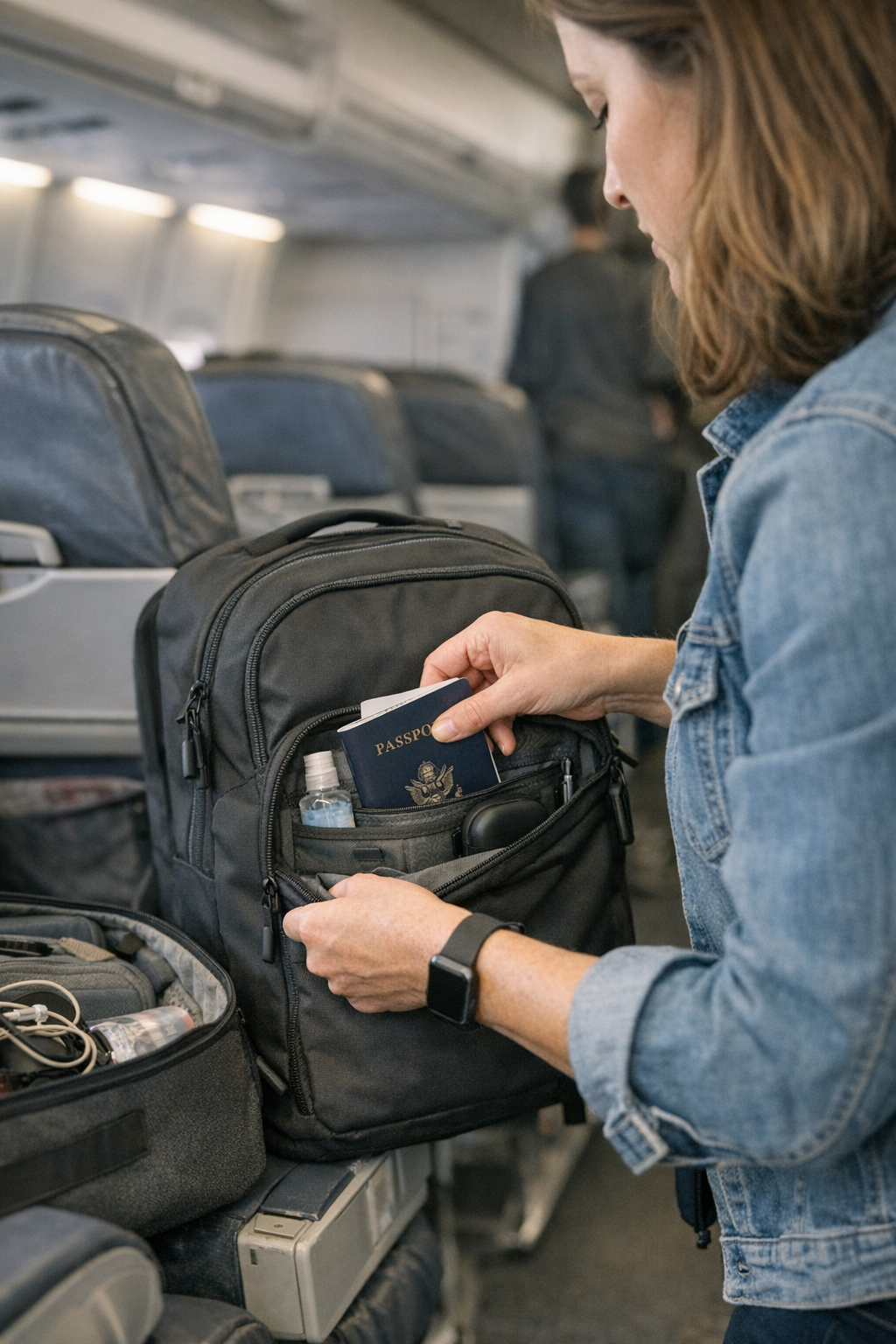
Your carry-on only looks organized until the airport exposes its weak points. That outer pocket you packed so carefully turns into a black hole when you’re three document checks deep and suddenly unzipping, digging, or reshuffling in the boarding line. Even if your bag “looked sorted” back on your hotel bed, most setups miss one thing: under pressure—at security, boarding, or gate changes—the real friction isn’t clutter; it’s awkward access, pointless pausing, or having to hunt for what should be at your fingertips.
The Unseen Slowdown: When “Organized” Isn’t Practical
Carry-on frustration doesn’t always come from visible mess. It starts subtly: a passport slid under one too many pouches, or a travel wallet trapped under a carefully stacked gear grid. That feeling of order crumbles the moment you need something now—like hitting check-in with your phone in one hand, a flattened boarding pass hiding below your headphones, and sanitizer tucked three pockets back. Every extra zip, rummage, or shuffling to find just one item—especially with travelers closing in behind you—breaks your movement. The bag didn’t fall apart, but your airport flow did.
The risk sneaks in quietly: a slim outer pocket packed just a layer too deep, an “everything-essentials” pouch morphing into an interchangeable catch-all. You aren’t failing, but after each gate, checkpoint, and aisle squeeze, the time loss becomes obvious. Missed beats pile up: a small delay at security, a pause finding your docs at boarding, or that moment mid-aisle when you expose half your bag to get to just one thing.
Real Carry-On Moments: Where the Friction Builds
Document Retrieval During Boarding
In the boarding queue, the flaw shows up the moment you attempt a quick reach—phone and ticket in one hand, carry-on nudged along with your foot. Now essentials are layered: a cable pouch covering the travel wallet, sanitizer wedged between, and the only way to your passport is to lift, tilt, and sort through pouches. The “organized” setup is suddenly blocking quick retrieval, and every second spent unpacking triggers the impatient shuffle of the line behind you.
The Security Tray Scenario
Security is the most unforgiving test. As soon as you unzip for your laptop, you realize documents are elsewhere—maybe pressed into a secondary pocket or lost between an organizer and a mesh pouch. Cords tumble out as you reach. Edges catch on zippers packed too tight. Every move multiplies: device here, ID there, something else tumbling, and the tray fills with loose items. The scramble signals the setup was never tuned for real-world flow.
Pocket Overlap in the Aisle
Down the airplane aisle, tight space turns minor setup flaws into full stalls. One overlapping pouch blocks the zipper path so badly, grabbing headphones with one hand means propping the bag in the crook of your knee and peeling open half your outer pocket. Your seatmates wait as you untangle. The better your bag looked at boarding, the more glaring it feels when simple retrieval turns into a balancing act just to reach what you need before sitting down.
After Arrival: The Repack Reset
Organization rarely survives the trip. Once you’re back on your feet and prepping to deplane, every rushed grab leaves gear scattered: passports shunted behind chargers, sanitizer sliding loose, pouches out of order. Repacking doesn’t really restore flow—it just hides the drift until the next checkpoint, and the same chaos returns with the next fast retrieval.
What Actually Works: Structure That Holds Up Under Pressure
More organizers don’t solve this problem—more often, they add layers rather than fewer. Only after repeating the same awkward reach for essentials on flight after flight does the fix start to surface: commit one outer pocket to real in-transit essentials only—not “might needs,” just the items you repeatedly reach for between curb and seat.
Test narrowing your grab zone to passport, boarding document, sanitizer, and a single comfort item—no stacked cases, no pouches to shuffle. What sounds like a small change turns out critical under pressure: at security or the jet bridge, a single reach replaces the instant where your bag blocks you and everyone behind you. The “clean” look at the hotel means nothing if it doesn’t survive repeated use; the best setup is the one that always offers one-move access while in motion.
Smart Separation: Reduce the Overlap, Cut Down the Delay
Letting your tech, documents, and comfort items blend in the same space guarantees redundancy and slow retrieval. It’s not about grouping by category; it’s about how—under pressure—you actually reach for each thing. If your hands never need passport and charging cable at once, splitting them pays off every time you move.
Reserving one exterior pocket for pure transit essentials—then making a habit of resetting it after each use—restores speed without more layers. Every checkpoint becomes a single, predictable motion, not multi-step recovery. Cutting overlap turns your bag from a mobile storage locker into a tool: ready to access, re-close, and move, not just get packed “neatly.”
On the Road: Living With the New Setup (And Where It Still Bends)
No method resists entropy forever. By your third airport in a week, even the best exterior pocket shows signs of drift. But with fewer layers, bouncing back is easy; essentials shift but stay visible, and instead of constant re-ordering, you just reset the pocket post-move. Not perfection—just friction drop.
The real signal your structure works isn’t the photo on packing day—it’s flashing your boarding pass instantly at a gate after a seat swap, or one smooth unzip for your passport at check-in, even after a rush. You’ll still get caught once in a while (wrong pocket, surprise transfer), but the time lost is less, and the need for a total unpack vanishes. Travel order isn’t cosmetic; it’s how well your setup survives repeat interruption and recovers when routine gets broken.
Small Improvements, Repeated Gains
The biggest difference isn’t what your bag can hold—it’s how that setup stands up during repeat airport demands. Cutting layers and overlap delivers smoother movement, faster resets, and less friction flight after flight. The best setups don’t win on looks—they keep you moving even when habits slip or travel days get long.
Match your packing to your actual in-transit behavior: fewer pockets to fuss with, one path to repeated essentials, and the hidden delays fade into the background. The smartest fix is often subtracting a pouch, not squeezing in another. If your current carry-on fails to keep up when you double back for one last item or juggle a last-minute gate change, it’s time to rethink the structure, not the surface.
For real-world-tested carry-on setups, organizers, and accessories that cut daily friction, visit CarryOnSupply.