
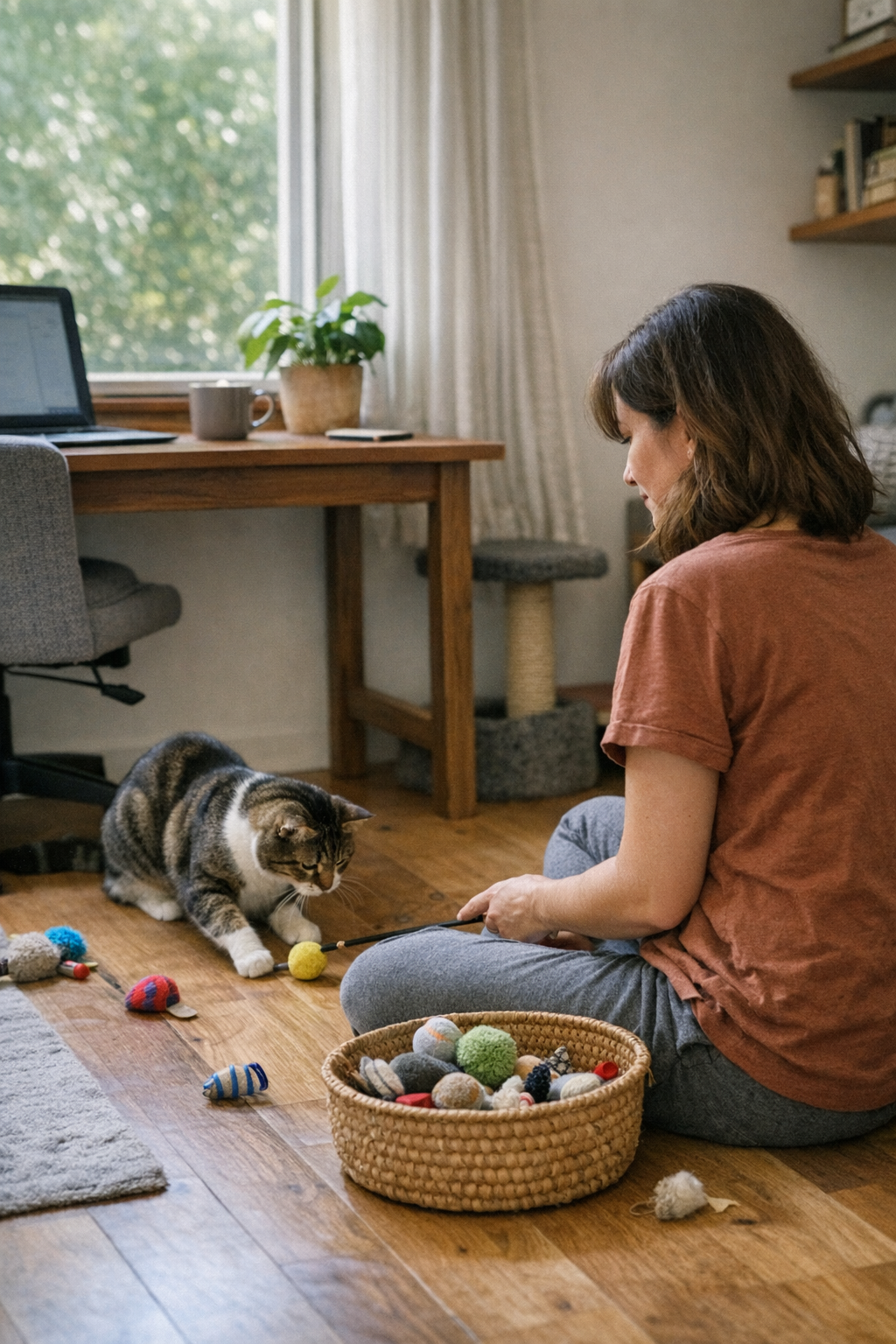
Your indoor cat finds the cracks in your routine faster than any organizing bin or tidy corner can keep up. A workspace that starts the morning looking orderly—baskets lined, toys stowed, surfaces wiped—quickly breaks apart the minute work and cat-life collide. By the second interruption, what seemed “easy to reset” now traps stray toys under rolling chairs, scatters pawed balls across hallways, and leaves cleaning cloths just out of reach when you need them most. The real pushback isn’t visual: it’s the repeated grind of routines that keep exposing the same weak points, from toy drift into shared space to cleanup that never stays finished. Each small interruption—batting a pen off the desk, dragging a string out of a “contained” box—clutters both the calendar and the room, turning every work break into another recovery mission. This is not just about order slipping; it’s about a setup that looks calm at 8 a.m. and feels unworkable by noon. StillWhisker’s world is built for these moments, so the solutions fit the points where daily life actually catches.
Why “Appears Organized” Doesn’t Hold Up to Daily Cat Life
The fantasy: neat workspace, a few toys nearby, no visible mess, and a setup that your cat won’t disrupt. The reality: after three “full resets,” minor cracks become obvious. Toys migrate under office chairs. A ribbon ends up in the hallway. The curated toy basket? It routinely empties itself as soon as your back is turned, leaving a wake of scattered objects in places you’re not ready for. The gap between “presentable” and actually functional widens with every day you have to restack, refill, or dig out a favorite item that’s vanished under furniture.
Unlike a food spill that you spot and wipe immediately, the slow breakdown—one toy at a time—means every step feels a little less controlled. What started as a clear walkway becomes an obstacle course before lunch. Each attempt at restoring order is undone by the next round of unscheduled cat energy. The invisible line separating your work zone from your cat’s play area ends up blurred, and daily resets start to feel less like solutions and more like delays before the next round of chaos.
Unpredictability Teaches Persistence—and Interruptions Grow
An indoor cat left to guess your boundaries will turn every pause in your attention into their open window. Sit for a meeting and a paw invades your keyboard. Answer an email and a toy appears on the edge of your mousepad. These aren’t accidents—they’re your cat’s way of testing when the rules slip. Each time you respond, you reinforce the routine: every minor break in your focus is one more chance for them to move the boundary. Soon, you notice yourself building your own schedule around anticipated interruptions—not because you want to, but because the costs of ignoring them build up quickly.
This seesaw logic rewards both unpredictability and persistence. Your cat learns that the smallest cues—a shift in your chair, a lid closing, a sigh—could mean playtime. You end up with play supplies inching across a shared workspace, boundaries gone soft, and cleanup loads sneaking upward. The turning point isn’t dramatic: it’s that gradual realization, midafternoon, that three plush toys have overtaken the walkway and the “fast reset” you managed at breakfast feels long gone.
What Actually Contains the Chaos: The Power of a Fixed Play Window
More toys or “better baskets” don’t solve this underlying cycle. The part most setups miss? A fixed window—a reliable time block when energy is allowed to peak and play is expected. Instead of reacting to endless interruptions, you set a mid-morning or afternoon play zone, pulling toys from the same accessible storage point. Your cat starts saving up for this event, learning that fun happens predictably—and that attention won’t always be up for grabs during meeting lulls or mid-call coffee breaks.
This rhythm changes the terms of daily life. When you always use the same basket, open it at ten, and play until the time’s up, your cat learns to anticipate. The difference isn’t hypothetical: walk through your space at noon, and the toys should be back in the basket, not peppered across every clear patch of floor. Fewer off-schedule requests, lower non-stop mess, and clearer boundaries flow from the window, not just the appearance of control.
How the Structure Pays Off Over a Real Use Week
Consider the ordinary week: it sounds harmless to drop a handful of toys by the desk for casual play. By Wednesday, balls edge under your bed, a plush mouse interrupts your coffee run, and your “clean corner” now mirrors every scrambled cat zone in the house. Even a careful sweep at night does little if there’s no real structure—play surfaces bleed into walking paths, and next morning’s tidy start falls apart faster.
Anchor playtime. Use a fixed window—eleven minutes at eleven o’clock, for example. Toys come out only for the block and are cleared before lunch. Cleanup isn’t “solved,” but now it’s compact and predictable. You’re no longer crawling under furniture between calls or discovering crumpled string toys under the fridge two days too late. The change isn’t perfection—it’s a cycle that’s lighter and less likely to derail your day.
Building in Boundaries: Location, Storage, and Reset Signals
A fixed play window is only reliable with real location discipline. The subtle shift: a single low-sided basket or box at the play hub, always returned to, becomes your reset trigger—fully visible, easy to reach, and never so deep that items disappear for days. Every toy goes back after play, not “when you get a minute.” Anything buried, blocked, or hard to grab: replace or move it until putting things away becomes nearly automatic.
Other specifics that reduce the friction:
- Keep daily-play toys in one basket, but stash a backup toy (like a felt ball) for solo play, tucked under a mat or behind a table leg.
- Position the basket within your work or walk zone—under the desk, beside a reading chair, or near a window if your cat prefers looking out.
- Always finish with toys back in the basket. If you leave “for later,” the drift resumes, and resets turn into sluggish rounds of hunting for the missing plush or crumpled ball.
Forget making the room flawless. The win is muscle memory: you reset toys as predictably as grabbing your keys. Your cat begins to track the same signals—when play is over, everything returns, and the room returns to its dual use.
Real-World Breakdowns: What Trips You Up (and How to Address It)
Even tight routines have weak points. Your fixed play window may not match your cat’s energy spikes—if they keep pestering at other times, shift the window: early afternoon instead of morning, or closer to dusk if that’s when they liven up. Real success comes from timing that lines up with actual behavior, not just the owner’s schedule.
Toy fatigue creeps in when the options don’t rotate—or when “backup toys” never change. If you’re seeing interest fade, pull two toys out of rotation and introduce a “forgotten favorite.” Even a simple swap reignites the system and helps the main cycle hold.
Setup details matter. If your basket is annoyingly far from your main chair, or so deep the smallest mouse vanishes for ages, change it. The best structure is one you barely think about when moving from work to play to reset. If wipes live in a drawer two rooms away, place another set closer. Don’t let a minor convenience gap become the opening for clutter to sneak back in.
Shared Space: Preventing the Toy Spill from Taking Over
Zoning breaks down most when shared spaces—walkways, eating areas, reading corners—become toy holding zones. Once toys bleed under key furniture or into traffic paths, each reset demands more effort, and shared space can feel surrendered. Smart setups don’t hide every sign of cat life—they draw clear lines so the cleanup stays doable.
Everyday cues that help build these boundaries:
- The play basket lives out only during the window, then gets shelved or moved aside (not abandoned as semi-permanent clutter).
- A quick sweep after scheduled play ensures toys aren’t collected mid-routine or underfoot. This sweep should be as short as it is non-negotiable.
- Reserve “backup toys” for solo moments, tucking them just out of sight so every play reset feels finished instead of lingering across the whole room.
After a week on this structure, results get visible: the living room returns to human use quickly. Fewer toys creep into shared floor space, and interruptions slowly drop—not because the system’s perfect, but because the signals finally match what’s workable for both sides. There’s always stray scatter or an extra wipe-down, but the spread stays contained, and the room doesn’t feel surrendered to cat chaos.
What to Expect After a Week—And What’s Still Up to You
Give a fixed play block seven days, and most cats start anticipating the routine—waiting for the basket, loitering at